How to Solve an Electric Circuit Like This?

Click For Summary
SUMMARY

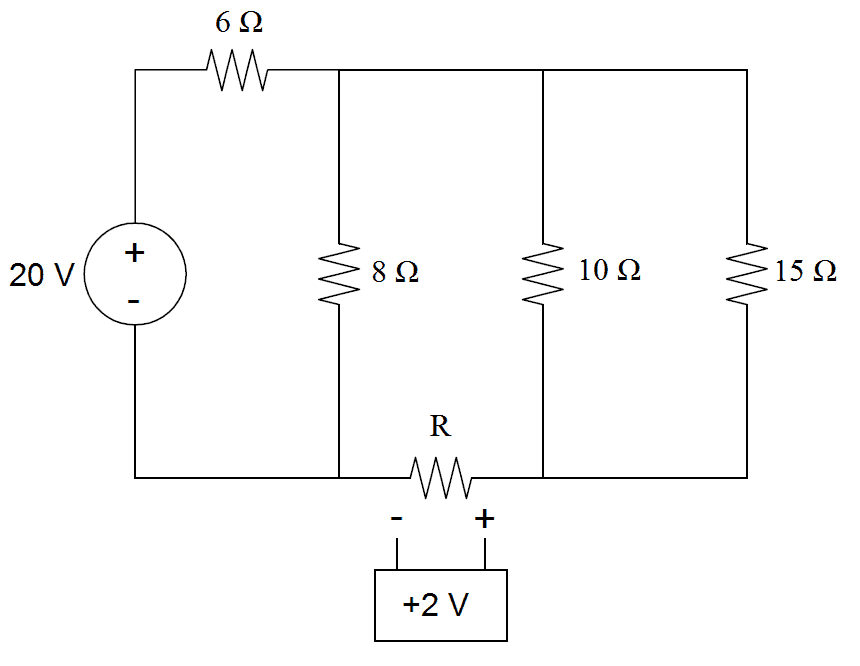
This discussion focuses on solving an electric circuit problem involving resistors R1, R2, R3, and R4 with values of 6 Ω, 8 Ω, 10 Ω, and 15 Ω respectively. The user successfully calculated the equivalent resistance R5 of resistors R3 and R4 in parallel, resulting in R5 = 6 Ω. The conversation emphasizes the importance of applying Kirchhoff's Laws to analyze circuits systematically and encourages users to engage actively in problem-solving rather than seeking direct answers.

PREREQUISITES
  • Understanding of Ohm's Law
  • Familiarity with Kirchhoff's Laws
  • Basic knowledge of series and parallel resistor combinations
  • Ability to solve simultaneous equations
NEXT STEPS
  • Study Kirchhoff's Voltage Law (KVL) and Kirchhoff's Current Law (KCL)
  • Practice solving electric circuits with multiple resistors in series and parallel
  • Learn to use circuit simulation software like LTspice or Multisim
  • Explore advanced topics such as Thevenin's and Norton's Theorems
USEFUL FOR

Electrical engineering students, hobbyists learning circuit analysis, and anyone looking to improve their skills in solving electric circuit problems.
askor
Messages
168
Reaction score
9
Can someone please tell me to find R of this electric circuit?
Please tell me the step-by-step.
I have many problems of electric circuit like this.
If you show me one, perhaps I can solve the rest of them.

ElecCirc.PNG
 
Physics news on Phys.org
askor said:
Can someone please tell me to find R of this electric circuit?
Please tell me the step-by-step.

This looks like homework, but even if it isnt, we will not just give you the answers here at PF
we expect you to make some effort to trying to solve problems yourself.

So with that said, where do you think would be a good place to start working it out ?
 
davenn said:
This looks like homework, but even if it isnt, we will not just give you the answers here at PF
we expect you to make some effort to trying to solve problems yourself.

So with that said, where do you think would be a good place to start working it out ?

OK, here is my attempt.

R1 = 6 Ω
R2 = 8 Ω
R3 = 10 Ω
R4 = 15 Ω

R3 and R4 are parallel and form a R5, so

##\frac{1}{R5} = \frac{1}{R3} + \frac{1}{R4}##
##\frac{1}{R5} = \frac{1}{10} + \frac{1}{15}##
##\frac{1}{R5} = \frac{1.5 + 1}{15}##
##\frac{1}{R5} = \frac{2.5}{15}##
##R5 = \frac{15}{2.5}##
##R5 = 6 Ω##

What next?
 
askor said:
What next?
Have you come across Kirchoff's Laws?
 
Moved from a technical forum, no template.
 
askor said:
What next?
What's needed in a problem like this is a systematic approach.You have reduced the circuit already by converting those two resistors to just one. Then you use Kirchoff's laws to produce some simultaneous equations for the currents and voltages around a circuit. Looks a pain but this problem is not too hard. There is no point in my explaining Kirchoff if you know it already.
 

Similar threads

  • · Replies 1 ·
Replies
1
Views
1K
Replies
5
Views
4K
  • · Replies 4 ·
Replies
4
Views
2K
  • · Replies 20 ·
Replies
20
Views
3K
  • · Replies 8 ·
Replies
8
Views
2K
  • · Replies 7 ·
Replies
7
Views
1K
  • · Replies 5 ·
Replies
5
Views
3K
  • · Replies 8 ·
Replies
8
Views
2K
  • · Replies 3 ·
Replies
3
Views
2K
  • · Replies 6 ·
Replies
6
Views
2K