Discussion Overview
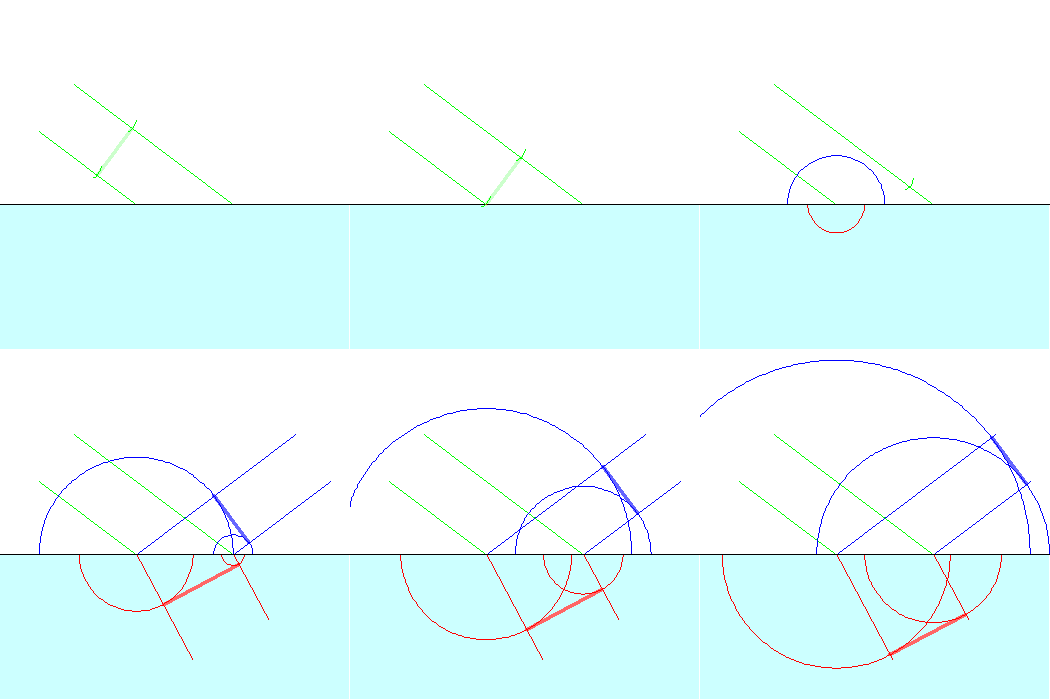
The discussion revolves around the application of Huygens' principle in drawing new wavefronts from wavelets, particularly in the context of reflection. Participants explore whether tangents can be drawn to wavelets that do not touch and how this affects the formation of new wavefronts.
Discussion Character
- Exploratory
- Technical explanation
- Debate/contested
Main Points Raised
- Some participants question whether tangents can be drawn to wavelets that do not touch, and if such tangents can still define new wavefronts.
- One participant suggests that only the tangents to all wavelets determine where constructive interference occurs, referencing the Fermat Principle.
- Another participant emphasizes that a tangent must be in phase with all wavelets to contribute to a new wavefront, suggesting a unique direction for this to happen.
- Concerns are raised about the implications of drawing tangents to only two wavelets, with a participant noting that this could lead to a circular resultant wavefront with amplitude variation.
- There is a mention of the laws of reflection and their role in predicting the direction of wave formation, as well as the neglect of diffraction effects in certain scenarios.
Areas of Agreement / Disagreement
Participants express differing views on the validity of drawing tangents to non-touching wavelets and the implications for wavefront formation. There is no consensus on whether such tangents can yield valid new wavefronts.
Contextual Notes
Participants highlight limitations regarding the assumptions made about wavelet interactions, the dependence on the configuration of wavelets, and the effects of diffraction and reflection laws.