SasQuach
- 3
- 0
Hi All!
I am trying to build a modular addition to a spectrophotometer (it needs to be mobile and easily removed) thus I have decided to base my design around an Arduino.
My application requires that I power/control a High Power (1W) Infrared LED, and read off temperature measurements from an NTC thermistor.
Currently I am primarily having difficulty with the Thermistor part of the circuit (left side for all schematics)
My original design (See Image):
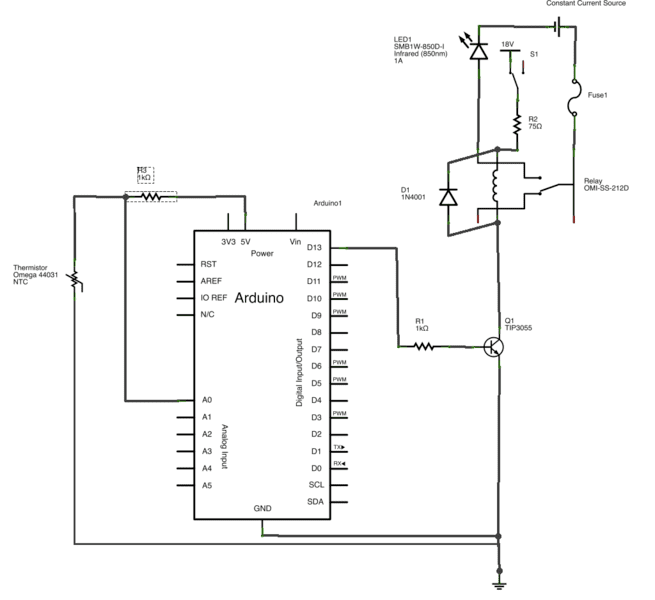
Used a voltage divider to measure the resistance of the thermistor. This worked fine, however due to the limitations of my thermistor and the small range of temperatures I am interested in, the voltage changes in that setup were minimal (on the order of a few tenths of a volt maximum). Thus I decided to add an OP-AMP in differential arrangement to amplify (and give a desired DC offset) my signal.
This led me to the following (current) design:
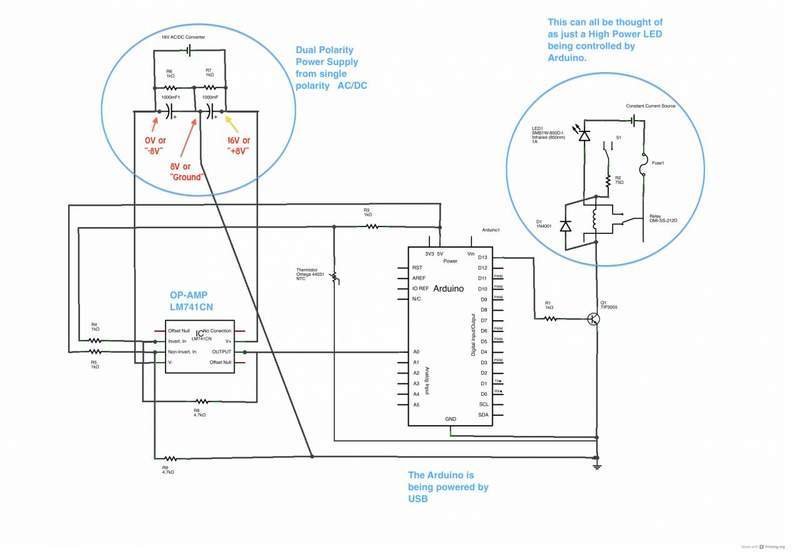
The OP-AMP that I am using called for a dual polarity power source. As such I put together the arrangement at the top left of the above schematic. My understanding is it produces a virtual ground at 8V.
The Issue I am having is tying this ground into the Arduino ground, so that the signal entering the Arduino at A0 (an analog input port) is between 0-5V
I really am stumped as to what I should connect my "Virtual Ground" up to.
Currently I keep reading non-trivial bias voltages between the input to A0 and the Arduino ground.
I have been beating my head against this for a few days now I would most appreciate some help.
Thank you so much,
Justin
I am trying to build a modular addition to a spectrophotometer (it needs to be mobile and easily removed) thus I have decided to base my design around an Arduino.
My application requires that I power/control a High Power (1W) Infrared LED, and read off temperature measurements from an NTC thermistor.
Currently I am primarily having difficulty with the Thermistor part of the circuit (left side for all schematics)
My original design (See Image):
Used a voltage divider to measure the resistance of the thermistor. This worked fine, however due to the limitations of my thermistor and the small range of temperatures I am interested in, the voltage changes in that setup were minimal (on the order of a few tenths of a volt maximum). Thus I decided to add an OP-AMP in differential arrangement to amplify (and give a desired DC offset) my signal.
This led me to the following (current) design:
The OP-AMP that I am using called for a dual polarity power source. As such I put together the arrangement at the top left of the above schematic. My understanding is it produces a virtual ground at 8V.
The Issue I am having is tying this ground into the Arduino ground, so that the signal entering the Arduino at A0 (an analog input port) is between 0-5V
I really am stumped as to what I should connect my "Virtual Ground" up to.
Currently I keep reading non-trivial bias voltages between the input to A0 and the Arduino ground.
I have been beating my head against this for a few days now I would most appreciate some help.
Thank you so much,
Justin