If frictional force in system is <= us*N then there is no slipping

Click For Summary
SUMMARY

The discussion centers on the relationship between frictional force and the coefficients of static and kinetic friction in a system. It establishes that if the frictional force (Ff) is less than or equal to the product of the coefficient of static friction (us) and the normal force (N), no slipping occurs. Conversely, if Ff exceeds us*N, slipping occurs due to the breaking of bonds between surfaces. The transition from static to kinetic friction is highlighted, where the frictional force during slipping is represented as uk*N.

PREREQUISITES
  • Understanding of static and kinetic friction coefficients (us and uk)
  • Knowledge of normal force (N) in physics
  • Familiarity with force balance concepts in mechanics
  • Basic grasp of frictional force calculations
NEXT STEPS
  • Study the principles of static and kinetic friction in detail
  • Learn about the force balance in static systems
  • Explore the effects of different materials on friction coefficients
  • Investigate practical applications of friction in engineering scenarios
USEFUL FOR

Students of physics, mechanical engineers, and anyone interested in understanding the mechanics of friction and its applications in real-world scenarios.

annamal
Messages
393
Reaction score
33
TL;DR
If frictional force in system is less than or equal to us*N then there is no slipping. Why is it that if the frictional force in the system is greater than us*N then there is slipping?
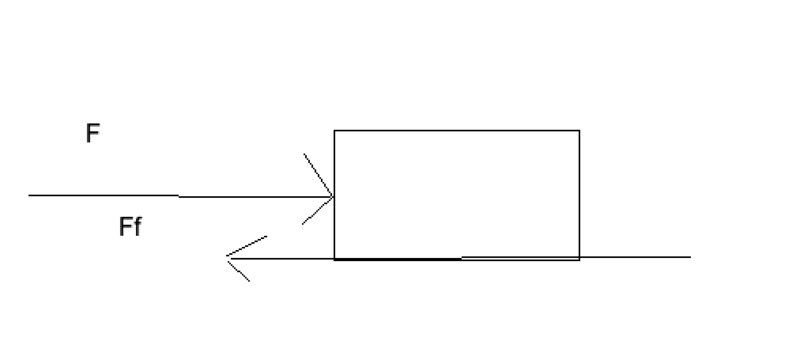
If frictional force in system (say a block being pushed on a horizontal surface) is less than or equal to us*N then there is no slipping. Why is it that if the frictional force (Ff) in the system is greater than us*N then there is slipping (I am finding it hard to wrap my head around this)? us is coefficient of static friction and N is normal force.
Screenshot 2023-08-01 at 8.27.28 PM.png
 
Physics news on Phys.org
I think you are misstating your query. You mean to ask why this happens when the applied horizontal force is less than ##\mu_s N## ?
 
  • Like
Likes   Reactions: Vanadium 50
annamal said:
Why is it that if the frictional force in the system is greater than us*N then there is slipping?
Because the bonds between the two materials are breaking. Note that the dynamic friction force drops as soon as the threshold force is reached.

Imagine the parts glued together and then you break the bond; one part can now move with respect to the other.

Static friction:

StaticFriction.gif

Kinetic friction:

KineticFrictionConstantMotion.gif
 
  • Like
Likes   Reactions: Lnewqban
berkeman said:
I think you are misstating your query. You mean to ask why this happens when the applied horizontal force is less than ##\mu_s N## ?
According to my notes if the frictional force <= us*N, then no slipping occurs, but if frictional force > us*N then there is slipping?

My notes say this, specifically what does part 3b mean? If Ff > us*N why are we now slipping because isn't the Ff < us*N if Ff = uk*N?
Screenshot 2023-08-01 at 10.50.37 PM.png
 
Last edited:
  1. If there is slipping, the friction force is ##\mu_kN##;
  2. If there is no slipping, the friction force may be anything between zero and ##\mu_sN##;
  3. If there is no slipping and the force exceeds ##\mu_sN##, slipping occurs (thus going to condition 1, i.e. ##F_f = \mu_kN##, and this is as long as there is slipping).
You can feel this by pushing an object sitting on another object. While increasing the force slowly, the object doesn't move. Once you reach the threshold force, the block suddenly starts to move and the block becomes easier to push (i.e. less force required).
 
annamal said:
Why is it that if the frictional force in the system is greater than us*N then there is slipping?
Because that is what we see in the experiments
 
berkeman said:
I think you are misstating your query. You mean to ask why this happens when the applied horizontal force is less than ##\mu_s N## ?
annamal said:
According to my notes if the frictional force <= us*N, then no slipping occurs, but if frictional force > us*N then there is slipping?
My point was more about how you are thinking about the forces.

The frictional force opposes the applied force to the object. So for a static object, the object does not slide until the applied horizontal force exceeds ##\mu_s N##. To state that in terms of only the frictional force being less than ##\mu_s N## seems to me to miss an important part of the force balance situation.

The frictional force is the result of the external force applied to the object; it does not exist all by itself.
 
  • Like
Likes   Reactions: Lnewqban
annamal said:
According to my notes if the frictional force <= us*N, then no slipping occurs, but if frictional force > us*N then there is slipping?

My notes say this, specifically what does part 3b mean? If Ff > us*N why are we now slipping because isn't the Ff < us*N if Ff = uk*N?
View attachment 329982
That value is a threshold between static and kinematic types of friction.
Please, see:
http://hyperphysics.phy-astr.gsu.edu/hbase/frict2.html

original_5.qstn.png
 

Similar threads

  • · Replies 4 ·
Replies
4
Views
2K
  • · Replies 7 ·
Replies
7
Views
5K
  • · Replies 59 ·
2
Replies
59
Views
4K
  • · Replies 14 ·
Replies
14
Views
2K
  • · Replies 20 ·
Replies
20
Views
2K
  • · Replies 20 ·
Replies
20
Views
4K
  • · Replies 8 ·
Replies
8
Views
2K
  • · Replies 5 ·
Replies
5
Views
2K
  • · Replies 2 ·
Replies
2
Views
1K
  • · Replies 20 ·
Replies
20
Views
2K