Importance of the energy gap in electronic transport properties

Click For Summary

Discussion Overview

The discussion revolves around the importance of the energy gap in electronic transport properties, particularly in the context of solid state physics as presented in Ashcroft & Mermin. Participants explore concepts related to electron dynamics in band theory, the effects of electric fields, and the implications of band gaps on conductivity.

Discussion Character

  • Technical explanation
  • Conceptual clarification
  • Debate/contested

Main Points Raised

  • Some participants discuss the behavior of electrons in k space under the influence of an electric field, noting that band gaps can lead to reflection at zone boundaries.
  • Others propose that in the absence of a band gap, electrons may transition to another band, leading to non-adiabatic dynamics.
  • A participant explains that large band gaps can prevent changes in occupancy of k-levels, suggesting that materials behave as insulators, while small or zero band gaps may allow for metallic behavior.
  • One participant questions the impact of electron reflections on electronic transport properties and seeks clarification on how these reflections influence current.
  • Another participant raises a point about the velocity of electrons upon reflection at the Brillouin zone edge, suggesting that the wave function becomes a standing wave, potentially leading to a velocity of zero.

Areas of Agreement / Disagreement

Participants express varying levels of understanding and interpretation of the concepts discussed, with no clear consensus on the implications of reflections at zone boundaries or the precise effects of band gaps on electronic transport properties.

Contextual Notes

The discussion includes references to specific chapters in Ashcroft & Mermin, indicating a reliance on the text for foundational concepts. There are also mentions of perturbation theory and the weak periodic potential, which may not be fully resolved in the conversation.

Who May Find This Useful

Readers interested in solid state physics, electronic transport phenomena, and band theory may find this discussion relevant, particularly those studying the effects of energy gaps in materials.
Rzbs
Messages
52
Reaction score
11
TL;DR
Importance of energy gap in electronic transport properties
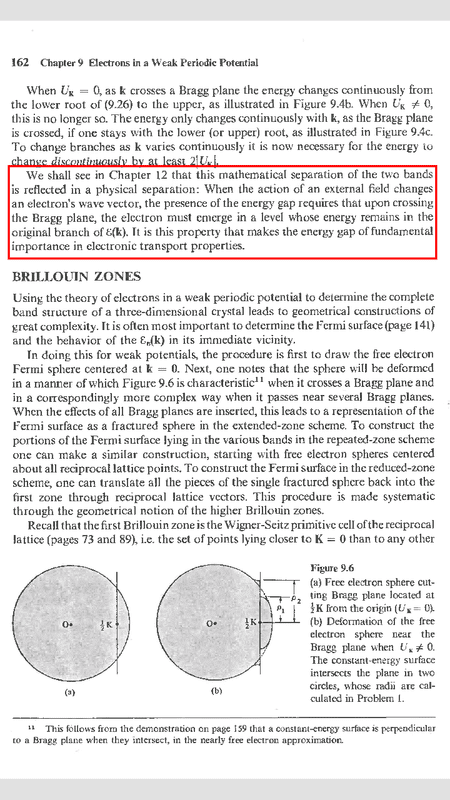
In the solid state physics by Ashcroft & Mermin, in chapter 9 there is a paragraph that I would be grateful if anyone could explain it more for me. The paragraph is:
Screenshot_20201116-190138.png

As it said in chapter 12 it will be seen. I read chapter 12 but unfortunately I can't understand what exactly it want to say...
 
Last edited by a moderator:
  • Like
Likes   Reactions: etotheipi
Physics news on Phys.org
Part of this we discussed in another thread. An electric field will drive the electrons through the band in k space. When they reach a zone boundary and there is a band gap, they get reflected to the opposite zone boundary. However, if there is no gap, the dynamics will be non-adiabatic and they will move on into another band. Did you study treating the crystal potential as a small perturbation?
 
  • Like
Likes   Reactions: Rzbs
DrDu said:
An electric field will drive the electrons through the band in k space. When they reach a zone boundary and there is a band gap, they get reflected to the opposite zone boundary.

I get this but I can't understand the following
However, if there is no gap, the dynamics will be non-adiabatic and they will move on into another band.
____

Did you study treating the crystal potential as a small perturbation?

I study Chapter 9 of Aschcroft & Mermin, electrons in weak periodic potential or nearly free electron approximation.
 
If you studied chapter 9, then you know that free electron bands are parabolic and the weak potential introduces gaps at the BZ boundary. If these gaps are large, the electrons will remain in the same band in extended BZ. If the band gap are small, the electrons may end up in a higher band if the electric field is strong enough. After all, the electrons will follow the parabolic band if there is no potential. You may also see it like this: When you accelerate an electron, it may get reflected if the Bragg condition is fulfilled (i.e. the wavelength is equal to a BZ boundary vector). If an electron is accelerated slowly, it will fulfill this condition approximately during a long time, so that many reflections take place. However, if the electron is accelerated rapidly, the time it fulfills the Bragg condition is very short, so that reflection becomes improbable. What is short and what is long depends not only on the strength of the accelerating field, but also on the strength of the crystal potential, which also determines the width of the gap.
So finally we understand, if the gap is large, and the band is full, the occupancy of the k-levels won't change on average, hence the substance is an isolator. If the band is not full or if the band gap is 0, the occupancy of the band will change when a field is applied and the substance will behave like a metal.
 
  • Like
Likes   Reactions: Rzbs
Thanks for your explanation. It is very helpful.
Could you please introduce another book except Kittel that could help me to understand more? (because I study Ashcroft & Mermin by myself).
______
I have another question. I would be grateful if you have time to answer it, as you said:

When they reach a zone boundary and there is a band gap, they get reflected to the opposite zone boundary

I don't know do electron reflections affect electronic transport properties? if yes (that I think it is so) how they affect?
 
current is e*v. What happens to v upon reflection?
 
DrDu said:
current is e*v. What happens to v upon reflection?
I think since the electron wave function is standing wave at BZ edge, v becomes zero;as this figure shows:
20201123_190043.png
 

Similar threads

  • · Replies 6 ·
Replies
6
Views
2K
  • · Replies 4 ·
Replies
4
Views
6K
  • · Replies 1 ·
Replies
1
Views
4K
  • · Replies 2 ·
Replies
2
Views
2K
  • · Replies 5 ·
Replies
5
Views
7K
  • · Replies 3 ·
Replies
3
Views
6K
  • · Replies 0 ·
Replies
0
Views
3K
  • · Replies 6 ·
Replies
6
Views
3K
  • · Replies 5 ·
Replies
5
Views
2K
  • · Replies 4 ·
Replies
4
Views
3K