Induction heater with high Q factor

Click For Summary

Discussion Overview

The discussion revolves around the design of a parallel LC resonance induction heater intended for heating a cylindrical copper workpiece. Participants explore the implications of achieving a high Q factor (above 100) in the context of induction heating, considering factors such as frequency, energy loss, and the presence of an air gap between the coil and the copper material.

Discussion Character

  • Exploratory
  • Technical explanation
  • Debate/contested

Main Points Raised

  • Some participants suggest that achieving a high Q factor while heating copper is unlikely due to energy losses from the LC circuit to the copper, which would lower the Q.
  • Others argue that if the goal is to heat the copper, the energy loss is necessary, and therefore the Q factor becomes less significant.
  • There is a mention of needing a capacitor in parallel with the coil to set the resonant frequency.
  • One participant points out a contradiction in wanting both high Q and effective heating, suggesting that a high Q might not facilitate heating the copper effectively.
  • Some participants discuss the role of the air gap, stating it prevents short-circuiting but may be irrelevant for heating purposes.
  • Questions are raised about the necessity of a high Q factor for melting copper, with some asserting that it is not relevant.
  • There are suggestions that increasing the supply frequency could lead to higher inductive reactance and potentially a higher Q, contingent on adjusting the capacitors to maintain resonance.

Areas of Agreement / Disagreement

Participants express multiple competing views regarding the relationship between high Q factors and effective heating of copper. The discussion remains unresolved, with no consensus on whether a high Q is beneficial or necessary for melting copper.

Contextual Notes

Participants highlight limitations related to energy loss in the LC circuit, the role of the air gap, and the conditions under which a high Q factor might be achieved, but these points remain open to interpretation and further exploration.

StoyanNikolov
Messages
50
Reaction score
0
TL;DR
LC Induction heater with high Q factor
Consider Parallel LC Resonance Induction heater.

The material to be heated is from copper

(it has relative magnetic permeability 1 and does not change with different temperatures)

and is placed inside Inductor coil and there is Air gap between the coil perimeter and the material.

Like this one on the picture:
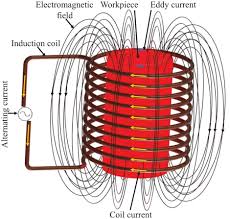
enter image description here
Source: https://www.semanticscholar.org/pap...Pant/a171ec4494599a22a7bde3ad92d24d56e43510d0

The shape of the material is Cylindrical.

Is it possible to design induction heater with high Q factor (above 100) when the copper cylindrical workpiece is inserted in the heating coil

(There is Air gap between coil and copper material)?

Perhaps with very high frequency? Thank you.
 
Engineering news on Phys.org
StoyanNikolov said:
Is it possible to design induction heater with high Q factor (above 100) when the copper cylindrical workpiece is inserted in the heating coil.
Probably not.

There will need to be a capacitor in parallel with the coil to set the resonant frequency. If the aim is to heat the copper, then energy must be lost from the LC circuit to the copper. That energy loss, will keep the Q down.

The energy needed to maintain the oscillation, and heating the copper, will come from an oscillator or a power amplifier. When energy is continuously available to keep the circuit oscillating, the Q is really unimportant.
 
Baluncore said:
Probably not.

There will need to be a capacitor in parallel with the coil to set the resonant frequency. If the aim is to heat the copper, then energy must be lost from the LC circuit to the copper. That energy loss, will keep the Q down.

The energy needed to maintain the oscillation, and heating the copper, will come from an oscillator or a power amplifier. When energy is continuously available to keep the circuit oscillating, the Q is really unimportant.
Consider Parallel LC Resonance Induction heater.
If we increase frequency and keep LC heater in Resonant state. There is also Air gap between coil and copper material as shown in the Picture.
 
Energy from the resonant LC induction heater goes into creating eddy currents in the copper.
A high Q resonator is efficient, and so has little loss.

There is a contradiction in your requirements.
Do you want to heat the copper, or let it cool?

If you keep the amplitude of oscillation low, with a high frequency to give a minimum skin depth in the copper, then yes, you can have a high Q, but you won't heat the copper.
 
StoyanNikolov said:
TL;DR Summary: LC Induction heater with high Q factor

Is it possible to design induction heater with high Q factor (above 100) when the copper cylindrical workpiece is inserted in the heating coil
A 'heater', by its nature will be dissipating heat which implies low Q. Resonance and
matching are not useful when transferring a lot of power efficiently. Ideally (as with the electricity supply system) the source impedance is as low as they can get it so that most of the power is dissipated in the load. The Maximum Power Theorem would suggest congugate matching of source and load BUT half of the generated power would be dissipated in the source: GW and GW dissipated in the generators and transformers. So MPT is not invoked for most high power systems.

Somewhere your system must act like a transformer with a secondary with very low resistance (lump of metal). and the source impedance would be even lower (looking back towards the source ).
 
sophiecentaur said:
A 'heater', by its nature will be dissipating heat which implies low Q. Resonance and
matching are not useful when transferring a lot of power efficiently. Ideally (as with the electricity supply system) the source impedance is as low as they can get it so that most of the power is dissipated in the load. The Maximum Power Theorem would suggest congugate matching of source and load BUT half of the generated power would be dissipated in the source: GW and GW dissipated in the generators and transformers. So MPT is not invoked for most high power systems.

Somewhere your system must act like a transformer with a secondary with very low resistance (lump of metal). and the source impedance would be even lower (looking back towards the source ).
Also consider the Air Gap between coil and Copper Workpiece , As Shown in the picture.

1709724693198.png
 
StoyanNikolov said:
Also consider the Air Gap between coil and Copper Workpiece , As Shown in the picture.
The air gap is irrelevant if you want to heat the copper. The gap is necessary to prevent the copper secondary from effectively short-circuiting and killing the oscillator immediately.

The eddy current, induced in the copper surface, cancels the magnetic field at the surface of the copper. The presence of a copper core in the coil, reduces the effective area of the coil, and so reduces the inductance, which raises the frequency.

Why do you need a high Q to melt copper ?
 
Baluncore said:
The air gap is irrelevant if you want to heat the copper. The gap is necessary to prevent the copper secondary from effectively short-circuiting and killing the oscillator immediately.

The eddy current, induced in the copper surface, cancels the magnetic field at the surface of the copper. The presence of a copper core in the coil, reduces the effective area of the coil, and so reduces the inductance, which raises the frequency.

Why do you need a high Q to melt copper ?
So if I Increase supply frequency I INCREASE inductive reactance of the Inductor with Workpiece and if readjust the Capacitors in the LC Tank (to keep resonance state of the LC Tank) I can obtain high Q?
 
StoyanNikolov said:
I can obtain high Q?
I repeat my question from earlier.
Do you want to melt copper, or to have a high Q oscillator?

Baluncore said:
Why do you need a high Q to melt copper ?
The Q of the induction furnace, is irrelevant when it comes to melting copper.
 

Similar threads

  • · Replies 5 ·
Replies
5
Views
2K
  • · Replies 4 ·
Replies
4
Views
3K
  • · Replies 10 ·
Replies
10
Views
2K
Replies
5
Views
4K
  • · Replies 2 ·
Replies
2
Views
2K
  • · Replies 51 ·
2
Replies
51
Views
4K
  • · Replies 28 ·
Replies
28
Views
3K
  • · Replies 4 ·
Replies
4
Views
2K
  • · Replies 11 ·
Replies
11
Views
4K
  • · Replies 5 ·
Replies
5
Views
4K