Infrared Waves in Optical Fibres

Click For Summary

Discussion Overview

The discussion revolves around the use of infrared waves in optical fibers, particularly focusing on the potential for information processing and the challenges posed by thermal effects. Participants explore the feasibility of utilizing infrared rays for optical applications, including telecommunications and thermal imaging.

Discussion Character

  • Exploratory
  • Technical explanation
  • Conceptual clarification
  • Debate/contested

Main Points Raised

  • Some participants discuss the concept of up-conversion and its relation to sum frequency generation, suggesting that infrared waves can carry information and be amplified for easier sensing.
  • It is noted that infrared optical systems can be affected by thermal noise, but high signal levels may allow for effective data transmission using infrared.
  • Participants mention that telecommunications primarily utilize near-infrared (NIR) wavelengths, with specific materials like silicon detectors and silica fibers being commonly used.
  • There is a distinction made between different infrared regions (NIR, mid-wave IR, long-wave IR) and their respective applications, particularly in thermal imaging.
  • Some participants express curiosity about the technical hurdles preventing the development of synthetic materials for NIR communications similar to those for visible light optical fibers.
  • Clarifications are made regarding the use of silica fibers and the role of polymers in optical fibers, with some confusion about the materials used for infrared communication.

Areas of Agreement / Disagreement

Participants generally agree that infrared waves can be used for optical applications, particularly in telecommunications. However, there are competing views regarding the challenges and limitations of using infrared for information processing, and the discussion remains unresolved on certain technical aspects.

Contextual Notes

Participants highlight the importance of understanding the different infrared wavebands and their implications for material selection and application. There are also mentions of unresolved technical challenges related to coherent optical processing in the mid-wave and long-wave infrared regions.

Who May Find This Useful

This discussion may be useful for individuals interested in optical communications, infrared technology, and the challenges associated with using infrared waves in various applications.

modulus
Messages
127
Reaction score
3
I was reading about a process called up-conversion mentioned in Robert Boyd's Non-Linear Optics. It is essentially a special case of sum frequency generation (in sum frequency generation, two waves of different frequencies are sent into the crystal, and out comes a wave with a frequency equal to the sum of the two input waves; this is possible due to the non-linear polarization of the crystal). where a weak information-carrying infrared wave is sent in with a strong intensity laser. The two interact, an essentially, the weaker wave is amplified to a higher intensity in the visible region, which is easier for sensing (See image attached for the actual text from the book).
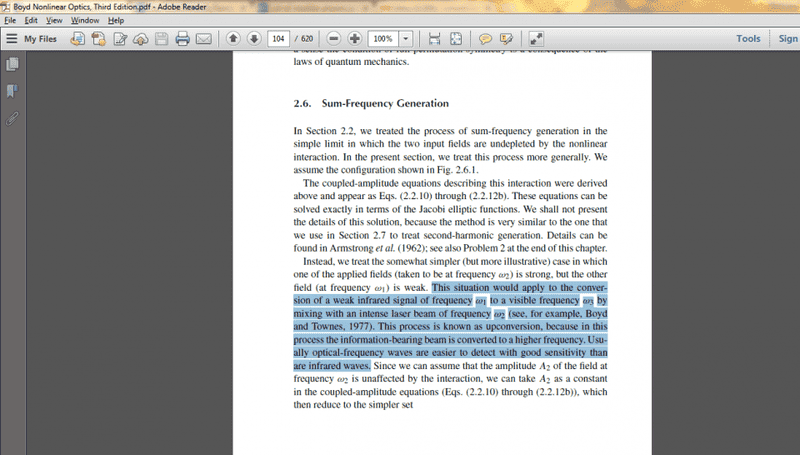
Capture.PNG


I found this very interesting - infrared waves which carry information! It got me thinking: theoretically, we could do 'optics' with 'infrared rays', right? But how do we overcome the problems posed by thermal effects like conduction (and in particular, convection)? Are there special materials out there that can make the use of infrared rays feasible? Can the thermal effects actually be used to our advantage?

I wanted to know if anybody here could tell me about experiments or devices which use infrared radiation for information processing. I'm not looking for research papers or anything, I just want a general idea of whether or not such things are attempted, and with what degree of success.

Thanks!
 
Science news on Phys.org
modulus said:
It got me thinking: theoretically, we could do 'optics' with 'infrared rays', right?
Yes, we can and do. For instance, the lens in a digital camera will pass IR and the sensor will detect IR. The only difference is that the focal length of the lens will be different from optical wavelengths and that can make focussing harder.
Thermal effects can introduce 'noise' into an IR optical system but if you have a high enough signal level, you can transmit and receive digital data easily with IR.
 
Chances are good the text for your post was transmitted via infrared light. That is the dominant way data gets transmitted via the internet.
Light in the near infrared (~1.5 µm) is still high-energetic enough for the photoelectric effect without upconversion.
modulus said:
The two interact, an essentially, the weaker wave is amplified to a higher intensity in the visible region
Not a higher intensity, just a shorter wavelength. There are optical amplifiers, however. Combine it with optical switches and it might be possible to get rid of the detour of electronic signal processing, which could allow higher data rates.

Infrared at much longer wavelengths is impractical - absorption becomes a significant problem, thermal noise becomes dominant and you don't want to cool your glass fibres with liquid nitrogen.
 
modulus said:
<snip> It got me thinking: theoretically, we could do 'optics' with 'infrared rays', right? But how do we overcome the problems posed by thermal effects like conduction (and in particular, convection)? Are there special materials out there that can make the use of infrared rays feasible? Can the thermal effects actually be used to our advantage?

Infrared optical systems are generally divided into 3 or 4 regions: Near IR (NIR)/short-wave IR (SWIR), mid-wave IR, and longwave IR because the waveband is so much larger than visible light and different materials are used for generation and detection for each sub-band.

As mentioned, NIR is where telecommunications lives- silicon detectors, silica fibers, GaAs sources, etc. Nothing too exotic here. NIR goes from the far red to about 1.7 um, while MWIR covers 3-5 um and LWIR covers 8-12 um. These wavebands are in 'water windows', meaning absorption by water is small enough to make free-space transmission feasible. There are laser sources in both; quantum cascade lasers are being developed in the LWIR. Both types of optical systems as predominantly used for 'thermal imaging', meaning heat signatures. Engines and rockets are best imaged in MWIR, room-temperature objects (people, etc) are best imaged using LWIR. I believe low-cost lightweight LWIR cameras are being developed for firefighters, to see through smoke.

There's also far-infrared, which goes out to about 100um: this is where FTIR machines typically operate to get information about molecular absorbance bands.

The materials used for MWIR and LWIR optical component are very different than NIR: typically hollow-core fibers are used for MWIR and LWIR, and lenses are usually Ge or ZnSe. I know less about far-IR materials, mainly wire-grid polarizers and attenuators.

modulus said:
I wanted to know if anybody here could tell me about experiments or devices which use infrared radiation for information processing. I'm not looking for research papers or anything, I just want a general idea of whether or not such things are attempted, and with what degree of success.

AFAIK, Because MWIR and LWIR sources are generally incoherent, not too much has been done on applying the principles of coherent optical processing. As coherent IR sources are developed, I expect to see more things like bulk metamaterials that have some interesting applications.
 
These wavebands are in 'water windows', meaning absorption by water is small enough to make free-space transmission feasible.
That's really interesting! I hadn't thought about thermal imaging having to worry about water vapour in the atmosphere.

Chances are good the text for your post was transmitted via infrared light. That is the dominant way data gets transmitted via the internet./
Now, I always thought that the miles of optical fibres which we lay into the seas is where all the internet communication goes on. So, is the NIR communication a relatively recent phenomenon? I have a feeling NIR would be smarter choice for long-range infrastructure (over higher frequency bands) because of an intuition I've gained reading about transmission in metallic conductors, where higher frequency waves experience stronger attenuation. Is something analogous true for optical communication?

As mentioned, NIR is where telecommunications lives- silicon detectors, silica fibers, GaAs sources, etc. Nothing too exotic here.
So, that makes me ask: why don't we have synthetic materials available yet for NIR communications (like the engineered polymers that have been developed for visible region optical fibres). Are there any specific technical hurdles that have prevented us from doing so until now?
 
Optical fibres for data transmission use infrared lasers - that is outside the visible wavelength range but it is optics as well.
 
modulus said:
T<snip>So, that makes me ask: why don't we have synthetic materials available yet for NIR communications (like the engineered polymers that have been developed for visible region optical fibres). Are there any specific technical hurdles that have prevented us from doing so until now?

I don't understand-optical telecommunications is already conducted within the NIR waveband.

Silica fiber is synthetic...?
 
I don't understand-optical telecommunications is already conducted within the NIR waveband.

Silica fiber is synthetic...?

Never mind that...the mention of GaAs threw me off. I held the notion that polymers (like polyethylene) were used for optical fibres. After some reading I learned that they are used in cladding, while the actual transmitting material is made up of those you mentioned.

And yes, 'optical communication' is indeed in NIR. Again, I was confused - I saw the 'optical' in 'optical fibre' and still expected something to be happening in the visible spectrum.Anyhow, I just want to say thank you for your replies, mfb and Andy. They gave me some good pointers for further reading.
 

Similar threads

  • · Replies 10 ·
Replies
10
Views
3K
  • · Replies 1 ·
Replies
1
Views
3K
  • · Replies 1 ·
Replies
1
Views
3K
Replies
9
Views
2K
  • · Replies 152 ·
6
Replies
152
Views
11K
  • · Replies 1 ·
Replies
1
Views
1K
  • · Replies 0 ·
Replies
0
Views
758
  • · Replies 3 ·
Replies
3
Views
2K
  • · Replies 1 ·
Replies
1
Views
5K
  • · Replies 4 ·
Replies
4
Views
2K