Input Resistance of Common Gate question....

Click For Summary
SUMMARY

The input resistance of a common-gate amplifier is defined as 1/gm when ro approaches infinity. The discussion highlights a common mistake in calculations involving the output voltage (Vo) being incorrectly grounded, which leads to miscalculating the input resistance. To accurately incorporate the drain resistor (Rd) into the equation, it is essential to keep Vo open and consider the high impedance at the output. The correct KCL equation for this scenario is ix = gmvx - vx/ro - (vx-vo)/ro, leading to rin = (1 + Rl/ro) / (gm + 1/ro).

PREREQUISITES
  • Understanding of common-gate amplifier configurations
  • Familiarity with the Hybrid pi model for MOSFETs
  • Knowledge of Kirchhoff's Current Law (KCL)
  • Basic concepts of input and output resistance in amplifiers
NEXT STEPS
  • Study the derivation of input resistance in common-gate amplifiers
  • Learn about the impact of output impedance on amplifier performance
  • Explore the role of drain resistors (Rd) in amplifier circuits
  • Investigate the differences between common-gate and common-source amplifier configurations
USEFUL FOR

Electrical engineers, students studying amplifier design, and professionals working with MOSFET circuits will benefit from this discussion.

perplexabot
Gold Member
Messages
328
Reaction score
5
Hey all. I have been trying to calculate the input resistance of a common gate amplifier, but seem to have problems doing so.

I know I have to set a test voltage (or test current) at the input, and I've been told, to ground the output. So using the Hybrid pi model for a mosfet, I did the following to calculate the input resistance:
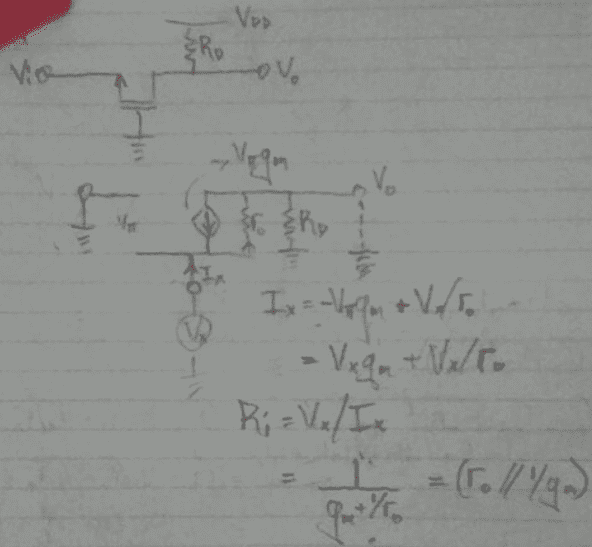
Untitled.png


I apologize for my low quality picture. Please any help or hints are greatly appreciated. I just don't know what I am doing wrong. I have used the exact same technique on other amps and it seems to have worked fine, just not with common gates amps : (

Thank you.
 
Engineering news on Phys.org
What's the problem? You got the right answer. The input resistance of a common-gate amplifier goes to 1/gm as ro goes to infinity.

If you're trying to calculate it including Rd (which is not standard but sometimes done) then you forgot to include the current going from the VCCS to ground through Rd (equals Vo/Rd).
 
  • Like
Likes perplexabot
analogdesign said:
What's the problem? You got the right answer. The input resistance of a common-gate amplifier goes to 1/gm as ro goes to infinity.

If you're trying to calculate it including Rd (which is not standard but sometimes done) then you forgot to include the current going from the VCCS to ground through Rd (equals Vo/Rd).

Thank you for your time and reply. Yes, I am trying to include Rd. If I take the node above the test voltage, there are 3 currents going in and out of that node. Rd doesn't seem to be part of any of those three. It also seems that Rd is shorted out due to connecting Vo to ground. How does one incorporate Rd into the equation?

Once again thank you so much.
 
perplexabot said:
Thank you for your time and reply. Yes, I am trying to include Rd. If I take the node above the test voltage, there are 3 currents going in and out of that node. Rd doesn't seem to be part of any of those three. It also seems that Rd is shorted out due to connecting Vo to ground. How does one incorporate Rd into the equation?

Once again thank you so much.

No problem. The issue is that Vo should be open; it is not shorted to ground. When you calculate the input resistance of a voltage amplifier you need to assume the output is connected to a high impedance. So your third current (that you set to zero) is wrong.

So the KCL equation should be ix = gmvx - vx/ro - (vx-vo)/ro

The second equation you need is vo = ixRl so you have (collecting terms)

ix + (ixRl)/ro = gmvx - vx/ro

Solving, rin = vx/ix = (1 + Rl/ro) / (gm+1/ro)

This is what you expect because if ro is larger than Rl (virtually always the case) then this collapses to 1/(gm+1/ro) ~= 1/gm

Does that make sense now?
 
  • Like
Likes perplexabot
Yes! Opening Vo fixed everything. I should have tried some more. Thank you.
 
  • Like
Likes analogdesign
glad I could help. :)
 
  • Like
Likes perplexabot
I am trying to understand how transferring electric from the powerplant to my house is more effective using high voltage. The suggested explanation that the current is equal to the power supply divided by the voltage, and hence higher voltage leads to lower current and as a result to a lower power loss on the conductives is very confusing me. I know that the current is determined by the voltage and the resistance, and not by a power capability - which defines a limit to the allowable...

Similar threads

  • · Replies 4 ·
Replies
4
Views
2K
  • · Replies 3 ·
Replies
3
Views
2K
Replies
12
Views
2K
  • · Replies 3 ·
Replies
3
Views
4K
  • · Replies 5 ·
Replies
5
Views
4K
  • · Replies 12 ·
Replies
12
Views
2K
  • · Replies 10 ·
Replies
10
Views
2K
  • · Replies 1 ·
Replies
1
Views
2K
  • · Replies 10 ·
Replies
10
Views
2K
  • · Replies 3 ·
Replies
3
Views
1K