Integrate divergence of a vector over an area

Click For Summary

Homework Help Overview

The discussion revolves around integrating the divergence of a vector field over an area, specifically using the divergence theorem in the context of a solid mechanics exam question. Participants are exploring the mathematical reasoning involved in applying the theorem and integrating over specified surfaces.

Discussion Character

  • Mathematical reasoning, Assumption checking, Problem interpretation

Approaches and Questions Raised

  • Participants discuss the application of the divergence theorem and the integration process over different surfaces. There are attempts to clarify the correct approach for integrating along lines versus areas, with some questioning the need for double integrals.

Discussion Status

Some participants have provided guidance on how to approach the integration, while others are exploring different methods and interpretations. There is a mix of confidence and uncertainty regarding the integration process and the results obtained.

Contextual Notes

Participants mention being out of practice with calculus and express concerns about their understanding of the integration process. There is also a reference to the exam requirements and the need to use the divergence theorem specifically.

JMoody
Messages
6
Reaction score
0
Hello, I'm hoping somebody can give me some insight on how to solve this problem. This was a solid mechanics exam question and I wasn't able to finish it because I'm rather weak in math.

1. Homework Statement
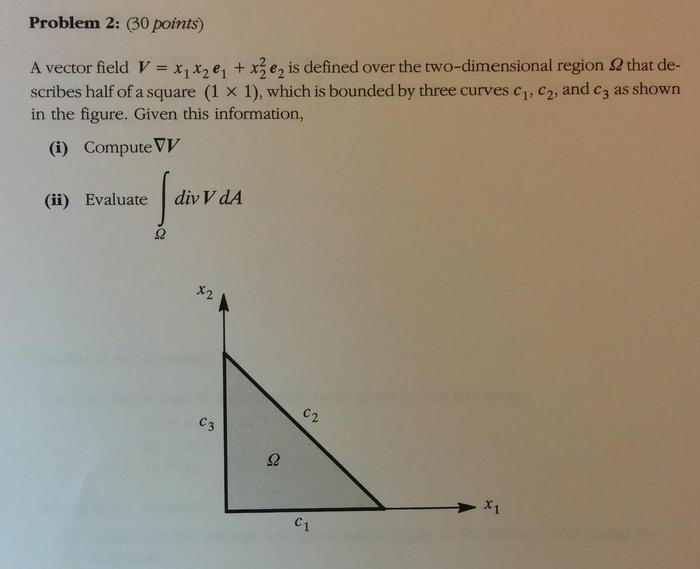
WOxeM7f.jpg


Homework Equations


Recall divergence theorem for part ii. ∫div(V)dA = ∫V⋅ndS where n is normal to the surface.

The Attempt at a Solution


Part i.
Not an issue, I can solve it easily.

Part ii.
I can apply divergence theorem no problem.
For the n vector field I get:
n1 = -e2
n3 = -e1
n2 = .707(e1 + e2)

The problem is that I've been out of school for quite a while, and I can't remember how to successfully integrate over the surface (perimeter) now. I realize I need to break it up into parts for each line of the surface, but it's been years since I've taken calculus.
 
Last edited:
Physics news on Phys.org
For c1, you will have ##\int_0^1 V\cdot n_1 \, dx_1##.
For c3, you will have ##\int_0^1 V\cdot n_2 \, dx_2 ##.
For c2, it gets a little tougher.
##\int_{c2} V\cdot n_2 dc2##
 
For c2, should I do a double integral (x1 and x2, both from 0 to 1) of V⋅n2?
 
It might be easier to directly compute the Area integral
##\int_0^1 \int_0^{1-x_1} div(V) dx_2dx_1 ##
 
JMoody said:
For c2, should I do a double integral (x1 and x2, both from 0 to 1) of V⋅n2?
I don't think that is right, you would be taking the integral over an area. you want the integral over the line.
 
Thanks RUber, I think you've provided the help I needed to finish it. It was required to perform divergence theorem for the exam though, I'll give it a shot with both methods and see how the solutions compare.
 
RUber said:
It might be easier to directly compute the Area integral
##\int_0^1 \int_0^{1-x_1} div(V) dx_2dx_1 ##
Nevermind this...that doesn't make any sense.
---
Try integrating over x1, and define x2 in terms of x1 along the line. That should do the trick.
 
I solved it, I get 1/2 using both methods. Thanks again for the help RUber, it helped set me on the write path.
 
When I worked it out, I still had the ##\frac 1 {\sqrt{2}}## in the answer.
 
  • #10
I'm not sure where the square root comes from, but I believe the accepted solution was 1/2 when we went over the exam (he just didn't take the time to go over something trivial like integration since most of my peers are coming straight out of undergrad >.<). I calculated it both by using divergence theorem to integrate over the line (more complicated) and by integrating the divergence over the area directly.
FmqC9lS.jpg
 
  • #11
Aha, I forgot to multiply by the ##\sqrt{2}## in the dS term.
Good work.
 
  • #12
Why (in post #7) "Nevermind this...that doesn't make any sense." ?
I thought I had div V = 3x2 and that would be a simple integral, so I'm grossly overlooking sonething ?
 
  • #13
Thanks BvU, I was clearly overthinking things and convinced myself I was wrong.
 

Similar threads

  • · Replies 4 ·
Replies
4
Views
2K
Replies
2
Views
2K
Replies
8
Views
3K
  • · Replies 1 ·
Replies
1
Views
2K
  • · Replies 7 ·
Replies
7
Views
2K
  • · Replies 3 ·
Replies
3
Views
2K
  • · Replies 5 ·
Replies
5
Views
3K
Replies
2
Views
2K
  • · Replies 3 ·
Replies
3
Views
2K
  • · Replies 1 ·
Replies
1
Views
1K