Integrating Factor: Need Help Solving Excersice?

Click For Summary
The discussion revolves around solving a homework exercise related to integrating factors in differential equations. A participant expresses uncertainty about their approach and seeks confirmation on whether their calculations support the statement that if N is an integrating factor, then N*f(S) is also an integrating factor. Key points raised include the ineffectiveness of concluding with 0 = 0 and confusion regarding the introduction of variables like q, dx, and dy. The importance of using the integrating factor correctly to transform a non-exact differential equation into an exact one is emphasized. Clarification on the specific differential equation being addressed is also requested.
B4cklfip
Messages
18
Reaction score
0
Homework Statement
Show that if N is an integrating factor also N*f(S) is an integrating factor.
Relevant Equations
##dS = \frac{dU+pdV}{N}##
I'm not sure if that is the right way to solve this excersice. Can someone maybe help and tell me if this calculation proofs the statement ?
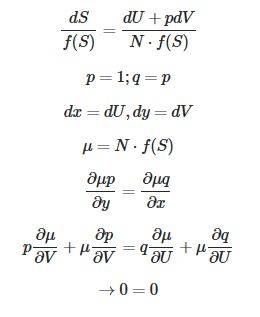
Integrating Factor.JPG
 
Physics news on Phys.org
B4cklfip said:
Homework Statement:: Show that if N is an integrating factor also N*f(S) is an integrating factor.
Relevant Equations:: ##dS = \frac{dU+pdV}{N}##

I'm not sure if that is the right way to solve this excersice. Can someone maybe help and tell me if this calculation proofs the statement ?

View attachment 263972
First off, ending with 0 = 0 doesn't do you any good.
Second, I'm having a hard time trying to follow what you're doing. Why are you introducing q in the 2nd line and dx and dy in the 3rd line?
What is the differential equation you're trying to solve? Is it Udx + Vdy = 0?
You are given that N is an integrating factor. How have you used it? The basic idea is that U(x, y)dx + V(x, y)dy = 0 is not an exact differential equation, multiplying by an integrating factor causes the new equation to be exact.
 
Question: A clock's minute hand has length 4 and its hour hand has length 3. What is the distance between the tips at the moment when it is increasing most rapidly?(Putnam Exam Question) Answer: Making assumption that both the hands moves at constant angular velocities, the answer is ## \sqrt{7} .## But don't you think this assumption is somewhat doubtful and wrong?

Similar threads

Replies
9
Views
2K
Replies
4
Views
2K
  • · Replies 5 ·
Replies
5
Views
2K
Replies
7
Views
2K
  • · Replies 9 ·
Replies
9
Views
2K
  • · Replies 1 ·
Replies
1
Views
2K
Replies
7
Views
2K
  • · Replies 6 ·
Replies
6
Views
2K
Replies
3
Views
2K
Replies
18
Views
2K