Is the Solution Manual's Approach to Internal Energy Calculation Accurate?

Click For Summary
SUMMARY

The discussion centers on the accuracy of a solution manual's approach to internal energy calculation, specifically regarding the omission of heat transfer. Participants confirm that the solution manual is correct in its context, as it serves to test understanding rather than provide a comprehensive analysis. The key equation referenced is work represented as PΔV, which highlights the relationship between work and energy without directly involving heat transfer. Additionally, there is a consensus that the manual incorrectly implies a direct conversion between work and heat energy, specifically the equivalence of 1 L atm to 1 J.

PREREQUISITES
  • Understanding of thermodynamics principles, specifically internal energy and work.
  • Familiarity with the equation PΔV in the context of work done by a system.
  • Knowledge of the relationship between work and heat energy conversion.
  • Basic comprehension of solution manuals and their purpose in educational contexts.
NEXT STEPS
  • Research the principles of thermodynamics, focusing on internal energy and work.
  • Study the implications of the PΔV equation in various thermodynamic processes.
  • Explore the relationship between work and heat energy, including the laws of thermodynamics.
  • Examine common misconceptions in solution manuals regarding energy conversions.
USEFUL FOR

Students and educators in thermodynamics, engineers dealing with energy calculations, and anyone seeking to clarify the concepts of work and heat transfer in energy systems.

r12214001
Messages
24
Reaction score
2
Homework Statement
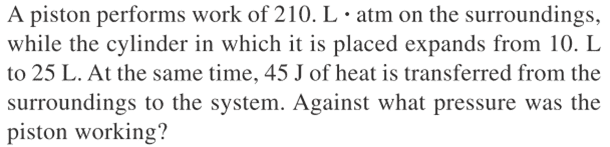
My calculation:
|210 X 101.3 – 45| = |-15 X (P)X 101.3 + 45|
Relevant Equations
N/A
Question:
圖片3.png

Solution manual:
圖片2.png

Is the solution manual correct or not? why does not contain heat transfer?
 
Physics news on Phys.org
The solution manual is correct. It does not contain heat transfer because it is a trick question. They wanted to test your understanding by providing more information than was necessary to solve the problem. Apparently, you fell for the trick. What puzzles me is how in the world you arrived at your solution.
 
  • Like
Likes   Reactions: Erico Romaric
Chestermiller said:
The solution manual is correct. It does not contain heat transfer because it is a trick question. They wanted to test your understanding by providing more information than was necessary to solve the problem. Apparently, you fell for the trick. What puzzles me is how in the world you arrived at your solution.
why does not contain heat transfer? please educate me.
 
  • Like
Likes   Reactions: Erico Romaric
r12214001 said:
why does not contain heat transfer? please educate me.
Because work is ##P\Delta V##. What has this got to do with the heat transfer?Anyway, if you had gotten the signs correct in your equation, you would have gotten the right answer. What's with those absolute value signs?
 
  • Like
Likes   Reactions: Erico Romaric
Chestermiller said:
Because work is ##P\Delta V##. What has this got to do with the heat transfer?Anyway, if you had gotten the signs correct in your equation, you would have gotten the right answer. What's with those absolute value signs?
TKS for reply
why the energy of work cannot converted to the energy of heat?
 
r12214001 said:
TKS for reply
why the energy of work cannot converted to the energy of heat?
What does TKS mean? Who says work can’t be converted to heat?
 
The solution manual is wrong in implying that 1 L atm = 1 J (although its final answer is correct).
 

Similar threads

  • · Replies 3 ·
Replies
3
Views
3K
  • · Replies 0 ·
Replies
0
Views
2K
  • · Replies 2 ·
Replies
2
Views
2K
  • · Replies 19 ·
Replies
19
Views
4K
  • · Replies 2 ·
Replies
2
Views
2K
  • · Replies 1 ·
Replies
1
Views
5K
Replies
5
Views
670
Replies
4
Views
7K
  • · Replies 5 ·
Replies
5
Views
4K
  • · Replies 8 ·
Replies
8
Views
879