Internal Energy of Gas and Work done

Click For Summary
SUMMARY

The discussion centers on the application of the first law of thermodynamics to a gas that absorbs 10,000 J of heat, releases 3,000 J, and does 2,000 J of work. The correct interpretation of the change in internal energy is that it increases by 5,000 J, despite the gas losing energy during the process. The confusion arises from misinterpreting the initial and final states of internal energy, emphasizing the importance of understanding energy transactions in thermodynamic systems.

PREREQUISITES
  • Understanding of the first law of thermodynamics
  • Familiarity with internal energy concepts
  • Basic knowledge of energy transfer (heat and work)
  • Ability to interpret thermodynamic processes
NEXT STEPS
  • Study the first law of thermodynamics in detail
  • Learn about energy state diagrams in thermodynamics
  • Explore examples of internal energy calculations in various systems
  • Investigate the implications of energy conservation in thermodynamic processes
USEFUL FOR

This discussion is beneficial for students of thermodynamics, engineers working with heat engines, and anyone interested in understanding energy transformations in physical systems.

Tesla In Person
Messages
34
Reaction score
13
Homework Statement
Find Internal energy of a Gas
Relevant Equations
Change in internal energy= Heat added to System - Work done by system
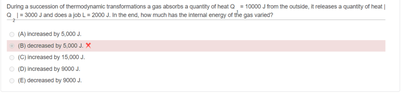
This is a thermodynamics question. A gas absorbs 10 000 J of heat , it releases 3000 J and does 2000 J of work. How much has the internal energy varied?
So I did 10 000 - 3000 -2000 = 5000 J so internal energy decreases by 5000 J. But the correct answer is A) it increased by 5000 J . How ?
 

Attachments

  • physics 6.png
    physics 6.png
    9.6 KB · Views: 139
  • Like
Likes   Reactions: Delta2
Physics news on Phys.org
You have correctly calculated using the first law of thermodynamics that change in internal energy is 5000J. The whole point here is how exactly you interpret the "change in internal energy".
Do you interpret it as "Initial Internal energy minus Final internal energy"?
or "Final internal energy minus Initial internal energy"?
 
Delta2 said:
You have correctly calculated using the first law of thermodynamics that change in internal energy is 5000J. The whole point here is how exactly you interpret the "change in internal energy".
Do you interpret it as "Initial Internal energy minus Final internal energy"?
or "Final internal energy minus Initial internal energy"?
Change is final - initial so 5000 - 10 000 = -5 000 J. What does the -ve sign mean ?
 
Hold on. Change is indeed final-initial but the problem statement doesn't tell you that final is 5000 and initial is 10000. All we can calculate from the problem data is that the change is 5000J , hence change=final-initial=5000J, hence final=5000J+initial, which means that the final internal energy is the initial increased by 5000J.
 
Last edited:
Delta2 said:
Hold on. Change is indeed final-initial but the problem statement doesn't tell you that final is 5000 and initial is 10000. All we can calculate from the problem data is that the change is 5000J , hence change=final-initial=5000J, hence final=5000J+initial, which means that the final internal energy is the initial increased by 5000J.
Oh i see what the problem was, i assumed 10 000 J was initial energy of the gas. Ok but one thing is still confusing me. How can the internal energy of the gas increase when it looses energy in both transformations?
When it releases 3000 J it looses energy and when it does 2000 J of work it again looses internal energy. So how did the internal energy of the gas increase? How is the final IE higher than initial IE ?
 
Tesla In Person said:
Oh i see what the problem was, i assumed 10 000 J was initial energy of the gas. Ok but one thing is still confusing me. How can the internal energy of the gas increase when it looses energy in both transformations?
When it releases 3000 J it looses energy and when it does 2000 J of work it again looses internal energy. So how did the internal energy of the gas increase? How is the final IE higher than initial IE ?
Because according to the problem's statement it absorbs 10000J of heat.
 
  • Like
Likes   Reactions: Tesla In Person
Read the question carefully. A way to solve this is by drawing a diagram of how energy is absorbed/released and splitting it into states. Since you have put in effort to answer the question, I'll help you out.

State 0: Initial total energy is some undefined non-zero quantity Q_init.
State 1: Absorbs 10 kJ. In this state, the total energy = Q_init + Q.
State 2: total energy = Q_init + Q - Q_2
State 3: total energy = Q_init + Q - Q_2 - L

Your answer would be correct if Q_init = 0.

This isn't an answer to your question, but it is a way to systematically model what is happening.

Now recall that ##\Delta U = q + w##

Can you solve the rest?
 
  • Informative
Likes   Reactions: Tesla In Person
Understanding the first law is as simple as understanding your bank account balance. After a transaction, the change in your balance follows the simple rule,

change in balance = (what goes in) - (what comes out).

In this case, 10,000 units go in and (2,000 + 3,000) units come out.
 
  • Like
Likes   Reactions: hutchphd and Tesla In Person
Thank you all @Delta2 @Mayhem and @kuruman. I understand what i was doing wrong. The 10 kJ was not the initial energy it absorbed that energy and only lost half of that amount (5 kJ) so it still has 5kJ left. So the internal energy increases by 5kJ instead of 10kJ due to the energy lost and work done by gas. 🙏
 
  • Like
Likes   Reactions: Delta2 and kuruman
  • #10
Mayhem said:
Read the question carefully. A way to solve this is by drawing a diagram of how energy is absorbed/released and splitting it into states. Since you have put in effort to answer the question, I'll help you out.

State 0: Initial total energy is some undefined non-zero quantity Q_init.
State 1: Absorbs 10 kJ. In this state, the total energy = Q_init + Q.
State 2: total energy = Q_init + Q - Q_2
State 3: total energy = Q_init + Q - Q_2 - L

Your answer would be correct if Q_init = 0.

This isn't an answer to your question, but it is a way to systematically model what is happening.

Now recall that ##\Delta U = q + w##

Can you solve the rest?
State 1: Q init + 10 kJ
State 2: Qinit + 10 kJ - 3kJ
State 3 : Qinit + 10 kJ - 3kJ - 2 kJ
Final : Qinit + 5 kJ.
So it increased by 5 kJ.
Thanks !
 
  • Like
Likes   Reactions: Mayhem and Delta2
  • #11
Tesla In Person said:
State 1: Q init + 10 kJ
State 2: Qinit + 10 kJ - 3kJ
State 3 : Qinit + 10 kJ - 3kJ - 2 kJ
Final : Qinit + 5 kJ.
So it increased by 5 kJ.
Thanks !
You got it.
 

Similar threads

  • · Replies 4 ·
Replies
4
Views
3K
  • · Replies 58 ·
2
Replies
58
Views
5K
  • · Replies 1 ·
Replies
1
Views
2K
Replies
5
Views
1K
  • · Replies 32 ·
2
Replies
32
Views
3K
  • · Replies 3 ·
Replies
3
Views
1K
  • · Replies 6 ·
Replies
6
Views
2K
Replies
13
Views
2K
Replies
3
Views
1K
  • · Replies 8 ·
Replies
8
Views
2K