Beelzedad
- 24
- 3
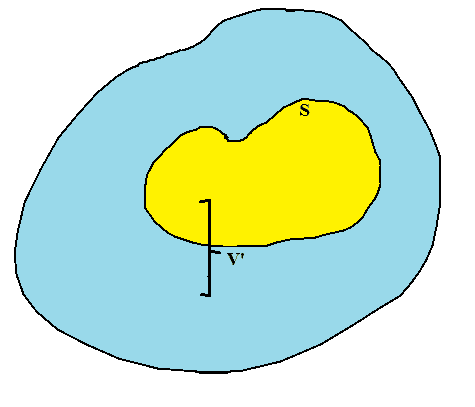
Consider a continuous charge distribution in volume ##V'##. Draw a closed surface ##S## inside the volume ##V'##.
Consider the following multiple integral:
##\displaystyle A=\iiint_{V'} \left[ \iint_S \dfrac{\cos(\hat{R},\hat{n})}{R^2} dS \right] \rho'\ dV' =4 \pi\ m_s##
where
##R=|\mathbf{r}-\mathbf{r'}|##
##\mathbf{r'}=(x',y',z')## is coordinates of source points
##\mathbf{r}=(x,y,z)## is coordinates of field points
##\cos(\hat{R},\hat{n})## is the angle between ##R## and normal to surface element
##\rho'## is the charge density and is continuous throughout the volume ##V'##
##m_s## is the total charge inside surface ##S##
______________________________________________________________________________________
Also consider the following multiple integral:
##\displaystyle B= \iint_S \left[ \iiint_{V'} \dfrac{\cos(\hat{R},\hat{n})}{R^2} \rho'\ dV' \right] dS##
where the symbols have the meanings stated above.
\begin{align}
B &= \iint_S \left[ \iiint_{V'} \rho' \dfrac{\hat{R} \cdot \hat{n}}{R^2} \ dV' \right] dS\\
&=\iint_S \left[ \iiint_{V'} \rho' \dfrac{\hat{R} }{R^2} \ dV' \right] \cdot \hat{n}\ dS\\
&=\iint_S \mathbf{E} \cdot \hat{n}\ dS
\end{align}
_____________________________________________________________________________________
Is ##A=B\ ?##
i.e. Is interchanging the order of surface and volume integration valid? I know it is usually valid but my doubt is due to the following reasons:
1. In the surface integral of equation ##A##, when ##\mathbf{r'} \in S##, we can only use spherical coordinate system with origin at point ##\mathbf{r'}## (in order to avoid improper integral with limits). So while computing ##A##, we cannot use only one coordinate system. Instead, we have to use infinitely many coordinate systems.
2. In the volume integral of equation ##B##, for all ##\mathbf{r}##, i.e. for all ##\mathbf{r} \in S##, we can only use spherical coordinate system with origin at point ##\mathbf{r}## (in order to avoid improper integral with limits). So while computing ##B##, we cannot use only one coordinate system. Instead, we have to use infinitely many coordinate systems.
Note:
I know ##\int \left[\int f(x,y)\,dx \right]dy = \int \left[\int f(x,y)\,dy \right]dx## is true usually. Also, if in the diagram, if the volume ##V'## is contained within the surface ##S##, then it is valid to change the order of integration. But here the issue is a little different. The surface ##S## is inside the volume ##V'## (please have a look at my diagram) and thus improper integral comes into play.
While computing ##A##, if we need to avoid improper integrals, we have no choice except to work with infinitely many spherical coordinate systems each having their origin at points ##\in V'##.
Similarly while computing ##B##, if we need to avoid improper integrals, we have no choice except to work with infinitely many spherical coordinate systems each having their origin at points ##\in S##.
Then how is it valid to change the order of integration in this situation? That is, how can ##A=B?##
Consider the following multiple integral:
##\displaystyle A=\iiint_{V'} \left[ \iint_S \dfrac{\cos(\hat{R},\hat{n})}{R^2} dS \right] \rho'\ dV' =4 \pi\ m_s##
where
##R=|\mathbf{r}-\mathbf{r'}|##
##\mathbf{r'}=(x',y',z')## is coordinates of source points
##\mathbf{r}=(x,y,z)## is coordinates of field points
##\cos(\hat{R},\hat{n})## is the angle between ##R## and normal to surface element
##\rho'## is the charge density and is continuous throughout the volume ##V'##
##m_s## is the total charge inside surface ##S##
______________________________________________________________________________________
Also consider the following multiple integral:
##\displaystyle B= \iint_S \left[ \iiint_{V'} \dfrac{\cos(\hat{R},\hat{n})}{R^2} \rho'\ dV' \right] dS##
where the symbols have the meanings stated above.
\begin{align}
B &= \iint_S \left[ \iiint_{V'} \rho' \dfrac{\hat{R} \cdot \hat{n}}{R^2} \ dV' \right] dS\\
&=\iint_S \left[ \iiint_{V'} \rho' \dfrac{\hat{R} }{R^2} \ dV' \right] \cdot \hat{n}\ dS\\
&=\iint_S \mathbf{E} \cdot \hat{n}\ dS
\end{align}
_____________________________________________________________________________________
Is ##A=B\ ?##
i.e. Is interchanging the order of surface and volume integration valid? I know it is usually valid but my doubt is due to the following reasons:
1. In the surface integral of equation ##A##, when ##\mathbf{r'} \in S##, we can only use spherical coordinate system with origin at point ##\mathbf{r'}## (in order to avoid improper integral with limits). So while computing ##A##, we cannot use only one coordinate system. Instead, we have to use infinitely many coordinate systems.
2. In the volume integral of equation ##B##, for all ##\mathbf{r}##, i.e. for all ##\mathbf{r} \in S##, we can only use spherical coordinate system with origin at point ##\mathbf{r}## (in order to avoid improper integral with limits). So while computing ##B##, we cannot use only one coordinate system. Instead, we have to use infinitely many coordinate systems.
Note:
I know ##\int \left[\int f(x,y)\,dx \right]dy = \int \left[\int f(x,y)\,dy \right]dx## is true usually. Also, if in the diagram, if the volume ##V'## is contained within the surface ##S##, then it is valid to change the order of integration. But here the issue is a little different. The surface ##S## is inside the volume ##V'## (please have a look at my diagram) and thus improper integral comes into play.
While computing ##A##, if we need to avoid improper integrals, we have no choice except to work with infinitely many spherical coordinate systems each having their origin at points ##\in V'##.
Similarly while computing ##B##, if we need to avoid improper integrals, we have no choice except to work with infinitely many spherical coordinate systems each having their origin at points ##\in S##.
Then how is it valid to change the order of integration in this situation? That is, how can ##A=B?##