SUMMARY
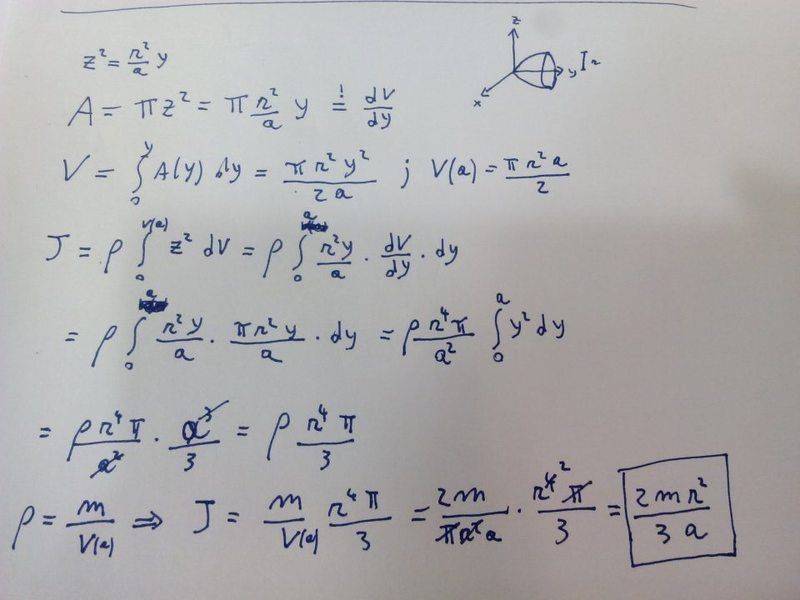
The discussion focuses on the calculation of the moment of inertia J for an object revolving around the y-axis, specifically using the function z² = (r²/a) y. The correct formula for the moment of inertia, as concluded by the participants, is (2 m r²) / 3, which does not include the variable "a". Participants identified errors in the initial calculations and confirmed the correct approach to derive the moment of inertia based on uniform density and the specified limits of y from 0 to "a".
PREREQUISITES
- Understanding of moment of inertia concepts
- Familiarity with calculus, particularly integration
- Knowledge of uniform density properties
- Basic understanding of cylindrical coordinates
NEXT STEPS
- Study the derivation of moment of inertia for various shapes
- Learn about integration techniques in cylindrical coordinates
- Explore applications of moment of inertia in physics and engineering
- Review uniform density calculations in solid mechanics
USEFUL FOR
Students and professionals in physics, mechanical engineering, and applied mathematics who are involved in calculating moments of inertia and understanding rotational dynamics.