Is the concept of a perpetual motion machine feasible in the realm of physics?

  • Context: Undergrad 
  • Thread starter Thread starter guss
  • Start date Start date
  • Tags Tags
    Energy Interesting
Click For Summary

Discussion Overview

The discussion centers on the feasibility of perpetual motion machines within the framework of physics, exploring concepts related to mechanical energy, gravitational effects, and the implications of relativity. Participants examine theoretical models and potential mechanisms, including the role of gears and levers, gravitational time dilation, and energy transmission in gravitational fields.

Discussion Character

  • Exploratory
  • Technical explanation
  • Debate/contested
  • Mathematical reasoning

Main Points Raised

  • Some participants propose that mechanical energy against gravity may not work due to relativistic effects, though the exact nature of these effects remains uncertain.
  • There is a suggestion that light does not accelerate, and while photons may gain energy, the implications for perpetual motion are not fully understood.
  • A participant discusses simplifying gear assemblies into levers and questions whether energy transfer through a gravity gradient affects the system's efficiency.
  • Gravitational time dilation is noted to potentially slow down the bottom gear's rotation, which may offset energy increases, although this is presented as a hypothesis rather than a conclusion.
  • Some participants explore the Ehrenfest paradox and its relevance to the rigidity of gears in gravitational fields, suggesting that perfect rigid-body rotation may not be achievable.
  • There are claims that if the machine operates horizontally, it could function without gravitational energy loss, indicating a distinction between scenarios with and without gravity.
  • Concerns are raised about the implications of energy scaling in different reference frames, particularly regarding kinetic energy and photon energy in gravitational contexts.
  • Participants express uncertainty about where energy loss occurs in the proposed systems and whether energy differences across reference frames can be accurately quantified.

Areas of Agreement / Disagreement

Participants do not reach a consensus on the feasibility of perpetual motion machines, with multiple competing views and hypotheses presented throughout the discussion. Uncertainties about the implications of relativity and gravitational effects remain unresolved.

Contextual Notes

Limitations include assumptions about the rigidity of materials, the dependence on gravitational fields, and the complexities of energy transfer in varying reference frames. The discussion highlights unresolved mathematical steps and the need for further analysis.

guss
Messages
246
Reaction score
0
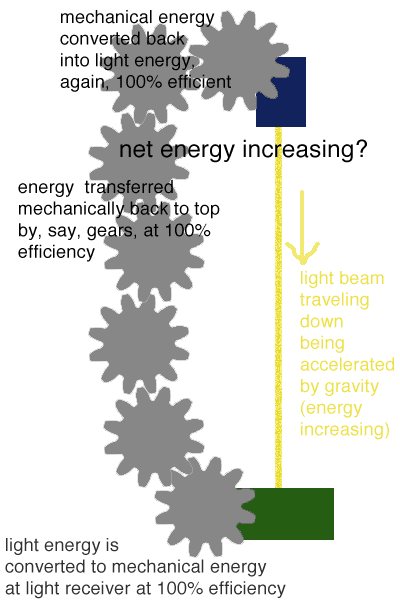
Mechanical energy against gravity? (Interesting energy problem)

fxT6c.png


Why doesn't the above picture work?
(I think it has to do with relativity, not 100% sure)
 
Last edited:
Physics news on Phys.org
To start, light doesn't accelerate. c is fixed, although that may not be the fundamental problem.
 
danR said:
To start, light doesn't accelerate. c is fixed, although that may not be the fundamental problem.
Oops, yeah, just meant the photons are gaining energy.
 
You can simplify the assembly of gears by replacing them with a train of levers (which is what gears of this sort are over the short haul), and then reducing the assembly to a single lever. You push the lever right at the bottom, and it goes left at the top and can do work. Or just one big wheel.

That done there is the relation of the lever action moving through a gravity gradient from bottom to top. Whether that matters or not to the energy-transfer would be for the experts to determine.
 
Gravitational time dilation means that the bottom gear would turn more slowly than expected for a given frequency. This exactly offsets the increased energy.
 
DaleSpam said:
Gravitational time dilation means that the bottom gear would turn more slowly than expected for a given frequency. This exactly offsets the increased energy.

That was the kind of thing that occurred to me when I looked at it, but I wasn't able to figure out a detailed analysis. Do you think you understand this in detail, or is this just a guess as to the outlines of the solution?

It seems to me that there may be a variation on the Ehrenfest paradox here: http://en.wikipedia.org/wiki/Ehrenfest_paradox . The Ehrenfest paradox is SR, not GR, but I think there may be similar issues in that it may not be correct to assume that perfect rigid-body rotation of the gears is possible in a gravitational field.

To avoid making an impossible assumption about rigidity, maybe it would be interesting to recast the machine as one in which the energy is transmitted upward mechanically through a vibration. If I tap the bottom end of a vertical rod, the frequency of the vibrations should decrease as they propagate up the rod, due to gravitational time dilation. If their amplitude stays the same (which I think they have to if the rod is going to end up in equilibrium at the end), then they should lose kinetic energy, although it seems like the energy loss would go like the square of the time-dilation factor, which wouldn't be the right factor to patch up conservation of energy in the perpetual motion machine as originally proposed.
 
bcrowell said:
Do you think you understand this in detail, or is this just a guess as to the outlines of the solution?
Definitely just a guess as to the outlines. But you can imagine a synthesizer locally generating a signal at the same frequency as the bottom gear and then transmitting that signal up. It would be redshifted on the higher side meaning that according to the top, the bottom is turning slower than it thinks it is.
 
bcrowell said:
It seems to me that there may be a variation on the Ehrenfest paradox here: http://en.wikipedia.org/wiki/Ehrenfest_paradox . The Ehrenfest paradox is SR, not GR, but I think there may be similar issues in that it may not be correct to assume that perfect rigid-body rotation of the gears is possible in a gravitational field.

That does not seem right for 2 reasons.

First, if you set the machine to work horizontally (that is, you eliminate gravity), the machine will work, since there is no loss due to gravitational energy.
The Ehrenfest paradox would not be applicable for this reason, since the Lorentz-contraction of the circumference would be present in both cases.
In other words, it matters whether there is gravity or not, meaning this is GR and not SR.

Second, I thought GR and SR do not depend on nature being perfect or not. It's about the math. The math must still be right with perfect bodies. I believe this is essential in relativity theory: it's all about thought experiments that must mathematically work out.
 
I like Serena said:
First, if you set the machine to work horizontally (that is, you eliminate gravity), the machine will work, since there is no loss due to gravitational energy.
The Ehrenfest paradox would not be applicable for this reason, since the Lorentz-contraction of the circumference would be present in both cases.
In other words, it matters whether there is gravity or not, meaning this is GR and not SR.
I'm not suggesting that it's the same as the Ehrenfest paradox, just that there might be some ideas in common.

I like Serena said:
Second, I thought GR and SR do not depend on nature being perfect or not. It's about the math. The math must still be right with perfect bodies. I believe this is essential in relativity theory: it's all about thought experiments that must mathematically work out.
The resolution of the Ehrenfest paradox is that the math doesn't allow perfect bodies. That is, it's not kinematically possible to impart an angular acceleration to a disk while keeping the disk perfectly rigid.
 
  • #10
As you went further from the source of gravity, you would start to see that the chain of gears carried less energy.
So what is the property of the chain of gears which indicates its energy? If it is simply the rotational speed of the gears, then that must mean as you went further away from the source of gravity, you would eventually notice that the gears are moving less quickly.
This seems like a paradox, since surely the gears wouldn't fit together if they were moving at different speeds. But there is no paradox, since local spacetime is flat, so the gears would connect properly.
 
  • #11
BruceW said:
As you went further from the source of gravity, you would start to see that the chain of gears carried less energy.
So what is the property of the chain of gears which indicates its energy? If it is simply the rotational speed of the gears, then that must mean as you went further away from the source of gravity, you would eventually notice that the gears are moving less quickly.
This seems like a paradox, since surely the gears wouldn't fit together if they were moving at different speeds. But there is no paradox, since local spacetime is flat, so the gears would connect properly.

This makes some sense to me, but:

(1) Let the difference in gravitational potential between the top and bottom of the apparatus be ΔΦ, so that time dilation gives t'=kt, where k=1+ΔΦ (with c=1). It seems to me that the kinetic energy of the gears would scale by k2, whereas the energy of the photons only scales by k.

(2) I don't think it really works to invoke locality. If you just use a single big gear, clearly "local" isn't big enough to include both the top and the bottom of the gear. This is why I'm guessing that it's not possible to have the gears be rigid to the approximation required for transmission of energy that is lossless compared to the energy gained by the photons on the way down.

Here are a couple of references on the generalization of rigidity from SR to GR:

F.A.E. Pirani and Gareth Williams, "Rigid motion in a gravitational field," Séminaire Janet. Mécanique analytique et mécanique céleste, tome 5, (1961-1962), exp. no 8-9, p. 1-16, available for free at permanent url http://www.numdam.org/item?id=SJ_1961-1962__5__A8_0

Boyer, Rigid Frames in General Relativity, Proc. R. Soc. Lond. A 19 January 1965 vol. 283 no. 1394 343-355

I don't have access to the second one.
 
  • #12
These responses do make sense to me, but I don't quite understand where the energy goes. Or maybe I do. If 1 J = kg*m^2/s^2, and we move that energy perpendicular to the gravitational field, is the energy in each reference frame going to differ by a factor of something like the inverse of the Lorentz factor squared?

If that's correct, then the change in energy of the beam should be the same. If it's not correct, maybe someone else can do it out properly (sorry).
 
  • #13
bcrowell said:
This makes some sense to me, but:

(1) Let the difference in gravitational potential between the top and bottom of the apparatus be ΔΦ, so that time dilation gives t'=kt, where k=1+ΔΦ (with c=1). It seems to me that the kinetic energy of the gears would scale by k2, whereas the energy of the photons only scales by k.

(2) I don't think it really works to invoke locality. If you just use a single big gear, clearly "local" isn't big enough to include both the top and the bottom of the gear. This is why I'm guessing that it's not possible to have the gears be rigid to the approximation required for transmission of energy that is lossless compared to the energy gained by the photons on the way down.

Here are a couple of references on the generalization of rigidity from SR to GR:

F.A.E. Pirani and Gareth Williams, "Rigid motion in a gravitational field," Séminaire Janet. Mécanique analytique et mécanique céleste, tome 5, (1961-1962), exp. no 8-9, p. 1-16, available for free at permanent url http://www.numdam.org/item?id=SJ_1961-1962__5__A8_0

Boyer, Rigid Frames in General Relativity, Proc. R. Soc. Lond. A 19 January 1965 vol. 283 no. 1394 343-355

I don't have access to the second one.

If you use one big gear, and cut away all but the top and bottom, you have a lever and can solve for the instantaneous case. What happens to an arbitrarily small amount of work at the bottom in terms of the work done at the top, factoring in all GR effects? I wouldn't even know how to set it up.

[For simplicicy, you could have a mirror at the bottom to reflect the photon into a perfect absorber (pretending such a thing could theoretically exist) that would convert all the photon's energy into lateral momentum.]
 
  • #14
guss said:
These responses do make sense to me, but I don't quite understand where the energy goes. Or maybe I do. If 1 J = kg*m^2/s^2, and we move that energy perpendicular to the gravitational field, is the energy in each reference frame going to differ by a factor of something like the inverse of the Lorentz factor squared?

If that's correct, then the change in energy of the beam should be the same. If it's not correct, maybe someone else can do it out properly (sorry).

You'll make it simpler for me if you simplify the gear assembly to a single lever, as per my comment just above. Really that's all we need if we go one photon at a time. I'm not the sharpest candle in the drawer. How does the energy 'travel up' the lever? Is it subject to GR distortion in its corresponding movement at the top, so that it does not move as far above as below, and cannot do as much work as expected?
 
  • #15
I'll throw in a few abstract observations, without getting into the mechanical details of impossible devices.

Time and energy are intimately connected in SR and GR. (They also are in quantum mechanics; I suspect some argument can be made for this from Noether's theorem). Therefore, whatever the details, what looks like energy x in one place, will look like less than x where time flows faster. This contraption ultimately is equivalent to 'imagine a magic fiber optic that carries blueshifted light up the gravity will while preserving its frequency'. Then use it with a mirror in a device analogous to the OP and you can rapidly transform light to gamma rays.

Again, without looking at details, noting that perfect rigidity is mathematically excluded by both SR and GR, any energy carried mechanically is going to encompassed in displacement and/or compression waves. These should clearly be affected by time dilation the same way as light.
 
  • #16
danR said:
If you use one big gear, and cut away all but the top and bottom, you have a lever and can solve for the instantaneous case. What happens to an arbitrarily small amount of work at the bottom in terms of the work done at the top, factoring in all GR effects? I wouldn't even know how to set it up.

I don't know either. But the lever has the same issue as the gear. I don't see how it can maintain rigidity while rotating in a gravitational field. Time dilation says that the top has to rotate more slowly than the bottom.

Here's a really strange way of thinking about it. Suppose that the bottom of the lever oscillates back and forth through n cycles in 1 second as measured by a clock at the bottom. You could be silly and imagine that due to time dilation, the top of the lever oscillates n/k cycles in 1 second as measured by a clock at the top. Then the mechanical work done at the top is reduced by a factor of k, which is exactly the factor needed in order to preserve conservation of energy. I suspect that this is essentially the solution to the problem. A rigid lever can't exist, but if you replace it with something that can exist, time dilation reduces the mechanical work by a factor of k.
 
  • #17
danR said:
You'll make it simpler for me if you simplify the gear assembly to a single lever, as per my comment just above. Really that's all we need if we go one photon at a time. I'm not the sharpest candle in the drawer. How does the energy 'travel up' the lever? Is it subject to GR distortion in its corresponding movement at the top, so that it does not move as far above as below, and cannot do as much work as expected?

A lever does make more sense, and I'd edit the diagram, but I don't have access to my computer for a few days.
 
  • #18
PAllen said:
Again, without looking at details, noting that perfect rigidity is mathematically excluded by both SR and GR, any energy carried mechanically is going to encompassed in displacement and/or compression waves. These should clearly be affected by time dilation the same way as light.

My knowledge of condensed matter physics is pretty weak, but you could probably argue that the waves are phonons with frequency f and energy E=hf, so they are affected the same way as photons.

So I don't know if we're converging on a solution, but anyway, I want to thank guss for posing a very fun brain-teaser!
 
  • #19
bcrowell said:
The resolution of the Ehrenfest paradox is that the math doesn't allow perfect bodies. That is, it's not kinematically possible to impart an angular acceleration to a disk while keeping the disk perfectly rigid.

bcrowell said:
I don't know either. But the lever has the same issue as the gear. I don't see how it can maintain rigidity while rotating in a gravitational field. Time dilation says that the top has to rotate more slowly than the bottom.

I've been trying to wrap my head around the notion that perfectly rigid bodies are not allowed and that this is part of the Ehrenfest resolution.
I thought you were saying that we need to accept nature's imperfections, which simply did not make sense to me.

Now I think I have it. I think what you're saying is that Euclidean rigid bodies are not allowed, which does make sense, since in GR we have to let go of Euclidean geometry!

I think we need to add adjectives to the use of the word rigidity.
It's important whether it actually deforms like it would in reality, or whether it is Euclidean or Riemannian rigid.
It seems to me that it still has to be mathematically rigid somehow.
I think you're right with your concept of an oscillating lever, where the moving part gets behind more and more, which is the effect of centripetal acceleration.
That means btw, that it only "looks" that way to an observer!
And with the added effect of gravity that is stronger at the bottom than it is at the top, we have our loss of energy.
That leaves the question how exactly the lever (or a wheel) should still be mathematically rigid.
I find that the wiki article on the Ehrenfest paradox, and also the related articles, are not quite clear on this.
It is suggested that the Langevin-Landau-Lifschitz metric approximates Riemannian rigidity "in the small".
But that just doesn't make mathematical sense to me.
In mathematics we don't do approximations. That's typically an engineering solution, meaning we don't quite understand what's going on yet.
 
Last edited:
  • #20
guss said:
A lever does make more sense, and I'd edit the diagram, but I don't have access to my computer for a few days.

I'd suggest to make it 2 opposing oscillating levers, to maintain symmetry.

This would decouple the effect of centripetal acceleration from the effect of gravity.
 
  • #21
I like Serena said:
I've been trying to wrap my head around the notion that perfectly rigid bodies are not allowed and that this is part of the Ehrenfest resolution.
I thought you were saying that we need to accept nature's imperfections, which simply did not make sense to me.

Now I think I have it. I think what you're saying is that Euclidean rigid bodies are not allowed, which does make sense, since in GR we have to let go of Euclidean geometry!

Actually, rigidity is trivially prohibited by SR. Consider the following:

Suppose you have a rigid rod and push one end. If the other end moves immediately, you have faster than light signalling. In fact, the most rapid rate the movement can propagate is defined as the speed of sound in the material. The time delay from pushing on one end of rigid ceramic rod to the other end moving has been measured nowadays on the scale of 1 meter.

This is the most basic change between relativistic (special or general) mechanics and classical - there is no such thing as rigid body mechanics. All disturbances propagate at less than or equal to c.

There is a mathematical abstraction called 'born rigidity'. This avoids the propagation speed limit by positing that a bunch of particles 'know' to move at the same time - no propagation of causation involved. The Ehrenfest paradox is that even with this definition, it turns out that you cannot rigidly start a disk rotating. Again, it is not based on any material assumptions - if you posit that local mutual distances between particles don't change, and that the disk changes from motionless to some speed, you find that you cannot satisfy these two conditions at the same time in special relativity. The last time I looked, Wikipedia had a reasonable discussion of this, though there better ones.
 
  • #22
I like Serena said:
It is suggested that the Langevin-Landau-Lifschitz metric approximates Riemannian rigidity "in the small".
But that just doesn't make mathematical sense to me.
In mathematics we don't do approximations. That's typically an engineering solution
Sure we do. That is what calculus is all about. You take an infinite number of first order approximations and add them up to get an exact result. That is what is being discussed there.
 
  • #23
Taking bits of what everyone has said so far and putting it together in an intuitive way, I would say that there is a complete electromagnetic symmetry here. I realize I'm simplifying the system a lot, but not to the extent of knocking down a strawman:

A photon is emitted from the top and gains energy at the bottom, is reflected into a ideal momentum absorber attached to the bottom of the vertical lever. The impulse is transmitted as a transverse wave/phonon upwards (then it does a complicated transverse-to-rotary impulse transformation at the fulcrum [in the middle] and re-emerges in the opposite transverse direction and continues up the lever.

All this upward movement is mediated by the electromagnetic force acting on the bond electrons of the metal, and the EM force exchange particle is the photon.

So really, the down energy (electromagnetic) in the photons is increasing in the field, GR-wise, and the up energy (electromagnetic) in the phonons is decreasing in the same field.

Now we can replace the lever with the whole assembly of gears, but the same situation applies, if someone didn't spell it out way back: we are still trying to get electromagnetically mediated energy from bottom to top, it will be weaker at the top.
 
  • #24
I'll point out that Wald, in problem 4 in chapter 6 (pg 158 in my edition) uses an argument similar to this one to say that the force on a spring held by an observer at infinity differs from the local force by the "redshift factor" K, which can be thought of as sqrt|g_00| in Schwarzschild coordinates, or the length of the time-like Killing vector normalized to unit legnth at infinity, [itex]\xi^a \xi_a[/itex].

In part a) of the problem, which I"ve omitted, they calculate the local force required to hold someone stationary by a potential function.

Wald uses this argument later on when they are talking about Energy in chapter 11, section 2.

There should be a way to derive this result directly from Noether's theorem, but I haven't seen one published.
 
  • #25
Here is a simplified version of the original problem:

energyX2.gif


Assuming 100% efficiency and assuming the light is blue shifted by a factor of 2 on its way down, then if the motor at the bottom is rotating at 1000 rpm measured locally, the generator at the top would rotate at a rate of 500 rpm measured locally. This would cancel out the apparent energy gain of the light traveling downwards. The observer at the top would see both the motor and generator as turning at a rate of 500 rpm and the observer at the bottom would see both the motor and generator as turning at a rate of 1000 rpm. If this was not the case, the connecting shaft would eventually break.

If the observer at the top sent a synchronisation signal down at a rate of once per second and the observer at the bottom synchronised his clock with the signal from the top, both observers would agree that the top and bottom of the connecting rod is turning at 500 rpm and that the apparent increase in energy of the falling photons is just an artefact of the difference in clock rates of the unsynchronised clocks and that there is no actual energy gain.
 
Last edited:
  • #26
yuiop said:
The observer at the top would see both the motor and generator as turning at a rate of 500 rpm and the observer at the bottom would see both the motor and generator as turning at a rate of 1000 rpm. If this was not the case, the connecting shaft would eventually break.
I think this is wrong, unless there are holes in the following (admittedly sketchy) argument. The Herglotz-Noether theorem says that in a flat spacetime there are only two types of Born-rigid motion:
1. congruences without rotation
2. uniform translation with uniform rotation
This means that giving rotation to a rigid body causes it to have infinite linear inertia.

Suppose your shaft is in a uniform gravitational field. This can be made into a zero gravitational field by changing to a set of coordinates defined by a free-falling observer. To this observer, the shaft is violating the Herglotz-Noether theorem, so it can't be Born-rigid.

So I think the right way to think about this is that we need to stop talking about rigid-body rotation in a uniform gravitational field, which is a kinematical impossibility.

You can replace the rotating levers, gears, and shafts with energy transmission via phonons propagating up a rod, and then everything seems to work out consistently and energy is conserved.

Baez has a nice discussion of rigid rotation in relativity: http://math.ucr.edu/home/baez/physics/Relativity/SR/rigid_disk.html

[EDIT] Fixed a mistake above: "can be made into a flat spacetime" -> "can be made into a zero gravitational field"
 
Last edited:
  • #27
bcrowell said:
You can replace the rotating levers, gears, and shafts with energy transmission via phonons propagating up a rod, and then everything seems to work out consistently and energy is conserved.[/url]
Energy is conserved (when we complete the loop back to the top) whether we use rotating levers, gears, shafts or any other mechanical device. Nature forbids a net gain of energy (or over unity devices) even in GR. As for the rigidity aspect, nature allows a rigid rotating disk in SR and GR if we mean constant angular velocity. What gets complicated is when we talk about rigid angular acceleration, but that is another matter that is not directly concerned here. In my example the rod may twist slightly when initially accelerated but it will reach an equilibrium at constant angular velocity whereby the rod reaches a constant state of stress with no further deformation and we do not require to imply an infinitely rigid rod for the experiment. Perhaps you could clarify what you mean by the impossibility of rigid rotation. For example it is possible to spin a ring up to relativistic speeds without inducing any stress in the ring (if you allow the radius to shrink). You can also spin a ring to relativistic speeds and maintain constant radius, but there will then be significant stresses in the ring which will eventually tear it apart. So if you mean that it is impossible to spin a ring to relativistic speeds WHILE maintaining constant stress and WHILE maintaining constant radius, then I would agree, but I do not think that is a big issue in the posed problem.

I stand by and assert the accuracy of everything I said in the first paragraph of #25. If you disagree, please state what you think the various observers will measure in the experiment outlined in #25. The second paragraph is just interpretation and philosophical and is up to the individual.
 
Last edited:
  • #28
yuiop said:
As for the rigidity aspect, nature allows a rigid rotating disk in SR and GR if we mean constant angular velocity.
So are you saying that:
The Herglotz-Noether theorem is false?
My statement of the Herglotz-Noether theorem is wrong?
The argument I made based on the Herglotz-Noether theorem is wrong?

yuiop said:
Energy is conserved (when we complete the loop back to the top) whether we use rotating levers, gears, shafts or any other mechanical device. Nature forbids a net gain of energy (or over unity devices) even in GR.
Well, I don't think that's quite right. There's the principle of ex contradictione sequitur quodlibet, which is that once you assume a contradiction, you can prove anything you like. I'm claiming that Born-rigid rotational motion in a uniform gravitational field is a kinematically impossible. Therefore if I'm allowed to assume that an object is undergoing Born-rigid rotational motion in a uniform gravitational field, I can certainly prove that energy is not conserved. I can also prove that 2+2=5.
 
  • #29
bcrowell said:
So are you saying that:
The Herglotz-Noether theorem is false?
My statement of the Herglotz-Noether theorem is wrong?
The argument I made based on the Herglotz-Noether theorem is wrong?

This is my statement restated with the important part in bold:
As for the rigidity aspect, nature allows a rigid rotating disk in SR and GR if we mean constant angular velocity.

The original problem can be analysed in terms of constant angular velocity when the system is in equilibrium, so we do not need to concern ourselves with the rigidity complications of a system with angular acceleration.

I am not saying the Herglotz-Noether theorem is wrong, but maybe there is a breakdown in interpretation of those theorems as applies to this problem. I am saying the very simple analysis in #25 is correct and less prone to error and misinterpretation because of its simplicity.

As I said before, If you think the Herglotz-Noether theorem predicts something different for the measurements made by the observers in #25, then please state what those theorems would predict in that example.
 
  • #30
yuiop said:
The original problem can be analysed in terms of constant angular velocity when the system is in equilibrium, so we do not need to concern ourselves with the rigidity complications of a system with angular acceleration.
Maybe you haven't read the statement of the Herglotz-Noether theorem carefully? It doesn't just say that angular acceleration is impossible, it also says that linear acceleration with nonzero angular velocity is impossible.

yuiop said:
As I said before, If you think the Herglotz-Noether theorem predicts something different for the measurements made by the observers in #25, then please state what those theorems would predict in that example.
It doesn't predict anything about the measurements you described in #25, because it says that the setup you've described in #25 is kinematically impossible. Similarly, special relativity doesn't predict anything about measurements you'd make if you accelerated smoothly past the speed of light, because SR says that accelerating smoothly past the speed of light is kinematically impossible.

BTW, I've started a WP article about the H-N theorem, http://en.wikipedia.org/wiki/Herglotz-Noether_theorem , including a link to an English-language paper that gives a precise statement and a proof.
 

Similar threads

  • · Replies 9 ·
Replies
9
Views
2K
  • · Replies 10 ·
Replies
10
Views
2K
  • · Replies 17 ·
Replies
17
Views
3K
  • · Replies 37 ·
2
Replies
37
Views
5K
  • · Replies 11 ·
Replies
11
Views
2K
  • · Replies 2 ·
Replies
2
Views
2K
  • · Replies 15 ·
Replies
15
Views
2K
  • · Replies 33 ·
2
Replies
33
Views
3K
  • Sticky
  • · Replies 31 ·
2
Replies
31
Views
16K
  • · Replies 25 ·
Replies
25
Views
3K