Is the equivalent lens of two such that f_1+f_2<h divergent?

Click For Summary
SUMMARY

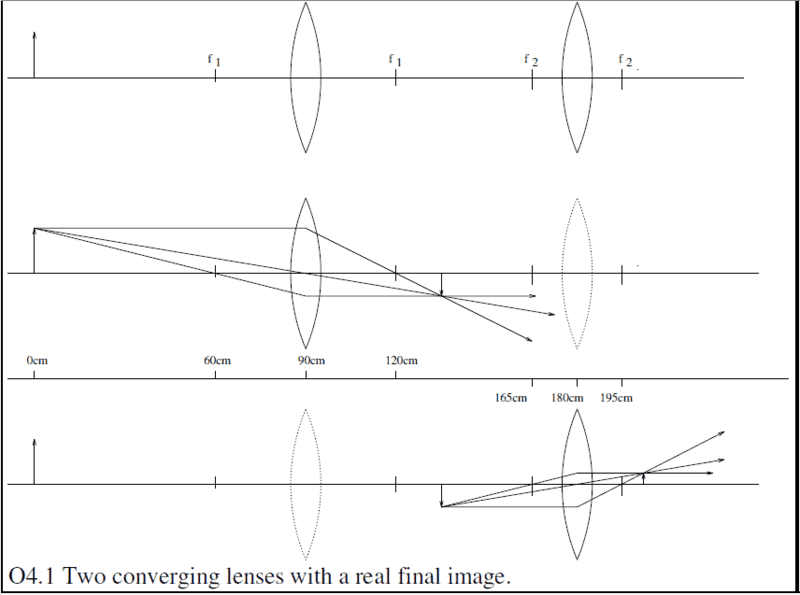
The discussion centers on the behavior of two thin lenses with focal lengths f1 and f2 separated by a distance h. The formula for the equivalent focal length is given by 1/f = 1/f1 + 1/f2 + h/(f1 f2). It is established that if f1 + f2 < h, the equivalent lens should theoretically be divergent. However, a counterexample is presented where the image remains real despite this condition, suggesting that the actual condition for divergence may be f1 + f2 > h. This is supported by a reference to a diagram in a lab manual illustrating the scenario.

PREREQUISITES
  • Understanding of thin lens equations and focal lengths
  • Knowledge of ray diagrams and image formation
  • Familiarity with optical principles regarding convergent and divergent lenses
  • Basic grasp of the relationship between lens separation and image characteristics
NEXT STEPS
  • Study the derivation of the thin lens formula in detail
  • Examine the implications of lens combinations on image formation
  • Learn about virtual and real images in optical systems
  • Review the referenced lab manual for practical examples of lens combinations
USEFUL FOR

Optics students, physics educators, and professionals in optical engineering who are exploring the principles of lens combinations and their effects on image formation.

crick
Messages
39
Reaction score
4
The focal of the lens equivalent of two thin lens at distance h is
$$1/f=1/f_1+1/f_2+h/(f_1 f_2)$$

Therefore, supposing that ##f_1>0## and ##f_2>0## (both lenses are convergent), if ##f_1+f_2 <h## then the equivalent lens should be divergent.

Nevertheless consider the example in picture
11.png


The two lenses have focals such that ##f_1+f_2 <h## but the image is real, i.e. the equivalent lens cannot be divergent. I understood the ray diagram, but how can this hold true?
 
Science news on Phys.org
crick said:
Therefore, supposing that f1>0f1>0f_1>0 and f2>0f2>0f_2>0 (both lenses are convergent), if f1+f2<hf1+f2<hf_1+f_2
Can you quote the source for this claim?
 
Check out Fig. 5.30 here: http://engineering.tufts.edu/bme/people/georgakoudi/EN31Lab4ThinLensCombinations.pdf

It shows two thin lenses separated by a distance greater than the sum of their focal lengths and a real, erect image.
 
Maybe the condition for the equivalent lens to be diverging is ##f_1+f_2 >h## . In that case, f1 is to the right of f2 in your diagram. A real image formed by the first lens will be within a focal length of the second lens and the result will be a virtual image.
 

Similar threads

  • · Replies 5 ·
Replies
5
Views
2K
  • · Replies 8 ·
Replies
8
Views
3K
  • · Replies 17 ·
Replies
17
Views
3K
Replies
1
Views
2K
  • · Replies 2 ·
Replies
2
Views
2K
Replies
1
Views
2K
  • · Replies 8 ·
Replies
8
Views
3K
  • · Replies 2 ·
Replies
2
Views
4K
  • · Replies 1 ·
Replies
1
Views
3K
  • · Replies 11 ·
Replies
11
Views
3K