schniefen
- 177
- 4
- Homework Statement
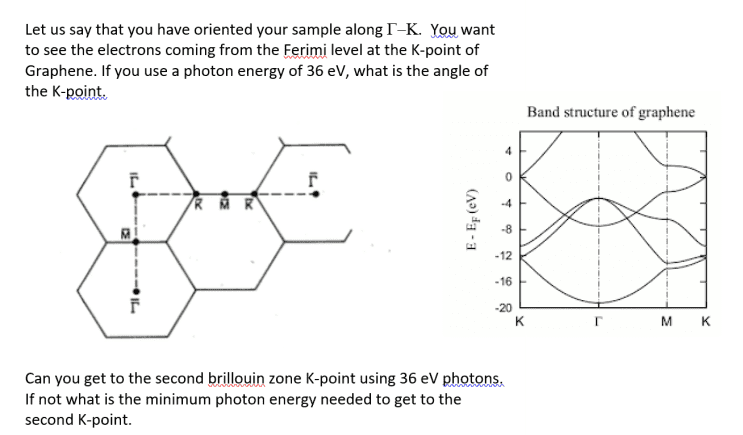
- See the attached image.
- Relevant Equations
- The theory section on ARPES on Wikipedia: https://en.wikipedia.org/wiki/Angle-resolved_photoemission_spectroscopy#Theory
Consider the attached screenshot. The work function of graphene is assumed to be 4.5 eV.
1. Does the work function correspond to the binding energy ##E_B## as given on Wikipedia? What is ##E## in ##E−E_F## in the graph on the right?
2. "...the Fermi level at the K-point..."; is this the point ##E=E_F## above K in the graph on the right?
3. "...the second Brillouin zone K-point..."; which point is this in the two pictures?
1. Does the work function correspond to the binding energy ##E_B## as given on Wikipedia? What is ##E## in ##E−E_F## in the graph on the right?
2. "...the Fermi level at the K-point..."; is this the point ##E=E_F## above K in the graph on the right?
3. "...the second Brillouin zone K-point..."; which point is this in the two pictures?
Last edited: