Is there a conflict between CPT symmetry and the 2nd law of thermodynamics?

Click For Summary
SUMMARY

This discussion addresses the perceived conflict between CPT symmetry, a fundamental principle in quantum field theory (QFT), and the second law of thermodynamics, which states that entropy increases over time. Participants argue that the assumption of "stosszahlansatz" in Boltzmann's H-theorem introduces a mean-field approximation that obscures the underlying time symmetry of entropy growth. The conversation highlights that while macroscopic processes appear irreversible, they are fundamentally reversible at the microscopic level, as demonstrated by particle interactions such as muon decay. The discussion concludes that the low entropy state of the Big Bang may be a key factor in the observed entropy growth in the universe.

PREREQUISITES
  • Understanding of CPT symmetry in quantum field theory (QFT)
  • Familiarity with the second law of thermodynamics and entropy concepts
  • Knowledge of Boltzmann's H-theorem and the stosszahlansatz assumption
  • Basic principles of particle physics, including muon decay and Feynman diagrams
NEXT STEPS
  • Explore the implications of CPT symmetry in quantum field theory
  • Research the relationship between entropy and the Big Bang in cosmology
  • Study the details of Boltzmann's H-theorem and its assumptions
  • Investigate the statistical mechanics of irreversible processes in macroscopic systems
USEFUL FOR

Physicists, cosmologists, and students of theoretical physics interested in the interplay between fundamental symmetries and thermodynamic laws, as well as anyone exploring the nature of entropy in the universe.

Jarek 31
Messages
157
Reaction score
31
Naively there is a conflict between CPT symmetry being at heart of fundamental physics models like QFT, and 2nd law of thermodynamics: saying that entropy grows toward future.
Is there really a conflict here - so is physics symmetric or not? How to understand it?

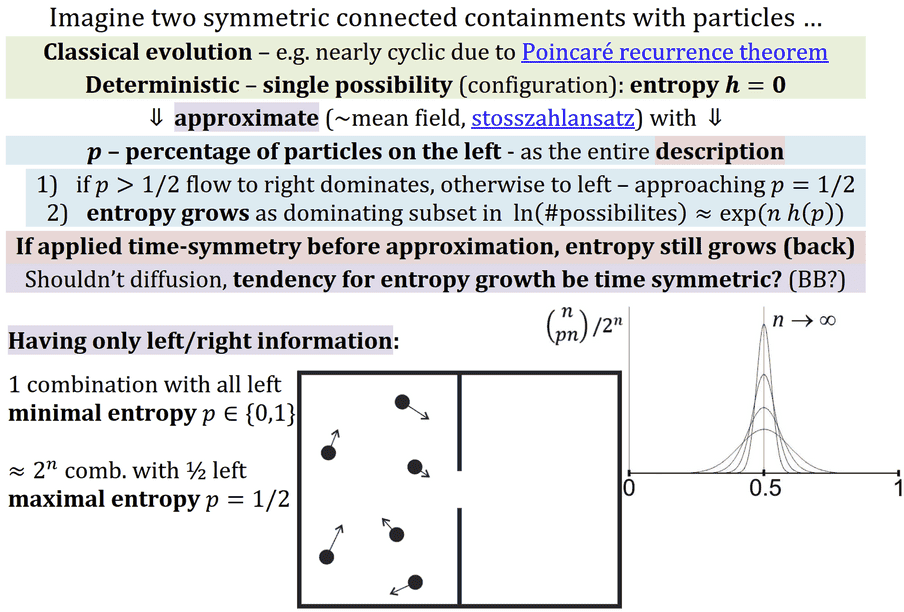
Personally I disagree with that there is conflict: to "prove" entropy growth e.g. in Boltzmann H-thoerem, we need to make this "stosszahlansatz" assumption, which corresponds to kind of mean-field approximation, allowing to prove entropy growth.
Without this approximation/smoothing, we have e.g. positions of particles with time/CPT symmetric behavior: if "proving" entropy growth, we could perform symmetry first and apply this proof - getting contradiction.

So this tendency for entropy growth seems in fact time symmetric: having low entropy situation (e.g. all particles are in left hand side of a containment), the entropy should grow if evolving toward both future and past.
Low entropy situation in the history of our Universe was our Big Bang - can BB be seen as the reason of entropy growth we are observing?

Yesterday PBS " The Arrow of Time and How to Reverse It":

1605785951750.png
 
Science news on Phys.org
This is still an open question.
Yes, CPT symmetry suggests that all fundamental processes are reversible. We have no experimental evidence to the contrary.
Yes, all evidence of macroscopic systems, i.e. large configurations of particles undergoing physical processes shows that they are irreversible processes.

The basic theories are based on symmetry (general relativity and QFT) so they don't have any built in entropy. General relativity is time symmetric, as is QFT.

In my view, we see macroscopic events as irreversible because of how much space there is. For example, if you watch a muon decay into an electron and two neutrinos, you will have one particle become 3. In the Feynman diagram, you can just as easily combine the two neutrinos and electron back into the muon. It is reversible. So, why doesn't it ever happen? Space is big compared to the fundamental processes, and the odds of the particles aligning just right to recombine back into the muon are very low. Get rid of the enormity of space, and things will happen reversibly just fine. Technically, what happens is when you calculate the cross section for the interaction of two neutrinos and an electron, it is just way too small to ever happen. However, the decay time for a muon is only a few microseconds, so it'll happen all day!
 

Similar threads

  • · Replies 22 ·
Replies
22
Views
2K
  • · Replies 5 ·
Replies
5
Views
2K
  • · Replies 8 ·
Replies
8
Views
2K
  • · Replies 152 ·
6
Replies
152
Views
11K
  • · Replies 5 ·
Replies
5
Views
698
  • · Replies 2 ·
Replies
2
Views
2K
  • · Replies 11 ·
Replies
11
Views
3K
  • · Replies 2 ·
Replies
2
Views
1K
  • · Replies 12 ·
Replies
12
Views
3K
  • · Replies 13 ·
Replies
13
Views
3K