Is this a correct proof of a function's continuity?

Join the discussion
Ask a follow-up here, or get your own question answered by working scientists, mathematicians and engineers — people, not an autocomplete.
Real named experts · corrections over time · the nuance an AI answer skips
8 replies · 2K views
0x95
Messages
4
Reaction score
0
Hello,
1. Homework Statement

1) Let f(x) continuous for all x and (f(x)2)=1 for all x. Prove that f(x)=1 for all x or f(x)=-1 for all x.
2) Give an example of a function f(x) s.t. (f(x)2)=1 for all x and it has both positive and negative values. Does it contradict (1) ?

2. The attempt at a solution
1) f(x)2 = 1 → f(x)=±1 → f(x) = 1 ∨ f(x) = -1 (since f(x) can't be both)
2) There's no such function.
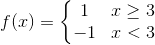
A step function s.t.
atrix%7D%201%20%26%20x%20%5Cgeq%203%5C%5C%20-1%20%26%20x%20%3C%203%20%5Cend%7Bmatrix%7D%5Cright..gif

I consider incorrect since in this case f(x) =1 or f(x)=-1 not for all x but f(x)=1 for some domain and f(x)=-1 for another domain.

Is this a correct solution ?

Thank you
 
Physics news on Phys.org
No, you have to show that ##f## is always equal to 1, or always equal to -1.
 
That's what I've shown in (1), that f(x)=1 for all x or f(x)=-1 for all x
 
No, you only show that for any ##x##, ##f(x) \in \{-1,1\}##, which is not the same thingEDIT: Why is it impossible to have ##x_a,x_b\in\mathbb{R}## such that ##f(x_a) = 1## and ##f(x_b) = -1## ?
 
Last edited:
ok, I see. a function can be a two-point function.
and for (1) would it be correct to say that:
lim f(g(x))=f(lim g(x) ):
lim (g(x)) ^ 2 = (lim g(x) ) ^ 2 = 1 -> lim g(x) = 1 or lim g(x) = -1
 
Why do you talk about limits? You are not looking for a local property, but a global one, aren't you ?

EDIT: Following the hint given in post #4, what kind of set would be ##f([x_a,x_b])## and why would it be absurd given that ##1,-1 \in f([x_a,x_b])## ?
 
Would you elaborate more on your last post, I didn't quite get you.
Thanks
 
The nature of ##f([x_a,x_b])## is given by the intermediate value theorem.
 
0x95 said:
Hello,
1. Homework Statement

1) Let f(x) continuous for all x and (f(x)2)=1 for all x. Prove that f(x)=1 for all x or f(x)=-1 for all x.
2) Give an example of a function f(x) s.t. (f(x)2)=1 for all x and it has both positive and negative values. Does it contradict (1) ?

2. The attempt at a solution
1) f(x)2 = 1 → f(x)=±1 → f(x) = 1 ∨ f(x) = -1 (since f(x) can't be both)
2) There's no such function.

You contradict yourself:

A step function s.t.
atrix%7D%201%20%26%20x%20%5Cgeq%203%5C%5C%20-1%20%26%20x%20%3C%203%20%5Cend%7Bmatrix%7D%5Cright..gif

This is a function such that [itex]f(x)^2 = 1[/itex] for all [itex]x[/itex] and takes both positive and negative values. Another example is [tex] f(x) = \begin{cases} 1 & x \in \mathbb{Q}, \\<br /> -1 & x \notin \mathbb{Q}.\end{cases}[/tex] Indeed the number of such functions is equal to twice the number of ways of partitioning the reals into two disjoint non-empty subsets.

But do any of these functions contradict the assertion that a continuous function [itex]f[/itex] satisfying [itex]f(x)^2 = 1[/itex] for all [itex]x[/itex] must be constant?