Discussion Overview
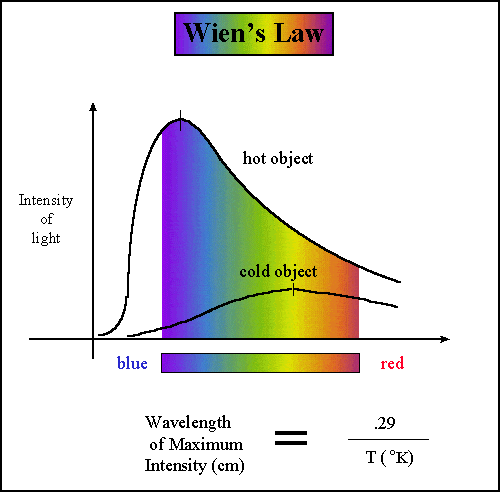
The discussion centers on Wien's Law and its applicability to various materials and conditions, particularly in relation to thermal radiation and the behavior of materials at temperatures above absolute zero.
Discussion Character
- Debate/contested
- Conceptual clarification
Main Points Raised
- One participant questions whether Wien's Law applies universally to all elements, products, and conditions, specifically above absolute zero.
- Another participant inquires if there are any exclusions in nature regarding Wien's displacement law, particularly if any materials do not radiate waves at temperatures above absolute zero.
- A later reply asserts that no such material exists that does not radiate at temperatures above absolute zero, but notes that some materials may not have a peak frequency proportional to temperature, suggesting a distinction in behavior.
- Further, a participant mentions that colored materials that are heat-resistant could exhibit deviations from a blackbody spectrum, indicating that nearly no object is a perfect blackbody.
Areas of Agreement / Disagreement
Participants express differing views on the universality of Wien's Law, with some asserting that all materials radiate above absolute zero while others explore the nuances of materials that deviate from ideal blackbody behavior. The discussion remains unresolved regarding the specific conditions and exceptions related to Wien's Law.
Contextual Notes
There are unresolved questions about the definitions of materials and the conditions under which Wien's Law may or may not apply, as well as the implications of deviations from blackbody radiation.