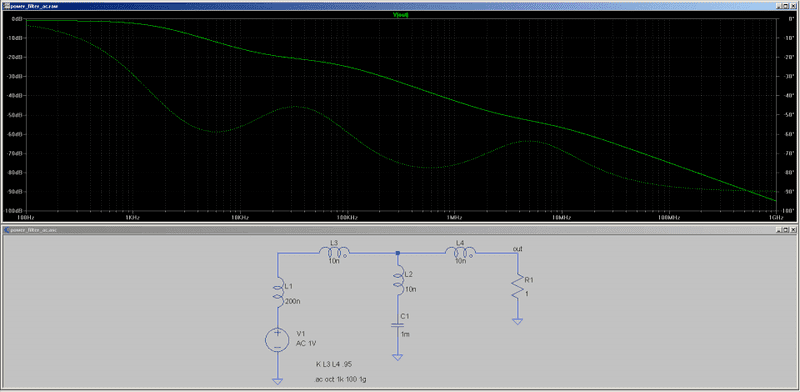
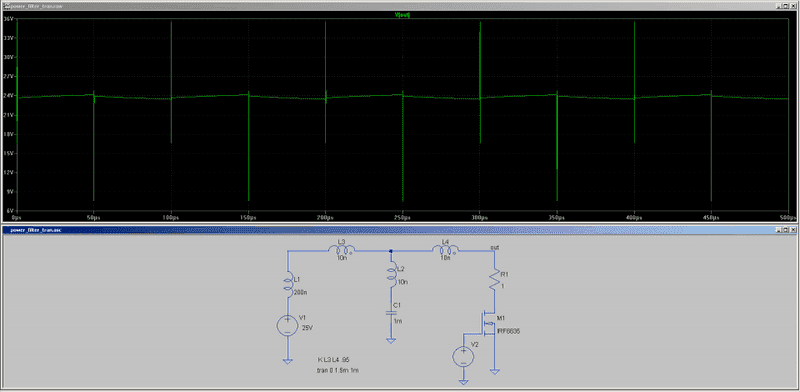
I tell you, I do a lot of circuit design as a hobby and it really does feel like you have to beat things into submission sometimes, haha. Yea it's pretty cool. I never looked into a filter like that before, but in building a 50V BLDC controller capable of 50 Amps plus I figured there had to be a way to cancel out the pesky parasitic inductance that serves hell with switching high currents.
Spent a lot of time looking and that was the best I found. If noise is on the supply side that filter does an amazing job killing off those inductive effects. Just too bad I could not find or think of a way to get it to cover heavy load switching from the output side. Believe me I tried all kinds of iterations via simulation inserting coupled inductors here or there and could not find a way to do it. Actually I did find a way, but it's necessary to couple the parasitic inductance of the capacitor with the inductor on the output side of the T. Works great in simulation, actually cancels inductance on all three legs, but it's not something you could physically do. There's no way to couple inductance that's originating from inside the capacitor.
Anyway what I have in mind now will do the job and it's actually better that I don't have to use those bulky electrolytics with all their failings. Though the DC bias of MLCCs is a real pain. You have to go with a good number of larger size smaller value caps to cover it. Won't someone please invent the perfect capacitor already? It would be worth a million, no a trillion.