Kinetics with Pressure: Explanation & Derivation

  • Thread starter Thread starter sidt36
  • Start date Start date
  • Tags Tags
    Kinetics Pressure
Click For Summary
SUMMARY

The discussion centers on the derivation of pressure kinetics in the context of first-order reactions, specifically under isothermal conditions. Participants clarify that for a reaction where one molecule of A produces one molecule of B, there is no change in pressure over time. The formula referenced relates to the pressure at the start (P0) and its behavior as time approaches infinity (t = ∞). The conversation emphasizes the simplicity of the kinetics involved, dismissing the need for complex derivations.

PREREQUISITES
  • Understanding of first-order reaction kinetics
  • Familiarity with isothermal reaction conditions
  • Basic knowledge of chemical reaction equations
  • Concept of pressure changes in chemical reactions
NEXT STEPS
  • Research the derivation of first-order reaction kinetics
  • Study isothermal reaction principles in physical chemistry
  • Explore the relationship between pressure and concentration in reactions
  • Learn about the implications of reaction stoichiometry on pressure changes
USEFUL FOR

Chemistry students, physical chemists, and professionals involved in reaction kinetics and thermodynamics will benefit from this discussion.
sidt36
Messages
36
Reaction score
3
This post is not about a homework problem but about a derivation
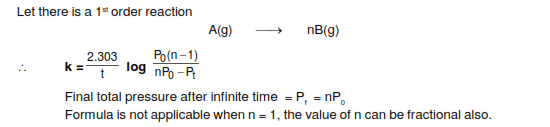
When i was flipping through a physical chemistry book I found a formula which looked like
Capture4.PNG

How ever I am clueless to what it is

Can anyone explain what it is for
And possibly Derive it

Thank you
 
Physics news on Phys.org
Flipping, eh ?
Google first order reaction rate
 
This must be for an isothermal reaction.

In which case, when n = 1, if the pressure is P0 at the start what is it at t = ∞ ?

The pressure kinetics is exceptionally easy, not to say degenerate. :oldlaugh:
 
I don't know why I am that dumb but i haven't been able to derive it at all
 
Maybe you are looking for something too clever or complicated.

If all the chemical reaction is one molecule of A producing one of B, then there is just no change of pressure.
 

Similar threads

  • · Replies 14 ·
Replies
14
Views
2K
Replies
4
Views
1K
  • · Replies 9 ·
Replies
9
Views
2K
  • · Replies 35 ·
2
Replies
35
Views
5K
  • · Replies 9 ·
Replies
9
Views
2K
  • · Replies 69 ·
3
Replies
69
Views
5K
Replies
5
Views
931
  • · Replies 2 ·
Replies
2
Views
3K
Replies
4
Views
2K
  • · Replies 10 ·
Replies
10
Views
3K