Kinetics with Pressure: Explanation & Derivation

  • Thread starter Thread starter sidt36
  • Start date Start date
  • Tags Tags
    Kinetics Pressure
Click For Summary

Discussion Overview

The discussion revolves around the derivation and explanation of a formula related to kinetics and pressure in the context of physical chemistry. Participants explore the implications of pressure changes during chemical reactions, particularly focusing on isothermal reactions.

Discussion Character

  • Exploratory, Technical explanation, Debate/contested

Main Points Raised

  • One participant seeks clarification on a formula encountered in a physical chemistry book and requests a derivation.
  • Another participant suggests looking up first-order reaction rates as a potential starting point for understanding the formula.
  • A participant proposes that the discussion may pertain to isothermal reactions and questions the pressure at infinite time for a specific case where n = 1.
  • One participant expresses frustration over their inability to derive the formula, questioning their understanding.
  • Another participant suggests that the issue may stem from overcomplicating the problem, noting that in a simple reaction where one molecule of A produces one of B, there would be no change in pressure.

Areas of Agreement / Disagreement

Participants do not reach a consensus on the derivation or the implications of the formula. Multiple viewpoints are presented regarding the nature of the reaction and the associated pressure changes.

Contextual Notes

There are limitations in the discussion regarding assumptions about the reaction conditions, such as whether the reaction is indeed isothermal and the specific nature of the reactions being considered.

sidt36
Messages
36
Reaction score
3
This post is not about a homework problem but about a derivation
When i was flipping through a physical chemistry book I found a formula which looked like
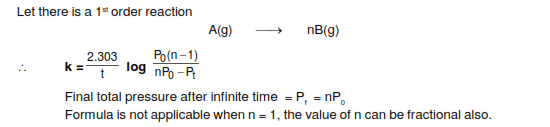
Capture4.PNG

How ever I am clueless to what it is

Can anyone explain what it is for
And possibly Derive it

Thank you
 
Physics news on Phys.org
Flipping, eh ?
Google first order reaction rate
 
This must be for an isothermal reaction.

In which case, when n = 1, if the pressure is P0 at the start what is it at t = ∞ ?

The pressure kinetics is exceptionally easy, not to say degenerate. :oldlaugh:
 
I don't know why I am that dumb but i haven't been able to derive it at all
 
Maybe you are looking for something too clever or complicated.

If all the chemical reaction is one molecule of A producing one of B, then there is just no change of pressure.
 

Similar threads

  • · Replies 14 ·
Replies
14
Views
2K
Replies
4
Views
1K
  • · Replies 9 ·
Replies
9
Views
2K
  • · Replies 35 ·
2
Replies
35
Views
5K
  • · Replies 9 ·
Replies
9
Views
2K
  • · Replies 69 ·
3
Replies
69
Views
5K
Replies
5
Views
968
  • · Replies 2 ·
Replies
2
Views
3K
Replies
4
Views
2K
  • · Replies 10 ·
Replies
10
Views
3K