Lagrange equations: Two blocks and a string

Join the discussion
Ask a follow-up here, or get your own question answered by working scientists, mathematicians and engineers — people, not an autocomplete.
Real named experts · corrections over time · the nuance an AI answer skips
9 replies · 3K views
Zamarripa
Messages
11
Reaction score
0
Homework Statement
Two blocks, each of mass M, are connected by an extensionless, uniform string of length l. One block is placed on a smooth horizontal surface, and the other block hangs over the side, the string passing over a frictionless pulley. Describe the motion of the system in two cases, first when the mass of the string is negligible, and second when the string has a mass m.
Relevant Equations
$$T_{string}=\frac{1}{2}m\dot{y} $$
I've problems understanding why the kinetic energy of the string is only
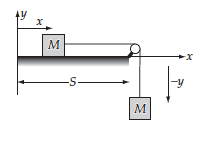
Captura de Pantalla 2020-05-29 a la(s) 14.37.32.png

$$T_{string}=\frac{1}{2}m\dot{y} $$

Why the contribution of the string in the horizontal line isn't considered?
 
Physics news on Phys.org
PeroK said:
What's the formula for KE?
$$T=\frac{1}{2}mv^2$$
 
Yes, but what about the contribution on the horizontal?
 
PeroK said:
What contribution from the horizontal?

The problem is that you have ##\frac 1 2 m \dot y## instead of ##\frac 1 2 m \dot y^2##.
The string at the horizontal is also moving
 
PeroK said:
So, what do you think the KE of the string should be?
$$\frac{1}{2}m\frac{(s-x)}{l}\dot{x}$$

where ##m\frac{(s-x)}{l}## is the mass of the string in the horizontal
 
Zamarripa said:
$$\frac{1}{2}m\frac{(s-x)}{l}\dot{x}$$

where ##m\frac{(s-x)}{l}## is the mass of the string in the horizontal

1) The whole string is moving, so you need the whole mass of the string: ##m##.

2) ##\dot x = \dot y##, as the string is inextensible.

3) You need to use ##v^2 = \dot x^2 = \dot y^2## for KE. You can't use ##\dot x## or ##\dot y##.
 
  • Like
Likes   Reactions: vanhees71