Mason Smith
- 21
- 2
- Homework Statement
- Consider a conical pendulum. This is a simple pendulum that, instead of swinging back and forth through an equilibrium point, traces out a right circular cone.
- Relevant Equations
- The Lagrangian is defined as the difference of the kinetic energy T and the potential energy U.
Lagrange's equations say that the partial derivative of the Lagrangian with respect to some generalized coordinate is equal to the time derivative of the partial derivative of the Lagrangian with respect to the time derivative of some generalized coordinate.
Here is a picture of the problem.
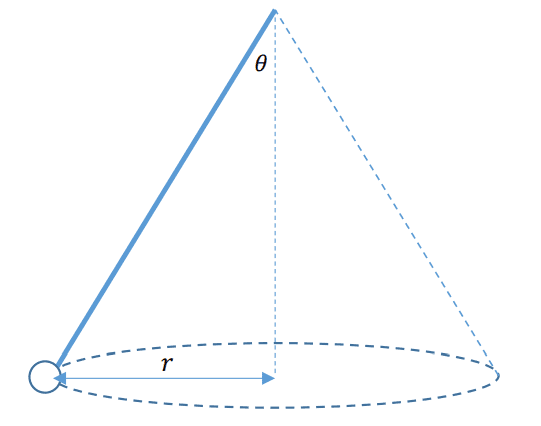
I have chosen the origin to lie in the middle of the circle around which the mass moves. I have also chosen the z axis to pass through the origin and through the vertex of the right circular cone. The x-axis and y-axis are so that one when curls his or her fingers from the x-axis to the y axis, the thumb of the right hand will point in the direction of the z axis. Since the mass lies in the xy plane, I have defined the potential energy U to be zero. This leads to
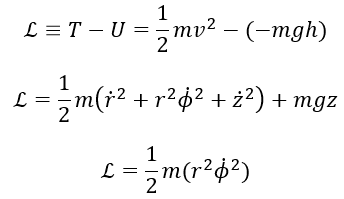 .
.
Applying Lagrange's equations,
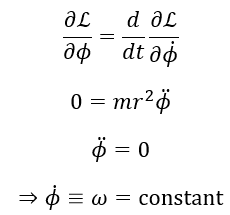
where ω is the angular velocity.
While this result is convenient, it leads me to question its correctness. If I have made a mistake anywhere, then can anyone please point me in the correct direction for analyzing the motion of the mass? Thanks in advance! :)
I have chosen the origin to lie in the middle of the circle around which the mass moves. I have also chosen the z axis to pass through the origin and through the vertex of the right circular cone. The x-axis and y-axis are so that one when curls his or her fingers from the x-axis to the y axis, the thumb of the right hand will point in the direction of the z axis. Since the mass lies in the xy plane, I have defined the potential energy U to be zero. This leads to
Applying Lagrange's equations,
where ω is the angular velocity.
While this result is convenient, it leads me to question its correctness. If I have made a mistake anywhere, then can anyone please point me in the correct direction for analyzing the motion of the mass? Thanks in advance! :)
