member 731016
- Homework Statement
- Please see below
- Relevant Equations
- ##\frac{2s + 1}{((s - 1)(s - 1)} = \frac{A(s - 1) + B(s - 1)}{(s - 1)(s - 1)}##
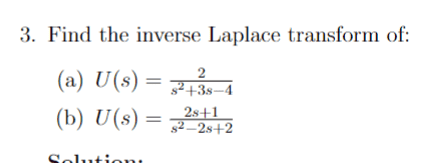
For this problem (b),
The solution is,
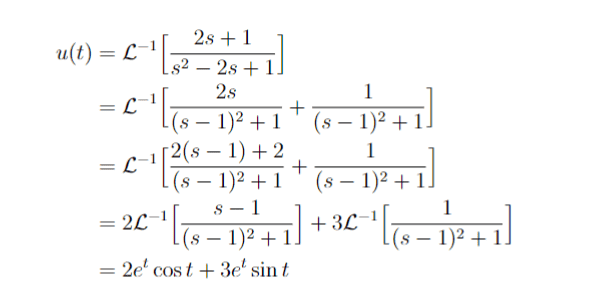
However, I don't understand how they got their partial fractions here (Going from step 1 to 2).
My attempt to convert into partial fractions is:
##\frac{2s + 1}{(s - 1)(s - 1)} = \frac{A(s - 1) + B(s - 1)}{(s - 1)(s - 1)}##
Thus,
##2s + 1 = A(s - 1) + B(s - 1)##
##2s + 1 = (A + B)s - A - B##
##2 = A + B##
##1 = - A - B##
##-1 = A + B##
However, ##2 ≠ -1##
Does someone please know how they got their partial fractions expression in step 2?
Thanks!
The solution is,
However, I don't understand how they got their partial fractions here (Going from step 1 to 2).
My attempt to convert into partial fractions is:
##\frac{2s + 1}{(s - 1)(s - 1)} = \frac{A(s - 1) + B(s - 1)}{(s - 1)(s - 1)}##
Thus,
##2s + 1 = A(s - 1) + B(s - 1)##
##2s + 1 = (A + B)s - A - B##
##2 = A + B##
##1 = - A - B##
##-1 = A + B##
However, ##2 ≠ -1##
Does someone please know how they got their partial fractions expression in step 2?
Thanks!