Laplace Transforms Homework: Initial Displacements & Velocities

Click For Summary
The discussion revolves around solving a system of differential equations using Laplace transforms and initial conditions. The user attempts to find initial displacements and velocities but encounters discrepancies in their results, particularly when differentiating the equations. They are advised to ensure the correct application of Laplace transforms and to verify their algebraic manipulations, especially regarding the inversion of terms. Additionally, guidance is provided on how to approach the problem using matrices and eigenvalues, emphasizing the importance of correctly setting up the system of equations. The conversation highlights the significance of accuracy in both the Laplace transform process and subsequent algebraic steps.
  • #31
jake96 said:

Homework Statement


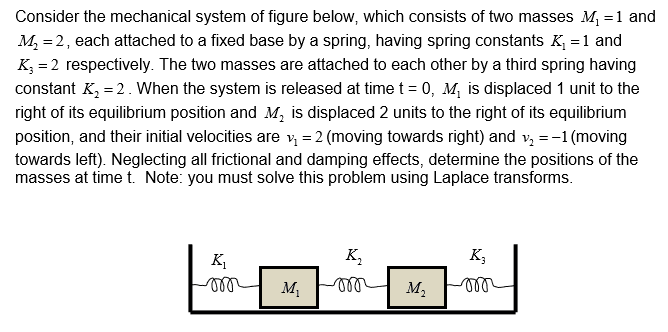
tFewRWs.png


Homework Equations


Laplace Transforms

The Attempt at a Solution


Using basic physics knowledge I got
m1a1=-k1x1+k2(x2-x1)
and
m2a2=-k3x2-k2(x2-x1)

Sub in values and use laplace transforms and rearrange partial fraction and I found that

By doing this I am assuming that the xII and xIII will equal 0 when t=0 because this is not stated at all in the question. do you believe this is correct?x1=-(1/3)cos2t-(2/3)sin2t+(4/3)cost+(8/3)sint
x2=-(2/3)cos2t+(1/3)sin2t+(8/3)cost-(4/3)sint

Finding the initial displacements by subbing in t=0 for both x_1 and x_2 comes out with what is written in the question 1 and 2, respectively.

However, when I try to sub t=0 into the differentials of the 2 above equations. I believe I should receive the initial velocities stated in the question. however I do not receive these results.

I receive 4/3 for x1 and -2/3 for x2
the difference between these values and the actual values appears to differ once I differentiate the sin2t and it is multiplied by 2

Does anyone know if I should receive the values listed in the question using this methods and have just made a calculation error in my working earlier on, or should I have done something differently.

Also, the next part of the questions asks to use a matrix and eigenvalues/eigenvectors to solve it. any pointers to help me get started

Thanks very much

I'll just give you a hint for the next part. Let ##y_1 = x_1##, ##y_2 = dx_1/dt## (velocity of 1), ##y_3 =x_2## and ##y_4 = dx_2/dt ## (velocity of 2). Your DE system can be written as
\begin{array}{rcl}dy_1 /dt &amp;=&amp; y_2 \\<br /> dy_2/dt &amp;=&amp; -3 y_1 + 2 y_3 \\<br /> dy_3/dt &amp;=&amp; y_4\\<br /> dy_4/dt &amp;=&amp; y_1 - 2 y_3\end{array}<br />
This can be written as
\frac{d}{dt} \pmatrix{y_1\\y_2\\y_3\\y_4}=<br /> \pmatrix{0&amp;1&amp;0&amp;0\\-3&amp;0&amp;2&amp;0\\0&amp;0&amp;0&amp;1\\1 &amp;0 -2&amp;0} \pmatrix{y_1\\y_2\\y_3\\y_4}
This is of the form ##dY/dt = A Y##, where ##Y## is the column vector of ##y_i##s and ##A## is the ##4 \times 4## matrix above. The solution is of the form
Y(t) = \exp(A t) Y(0)
You can compute the matrix exponential from the eigenvalues and eigenvectors (at least, if none of the eigenvalues are repeated). Google 'matrix exponential'.
 
Physics news on Phys.org
  • #32
Ray Vickson said:
I'll just give you a hint for the next part. Let ##y_1 = x_1##, ##y_2 = dx_1/dt## (velocity of 1), ##y_3 =x_2## and ##y_4 = dx_2/dt ## (velocity of 2). Your DE system can be written as
\begin{array}{rcl}dy_1 /dt &amp;=&amp; y_2 \\<br /> dy_2/dt &amp;=&amp; -3 y_1 + 2 y_3 \\<br /> dy_3/dt &amp;=&amp; y_4\\<br /> dy_4/dt &amp;=&amp; y_1 - 2 y_3\end{array}<br />
This can be written as
\frac{d}{dt} \pmatrix{y_1\\y_2\\y_3\\y_4}=<br /> \pmatrix{0&amp;1&amp;0&amp;0\\-3&amp;0&amp;2&amp;0\\0&amp;0&amp;0&amp;1\\1 &amp;0 -2&amp;0} \pmatrix{y_1\\y_2\\y_3\\y_4}
This is of the form ##dY/dt = A Y##, where ##Y## is the column vector of ##y_i##s and ##A## is the ##4 \times 4## matrix above. The solution is of the form
Y(t) = \exp(A t) Y(0)
You can compute the matrix exponential from the eigenvalues and eigenvectors (at least, if none of the eigenvalues are repeated). Google 'matrix exponential'.
thanks
 
  • #33
Ray Vickson said:
I'll just give you a hint for the next part. Let ##y_1 = x_1##, ##y_2 = dx_1/dt## (velocity of 1), ##y_3 =x_2## and ##y_4 = dx_2/dt ## (velocity of 2). Your DE system can be written as
\begin{array}{rcl}dy_1 /dt &amp;=&amp; y_2 \\<br /> dy_2/dt &amp;=&amp; -3 y_1 + 2 y_3 \\<br /> dy_3/dt &amp;=&amp; y_4\\<br /> dy_4/dt &amp;=&amp; y_1 - 2 y_3\end{array}<br />
This can be written as
\frac{d}{dt} \pmatrix{y_1\\y_2\\y_3\\y_4}=<br /> \pmatrix{0&amp;1&amp;0&amp;0\\-3&amp;0&amp;2&amp;0\\0&amp;0&amp;0&amp;1\\1 &amp;0 -2&amp;0} \pmatrix{y_1\\y_2\\y_3\\y_4}
This is of the form ##dY/dt = A Y##, where ##Y## is the column vector of ##y_i##s and ##A## is the ##4 \times 4## matrix above. The solution is of the form
Y(t) = \exp(A t) Y(0)
You can compute the matrix exponential from the eigenvalues and eigenvectors (at least, if none of the eigenvalues are repeated). Google 'matrix exponential'.
so I got the Eigen values as i, -i, 2i, -2i

for i, i found an Eigen value of
-i
1
-i
1
Does this seem correct?
Now if i find the eigenvectors for the other eigenvalues. i can use this in the exponential equation and eventually reach values of x1 and x2 which should be the same answers from the previous part of the question?
 
  • #34
I am also having trouble finding good sites online that delve into complex eigenvalues and eigenvectors for any matrix above 2x2. My textbook does touch on this and i was just wondering if anyone knew of anywhere good that i can find some examples to refer to.
 
  • #35
jake96 said:
so I got the eigenvalues as i, -i, 2i, -2i

for i, i found an eigenvector of
-i
1
-i
1
Does this seem correct?
It's easy enough to check yourself. Multiply it into the matrix and see if you get ##i## times the vector back.
Now if i find the eigenvectors for the other eigenvalues. i can use this in the exponential equation and eventually reach values of x1 and x2 which should be the same answers from the previous part of the question?
Yes.
 
  • #36
So now that I have my eigenvalues and eigenvectors. I believe I now use them for the exponential matrix and that should give me my sin and cos equations of x1 and x2 from earlier in the question. However I am unsure how I am able to reach this point as I have not fully learned this yet and am unable to find suitable sources. Does anyone know of a decent source?
 
  • #37
Are you familiar with ##e^{iθ}=cosθ+isinθ##? If the eigenvalues and eigenvectors were real, would you know how to proceed next?

Chet
 
  • #38
ive only ever used it for 2x2 matrix's, I assume this way I would receive 4 equations with 4 unknowns? I'm still a little unsure as to how those unknowns are calculated, will the 4 equations be equal to the 4 y equations that Ray Vickson listed?
 
  • #39
also I just want to double check, if I had the eigenvalue of 'i' and the corresponding eigenvector (-i,1,-i,1)
the first term of the first y equation would be -i(acost+ibsint)
with a and b as unknowns
and so on with each value and vector
 
Last edited:
  • #40
Chestermiller said:
Are you familiar with ##e^{iθ}=cosθ+isinθ##? If the eigenvalues and eigenvectors were real, would you know how to proceed next?

Chet
OK, so I believe I have gotten my four y equation out with 4 unknowns c1, c2, c3 and c4. What will these 4 equations equal so that I am able to determine the value of each 'c'
 
  • #41
jake96 said:
So now that I have my eigenvalues and eigenvectors. I believe I now use them for the exponential matrix and that should give me my sin and cos equations of x1 and x2 from earlier in the question. However I am unsure how I am able to reach this point as I have not fully learned this yet and am unable to find suitable sources. Does anyone know of a decent source?

Check out the concept of "matrix function". Basically, if ##f(x) = c_0 + c_1 x + c_2 x^2 + \cdots## is an analytic function of ##x##, we can define ##f(A) = c_0 I + c_1 A + c_2 A^2 + \cdots## for an ##n \times n## matrix ##A##. Here, ##I = n \times n## unit matrix. It is a fact that for a matrix with ##n## distinct eigenvalues ##\lambda_1, \lambda_2, \ldots, \lambda_n## we can find ##n## matrices ##E_1, E_2, \ldots, E_n## such that
f(A) = E_1 f(\lambda_1) + E_2 f(\lambda_2) + \cdots + E_n f(\lambda_n)
The crucial point is that the matrices ##E_1, E_2, \ldots, E_n## are independent of the function ##f##. That means we can find them by applying this formula successively to the functions ##f_0(x) = 1 = x^0, f_1(x) = x, f_2(x) = x^2, \ldots, f_{n-1}(x) = x^{n-1}## using the known (or computable) matrices ##I = A^0, A, A^2, \ldots, A^{n-1}##.

If you have repeated eigenvalues the formula becomes a bit more complicated.

See, eg., http://www.siam.org/books/ot104/OT104HighamChapter1.pdf or
Gantmacher, "Theory of Matrices, Vol. I", Chapter 5; now available free as http://www.maths.ed.ac.uk/~aar/papers/gantmacher1.pdf .
 
  • #42
thanks for your help everyone, I've managed to get the correct answer using a 2x2 matrix made from the original equations
 

Similar threads

Replies
9
Views
2K
Replies
2
Views
2K
  • · Replies 8 ·
Replies
8
Views
2K
  • · Replies 1 ·
Replies
1
Views
1K
  • · Replies 2 ·
Replies
2
Views
3K
  • · Replies 2 ·
Replies
2
Views
2K
  • · Replies 9 ·
Replies
9
Views
3K
  • · Replies 4 ·
Replies
4
Views
3K
Replies
4
Views
2K
  • · Replies 2 ·
Replies
2
Views
2K