Learning PDEs from Scratch in 24 Hours

  • Thread starter Thread starter imsleepy
  • Start date Start date
  • Tags Tags
    Pdes scratch
Join the discussion
Ask a follow-up here, or get your own question answered by working scientists, mathematicians and engineers — people, not an autocomplete.
Real named experts · corrections over time · the nuance an AI answer skips
34 replies · 5K views
ehh my head's not working, i should go to bed soon.
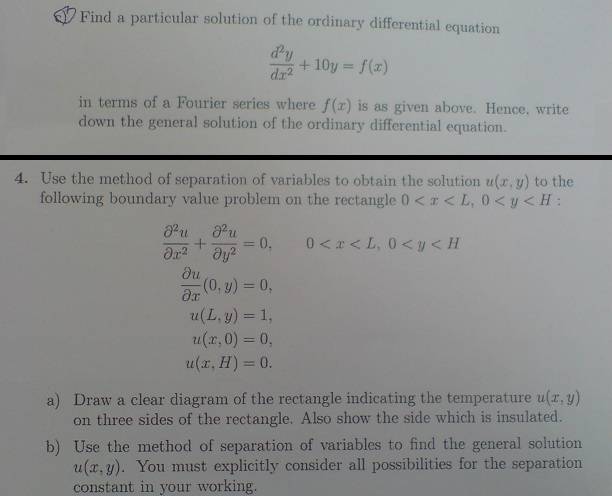
mVXNF.jpg


question 4. no clue.
H and L are just arbitrary points on the y and x-axis respectively, i presume..
what do each of those initial constraints mean, please?
and how do i know what is insulated?
 
Physics news on Phys.org
ok found some stuff in my notes.
i think the du/dx (0,y) = 0 line tells you that something is insulated.

i've done some question in my book (obviously lecturer has done it and i was merely copying it, lol), and i have written down:

uxx + uyy = 0
u(0,y) = 0
u(a,y) = 0
u(x,0) = x (maintain temp-profile 'x')
du/dy (x,0) = 0 -> temp gradient perpendicular to side on bottom is zero, ie. no heat can flow across side => INSULATED


i might've missed something because my graph has a 'b', and i see no b's written in the question, but main thing is that from this i can gather that with question 4, the du/dx (0,y) = 0 line tells me that something is insulated :)

now to find out what side is insulated...
 
du/dx (0,y) = 0
so, gradient at 0,y is equal to 0?
would this be just the y-axis (up to point H) that is insulated?
 
FMJYk.jpg


from there onwards, i simply cannot understand what worked solutions are doing >_<