Learning PDEs from Scratch in 24 Hours

  • Thread starter Thread starter imsleepy
  • Start date Start date
  • Tags Tags
    Pdes scratch
Click For Summary
SUMMARY

The discussion focuses on learning Partial Differential Equations (PDEs) from scratch, specifically using methods such as Fourier series and separation of variables. The user seeks guidance on solving boundary value problems, particularly how to apply boundary conditions like u(x,0) = 0 and du/dy(x,0) = 0, which indicate insulated boundaries. Key techniques discussed include finding complementary solutions to differential equations and constructing particular solutions using Fourier expansions.

PREREQUISITES
  • Understanding of Partial Differential Equations (PDEs)
  • Familiarity with Fourier series
  • Knowledge of boundary value problems
  • Basic skills in solving ordinary differential equations (ODEs)
NEXT STEPS
  • Study the method of separation of variables in PDEs
  • Learn how to apply Fourier series to solve boundary value problems
  • Explore the concept of insulated boundaries in heat transfer problems
  • Practice solving ordinary differential equations using complementary and particular solutions
USEFUL FOR

Students preparing for exams in mathematics or engineering, particularly those focusing on Partial Differential Equations and boundary value problems. This discussion is also beneficial for educators and tutors looking to enhance their understanding of teaching PDE concepts.

  • #31
ehh my head's not working, i should go to bed soon.
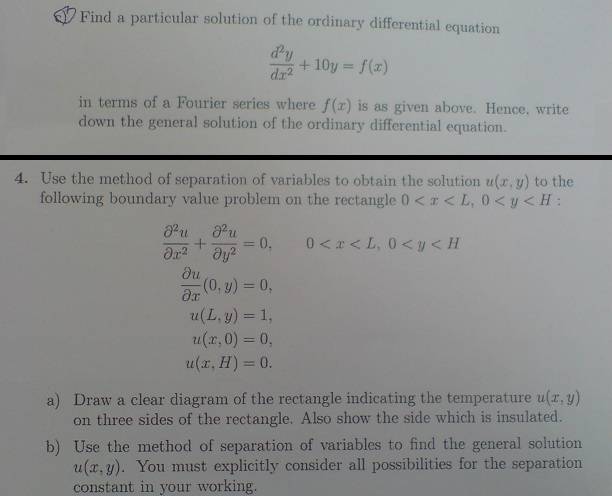
mVXNF.jpg


question 4. no clue.
H and L are just arbitrary points on the y and x-axis respectively, i presume..
what do each of those initial constraints mean, please?
and how do i know what is insulated?
 
Physics news on Phys.org
  • #32
ok found some stuff in my notes.
i think the du/dx (0,y) = 0 line tells you that something is insulated.

i've done some question in my book (obviously lecturer has done it and i was merely copying it, lol), and i have written down:

uxx + uyy = 0
u(0,y) = 0
u(a,y) = 0
u(x,0) = x (maintain temp-profile 'x')
du/dy (x,0) = 0 -> temp gradient perpendicular to side on bottom is zero, ie. no heat can flow across side => INSULATED


i might've missed something because my graph has a 'b', and i see no b's written in the question, but main thing is that from this i can gather that with question 4, the du/dx (0,y) = 0 line tells me that something is insulated :)

now to find out what side is insulated...
 
  • #33
du/dx (0,y) = 0
so, gradient at 0,y is equal to 0?
would this be just the y-axis (up to point H) that is insulated?
 
  • #34
FMJYk.jpg


from there onwards, i simply cannot understand what worked solutions are doing >_<
 
  • #35
in you question i think a=L, b=H as you have
0<x<L, 0<y<H

the insulated side is the one where the derivative is held at zero,
 

Similar threads

  • · Replies 5 ·
Replies
5
Views
2K
  • · Replies 16 ·
Replies
16
Views
4K
Replies
5
Views
2K
  • · Replies 27 ·
Replies
27
Views
4K
Replies
1
Views
1K
  • · Replies 3 ·
Replies
3
Views
2K
  • · Replies 2 ·
Replies
2
Views
2K
  • · Replies 6 ·
Replies
6
Views
3K
  • · Replies 7 ·
Replies
7
Views
3K
Replies
1
Views
2K