Length Contraction Euclidean Space

Click For Summary

Discussion Overview

The discussion revolves around the concept of length contraction in special relativity, particularly how it applies to a rod moving at a significant fraction of the speed of light. Participants explore the implications of Lorentz transformations on the coordinates of the rod's endpoints as observed from different inertial frames.

Discussion Character

  • Exploratory
  • Technical explanation
  • Conceptual clarification
  • Debate/contested
  • Mathematical reasoning

Main Points Raised

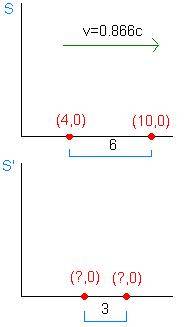
  • One participant describes a scenario where a rod in frame S has endpoints at (4,0) and (10,0), leading to a proper length of 6, which contracts to 3 in frame S' due to the Lorentz factor.
  • Another participant suggests that determining the coordinates of the rod in frame S' requires an arbitrary choice for one endpoint's coordinates, which can lead to different interpretations of the rod's length.
  • A follow-up question asks whether frame S' can assert that the rod endpoints exist in spacetime but that the measured length is 3 instead of 6.
  • Participants discuss the implications of measuring lengths in different frames and how simultaneity affects these measurements.
  • One participant introduces the idea of an infinite number of points two units apart in Euclidean space and relates this to the concept of relativistic measurements.
  • A later post questions the connection between special relativity and the twin prime conjecture, proposing that different frames might observe pairs of primes as twin primes due to length contraction.
  • Another participant expresses skepticism about the feasibility of linking length contraction to the existence of twin primes, emphasizing that changing frames does not alter the inherent properties of the numbers involved.

Areas of Agreement / Disagreement

Participants generally agree on the mechanics of length contraction and the need for careful consideration of simultaneity in different frames. However, there is no consensus on the proposed link between special relativity and the twin prime conjecture, with differing views on the validity of such a connection.

Contextual Notes

The discussion includes various assumptions about the nature of spacetime and the arbitrary choices made in defining coordinates. The implications of these choices on the interpretation of physical phenomena remain unresolved.

vengy
Messages
8
Reaction score
0
Hi,

Suppose a stationary frame S' is observing frame S moving with velocity v=0.866c in the x-direction, and let points (4,0),(10,0) define the ends of a rod in S, so its distance is 6, but as measured from S' contracts to 3 because of the Lorentz factor gamma.

I'm unable to determine what the rod coordinates (?,0),(?,0) are in frame S'.
Perhaps S' would say the rod endpoints (4,0),(10,0) do exist in S, but the distance is really 3?

length.JPG


Thanks for your time! ;)
 

Attachments

  • length.JPG
    length.JPG
    5.2 KB · Views: 447
Physics news on Phys.org
vengy said:
I'm unable to determine what the rod coordinates (?,0),(?,0) are in frame S'.

That's the right answer ;-)

From the information given, you are unable to determine the coordinates in S'. You'd have to decide what coordinates to give one event, such as the event of one end of the rod being at x=4 according to S. A simple choice would be to call this event x'=4, t'=0. Another would be to call this event x'=0, t'=0. But really it's up to you. Once you've made that arbitrary choice, you can determine the x' coordinate (space coordinate in S') of the other end of the rod at t'=0. In this case, you already know that it's 3 + whatever space coordinate in S' you decided to give to the event which S calls x=4, t=0. So if you called it x'=4, the other end would be at x'=7.
 
Good response - I actually understand it! :)

Followup question:

Can S' correctly assert that the rod endpoints 4,10 exist somewhere in spacetime,
but the rod length is 3 not 6?


Thanks.
 
Yes, that's one way of putting it: if the left end of the rod is at x'=4 at some value of t', then the right end will be at x'=10 at some other, different value of t'.
 
Assume coordinates (t,x,y,z), speed is 0.866c.

For S' the rod is (0,0,0,0) (0,3,0,0)
For S the rod is (0,0,0,0) (-5.19,6,0,0)
 
Does this mean there exists an infinite number of relativistic prime pair points whose separation is 2 based upon its frame velocity relative to a stationary observer?

Tried to express this using LaTeX:

http://bojx5g.blu.livefilestore.com/y1pKXAUTNPL3iezPwFkn1A_4uyslF-JutCDxELLNmEfp_TjFFBSNi4vKXzQtGFv1V8j7kDwtYImRqiKiUF4mTIGe7xqrPBy0UAc/untitled.bmp?psid=1

Gamma is the Lorentz factor.
Where did I go wrong this time? ;)

Thanks.
 
Last edited:
I'm a bit unclear about what you're asking. Could you rephrase the question?

There are infinitely many points two units apart from each other in a Euclidean space of any dimension greater than 0. Given one point, in such a Euclidean space: in 1 dimension, there are exactly 2 points that are 2 units away from it (one in each direction); in more than 1 dimension, infinitely many.

You can think of the space coordinates of each frame as a projection of 4d spacetime onto a Euclidean hyperplane (3d space) orthogonal to the time axis of this frame. The time axis is the world line (path through spacetime) of an object at rest in this frame which passes through the origin. This projection has all the usual properties of 3d Euclidean space. Points in it are distinguished only by their spatial distance from each other; you've squashed the universe down along the time axis.

Each frame has a velocity. When you choose to describe things relative to a particular frame, you're choosing to label its velocity as zero. If you do the same with another frame, having a different velocity to the first, you switch to calling the velocity of this new frame zero, and you'll get a different projection of spacetime onto 3d Euclidean space. The time axis of this new frame isn't parallel to that of the first, so you'll be squashing the universe down at a different angle. It's still Euclidean space, so you can still measure any distance you could before (0.0001, 3, 6, 108, 1 000 000,...), but the spatial distance you measure between a particular pair of events won't necessarily be the same as the distance which another frame measures between the same pair of events.

In any frame, if you want to measure the length of a moving object, you have to measure the positions of both ends at the same time (or if you measure them at different times, correct for that difference), so as to get a meaningful result. You ask, "When the left end is at such and such a position, where would the right end be?" But frames with different velocities from each other also differ in their judgment of which pairs of events happen at the same time as each other, hence the difference in length.
 
Passionflower said:
Assume coordinates (t,x,y,z), speed is 0.866c.

For S' the rod is (0,0,0,0) (0,3,0,0)
For S the rod is (0,0,0,0) (-5.19,6,0,0)

As you probably noticed, Passionflower has given the name S to a frame with the same velocity as your original frame S, but translated along the x-axis so that the event you called x=4, t=0 in your original frame S, is called x=0, t=0 in Passionflower's S. As in Euclidean space, a translation of coordinates doesn't affect lengths.
 
My main inquiry is if there exists any link between special relativity and the twin prime conjecture. I was attempting to determine if there's an infinite number of twin primes (p, p+2) by somehow relating that to the Lorentz factor contraction.

For example, consider these primes (3,7) in S moving at v=0.866c.
Frame S' agrees these are primes separated by 2 instead of 4.
So, S' observes what it thinks is a twin prime.
By adjusting the frame S velocity an infinite number of times,
is it possible that S' observes an infinite number of relativistic twin primes?

I know...crazy me. :redface:

I've never studied physics, but am curious about these things.
Your responses indicate you've studied special relativity quite well.

Thanks!
 
  • #10
Hmm, I guess I've studied some of the basics hard; whether that counts as well, I'll let others judge ;-) There are people far better qualified than me on this forum!

At the risk showing my ignorance about number theory, I don't see how the length contraction formula generates an infinite sequence of twin primes. Holding the input length, L, constant, and adjusting the speed over the interval [0,c), where c is the speed of light, gives you outputs in the range (0,L]. Or you could make it a function of two numbers, a and b, so that L = |b - a|, with the same result. Suppose the x coordinates of two points are 3 and 7 according to one frame; the distance between them is 7 - 3 = 4. You can find a frame where the distance between these points is 2, but not a frame where 7 - 3 = 2. In a frame where the distance between the points is 2, they'll have appropriate coordinates, such that |b - a| = 2. (What exact coordinates they have will depend on arbitrary choices in how you define the frame.)

These frames are just coordinate systems. They map spacetime to Rn. In this case, we're talking about the particular coordinate function, x(E), that associates each event E, i.e. each point in spacetime, with a real number, the x coordinate of the event. So it maps the set of events in spacetime to the real numbers. Here we're dealing with the kind of change of coordinates that comes from chosing a different velocity to call zero (a different state of motion to define, arbitrarily, as "at rest"). Changing from one coordinate system to another doesn't alter the properties of the real number line; we're just selecting a different function from the set of events to the set of real numbers.
 
  • #11
vengy said:
My main inquiry is if there exists any link between special relativity and the twin prime conjecture. I was attempting to determine if there's an infinite number of twin primes (p, p+2) by somehow relating that to the Lorentz factor contraction.

For example, consider these primes (3,7) in S moving at v=0.866c.
Frame S' agrees these are primes separated by 2 instead of 4.
So, S' observes what it thinks is a twin prime.
By adjusting the frame S velocity an infinite number of times,
is it possible that S' observes an infinite number of relativistic twin primes?

The coordinte axes used to give the spacetime location of events are usually represented
by the continuum or real number line. We can always choose our a spatial axes so that any chosen objects length, or any spatial distance lies along one of them and so is in a way modeled by the one spatial axis. We will consider this done.

Very loosely speaking, a one dimensional relativistic transformation, Lorentz transformation, which governs length contraction, is a continuous, non-linear mapping from R to R, although the structure of the real numbers along the axes remains intact, integers do not transform to integers, and hence the same can be said for primes, which are of course by definition integers. Even if a linear transformation was involved, and we chose a mapping which mapped all integers to integers, even in this simpler case all primes would not map to other primes except in the trivial case of the identity mapping. Of course the original and transformed axes each has the same mathematical structure and each has coordintes which contain the numbers called 1,3,5, and 7 . But the original numbers here, even under a simple linear teansformation, or mapping, which scales by a factor of two, we get the numbers 2, 6, 10 and 14, not primes.

Any mathematical corrections welcome.

Matheinste.
 
  • #12
shrink.jpg


Is the guy that sees only 2 twin primes correct?
Thanks.
 
  • #13
vengy said:
Is the guy that sees only 2 twin primes correct?

Black can find just as many twin primes labelled along his own (Black's) coordinate line as Red can find on Red's coordinate line. But if an event is labelled, say, with the x coordinate 2 in Red's coordinates (Red's "rest frame"), it won't necessarily be labelled with the x coordinate 2 in Black's rest frame. Where the relative speed difference between Black and Red is 0.866 c, if a pair of objects are not moving relative to Red, and Red measures them to be 2 units apart, Black will measure them to be 1 unit apart. Likewise if a pair of objects are not moving relative to Black, and Black measures them to be 2 units apart, Red will measure a distance between them of 1 unit. Their different coordinate systems are just different ways of associating real numbers with events in spacetime.

Their coordinates differ by a particular kind of coordinate transformation called a boost, the kind of Lorentz transformation that results from chosing a new arbitrary standard of zero velocity. Changing from one coordinate system to another doesn't change the intrinsic properties of spacetime, nor does it change the intrinsic properties of the real numbers, such as the amount of prime numbers or their spacing. It just changes a parameter in the rule whereby numbers are paired with events, so that different numbers are paired with different events.
 
  • #14
Wow - what a strange world!

Anyhow, thanks for all replies on this topic!
I'll definitely stop by here again... as I have several
niggling questions about the existence of the higgs boson.

Take care guys/gals...
 

Similar threads

  • · Replies 17 ·
Replies
17
Views
2K
  • · Replies 33 ·
2
Replies
33
Views
3K
  • · Replies 12 ·
Replies
12
Views
2K
  • · Replies 11 ·
Replies
11
Views
3K
  • · Replies 52 ·
2
Replies
52
Views
6K
  • · Replies 3 ·
Replies
3
Views
2K
  • · Replies 20 ·
Replies
20
Views
2K
  • · Replies 83 ·
3
Replies
83
Views
6K
  • · Replies 2 ·
Replies
2
Views
2K
  • · Replies 15 ·
Replies
15
Views
3K