Discussion Overview
The discussion revolves around the concept of "in focus" in the context of lenses and pinhole cameras. Participants explore the differences in image quality, light gathering capabilities, and the implications of using lenses versus pinholes in photography and imaging systems.
Discussion Character
- Exploratory
- Technical explanation
- Debate/contested
- Conceptual clarification
Main Points Raised
- Some participants suggest that pinhole cameras can achieve good focus, but the detail is limited by the diameter of the pinhole.
- Others argue that lenses gather more light, resulting in brighter and sharper images compared to pinholes.
- A participant notes that while pinholes avoid chromatic aberration, they produce blurred images due to limited light intake.
- Some contributions highlight that extreme depth of focus in pinhole cameras may not always be advantageous for artistic photography.
- There is a discussion about the trade-offs between pinholes and lenses, with one participant questioning the conditions under which a pinhole might be considered "better."
- One participant emphasizes that the perceived sharpness of a pinhole image can be good when projected on a large screen, despite its limitations.
- Another participant mentions that a lens with a small aperture can produce sharper images than a pinhole, while also minimizing chromatic aberration.
Areas of Agreement / Disagreement
Participants express differing views on the advantages and disadvantages of lenses versus pinholes, indicating that multiple competing perspectives remain unresolved. There is no consensus on which method is superior in all contexts.
Contextual Notes
Limitations include the dependence on specific conditions for image quality, such as light availability and artistic intent, as well as unresolved discussions about the effectiveness of various lens designs compared to pinholes.
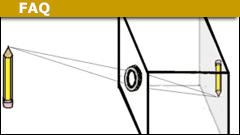
 . The image will have no more detail than the diameter of the pinhole. That is probably not as good as a 20MPx camera sensor can record. But, projected on a big screen, the perceived sharpness can be good. (Darkened room needed, of course)