Kakeh
- 9
- 0
Problem:
my photo diode receives pulses of width 10ns-150ns and repeating at rate of 1Hz-50KHz
the current from photo diode depending on incident light can go from 10nA-100mA,
in a nutshell, my application tries to digitalize the analog pulses for pulse width measurement
so i have 'only' two photo diodes to cover the dynamic range,after breaking the dynamic range into multiple channles like 1uA-5mA(less than 1uA its hard for me to measure 10ns pulses for several reasons,find here, here) and 500uA-100mA, there are some special reasons like optical attenuation before one sensor which made to break the photo diode ranges into overlapping one.
so for my first channel 1uA-1mA which is where i want to do I-V conversion using a TIA rather than using a resistor,so for a gain of 1K i was able to achieve proper gain 60dB at 100MHz, so i will not change the gain now,
through this 1uA will be 1mV and 5mA will be 5V, now that is not enough i have to put one more gain stage of 20V/V to read my 1mV, so the second stage would saturate with a input of 500uA itself, which is a set back to my approach (to stick to the problem i did not post second stage)
Approach 1:
so i used this techinique of using diodes in my loop so that the ouput would be limited to the cutoff of the diode, but this is leading to oscillations in other words unstability of the opamp
Results:
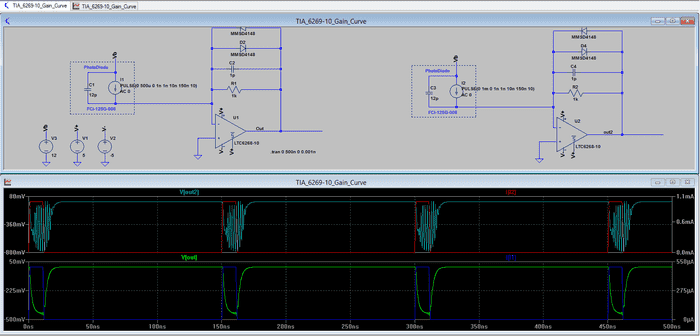
for a current above 450uA the opamp starts slightly oscillating, for a given current of 1mA on the right you can see completely unstable, i thought the problem is due to switching time of diode being 5ns only, so i changed it to schottky which resulted full fledged unstability, so there must some problem with opamp or the setup, please guide
Approach 2:
limiting the output current of the photo diode itself to 500uA ? using a current limiter, which did not workout properly, because the approach itself affects the frequency response and also adds distortion to the signal, the question quoted tries to limit the current to 5mA it can also be applied for 500uA, find it here, as its failed i don't want to bring it here.
Kindly suggest me an alternate approach to tackle this, or any modifications to existing design to get rid of the problem, to put it short i want to cover the range of 1uA-5mA
my photo diode receives pulses of width 10ns-150ns and repeating at rate of 1Hz-50KHz
the current from photo diode depending on incident light can go from 10nA-100mA,
in a nutshell, my application tries to digitalize the analog pulses for pulse width measurement
so i have 'only' two photo diodes to cover the dynamic range,after breaking the dynamic range into multiple channles like 1uA-5mA(less than 1uA its hard for me to measure 10ns pulses for several reasons,find here, here) and 500uA-100mA, there are some special reasons like optical attenuation before one sensor which made to break the photo diode ranges into overlapping one.
so for my first channel 1uA-1mA which is where i want to do I-V conversion using a TIA rather than using a resistor,so for a gain of 1K i was able to achieve proper gain 60dB at 100MHz, so i will not change the gain now,
through this 1uA will be 1mV and 5mA will be 5V, now that is not enough i have to put one more gain stage of 20V/V to read my 1mV, so the second stage would saturate with a input of 500uA itself, which is a set back to my approach (to stick to the problem i did not post second stage)
Approach 1:
so i used this techinique of using diodes in my loop so that the ouput would be limited to the cutoff of the diode, but this is leading to oscillations in other words unstability of the opamp
Results:
for a current above 450uA the opamp starts slightly oscillating, for a given current of 1mA on the right you can see completely unstable, i thought the problem is due to switching time of diode being 5ns only, so i changed it to schottky which resulted full fledged unstability, so there must some problem with opamp or the setup, please guide
Approach 2:
limiting the output current of the photo diode itself to 500uA ? using a current limiter, which did not workout properly, because the approach itself affects the frequency response and also adds distortion to the signal, the question quoted tries to limit the current to 5mA it can also be applied for 500uA, find it here, as its failed i don't want to bring it here.
Kindly suggest me an alternate approach to tackle this, or any modifications to existing design to get rid of the problem, to put it short i want to cover the range of 1uA-5mA