LT72884
- 341
- 50
- Homework Statement
- NA
- Relevant Equations
- delta(T+U)=0
We have a slide in class that states if no friction or damping force, then the system is conservative. Then it shows:
delta(T+U)=0 or T+U=constant. It then goes on to say that max kinetic energy is equal to max potential energy which is false.
no way can you have KEmax=Pemax... I double checked the slide and the book, and both say the same thing. Tmax=Umax.
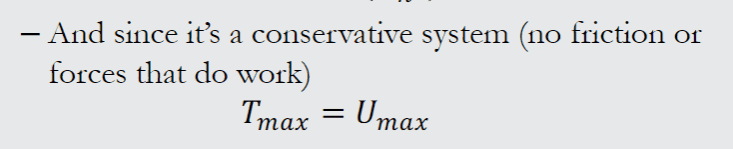
T is KE and U is PE. From every physics, dynamics, fluids, and statics course i have taken, when KE is max, PE is min. As a ball bounces or a spring bounces, at the bottom, velocity is high, and height is low. Holding a ball in my hand 3 feet from the ground, it has max PE, but no velocity so KE is min. If i drop the ball, near the bottom, velocity is high and the height of the ball is low.
thanks. Need some help understanding where they are coming from with this approach. even this simple website agrees with me:
https://www.ux1.eiu.edu/~cfadd/1150/06WrkEng/EngConsrv.html
delta(T+U)=0 or T+U=constant. It then goes on to say that max kinetic energy is equal to max potential energy which is false.
no way can you have KEmax=Pemax... I double checked the slide and the book, and both say the same thing. Tmax=Umax.
T is KE and U is PE. From every physics, dynamics, fluids, and statics course i have taken, when KE is max, PE is min. As a ball bounces or a spring bounces, at the bottom, velocity is high, and height is low. Holding a ball in my hand 3 feet from the ground, it has max PE, but no velocity so KE is min. If i drop the ball, near the bottom, velocity is high and the height of the ball is low.
thanks. Need some help understanding where they are coming from with this approach. even this simple website agrees with me:
https://www.ux1.eiu.edu/~cfadd/1150/06WrkEng/EngConsrv.html