Lorentz invariant integral measure

Click For Summary

Discussion Overview

The discussion revolves around the concept of Lorentz invariant integration measures in the context of electron-muon scattering. Participants explore various approaches to demonstrate the Lorentz invariance of certain integration measures, particularly focusing on the relationship between different variables in four-momentum space.

Discussion Character

  • Exploratory
  • Technical explanation
  • Debate/contested
  • Mathematical reasoning

Main Points Raised

  • One participant seeks to find an alternative method to demonstrate that the measure d(p^2) is Lorentz invariant, questioning the validity of their approach.
  • Another participant points out a mistake in the original attempt, clarifying that E is not the same as p^0 and that the variables are independent, which affects the conclusion about d(p^2).
  • Participants discuss the invariance of measures such as d^4p and d^3p/E, while noting that dE d^3p and d^3p/p^0 are not Lorentz invariant.
  • A later reply introduces a geometric analogy involving a sphere in three-dimensional space to illustrate the concept of invariance, suggesting that this might provide a clearer understanding.
  • One participant expresses concern that the derivation is overly complicated, suggesting a more standard proof involving delta functions and the on-shell condition.
  • Another participant defends the complexity of the approach, emphasizing the importance of understanding the geometric intuition behind the calculations.
  • Questions arise regarding the independence of components of four-momentum and the implications of the mass-shell condition p^2 = -m^2.
  • A participant provides an example from Feynman diagrams to illustrate the relationship between four-momentum and the mass condition, prompting further clarification on the nature of four-momentum space.
  • One participant concludes that they have gained a better understanding of four-momentum by considering the concept of hypersurfaces in momentum space.

Areas of Agreement / Disagreement

Participants express differing views on the complexity and methods of demonstrating Lorentz invariance. There is no consensus on a single approach, and multiple competing perspectives are presented throughout the discussion.

Contextual Notes

Participants highlight limitations in understanding the independence of four-momentum components and the implications of the mass-shell condition, which remain unresolved in the discussion.

DOTDO
Messages
8
Reaction score
2
Hi

I'm studying electron-muon scattering

and now considering the Lorentz invariant integration measure.

The textbook introduced it, which use dirac delta function to show that d3p/E is a Lorentz scalar.

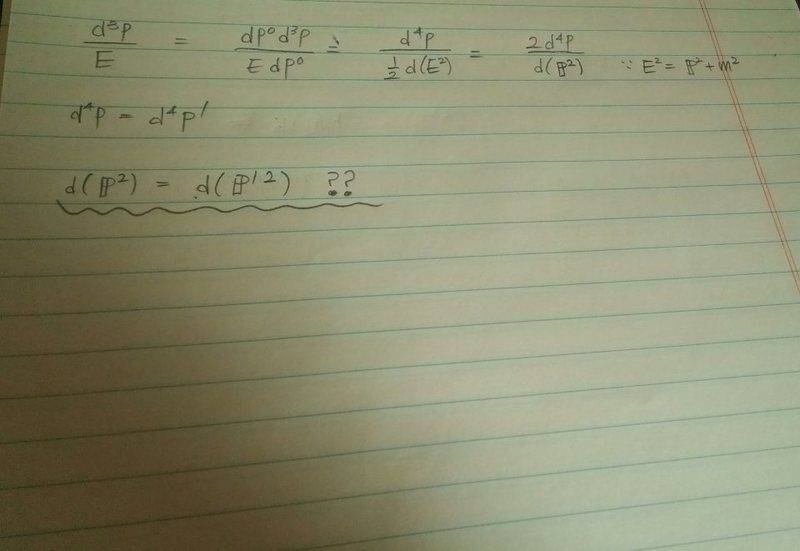
I understood it but I wanted to find other way and tried like this:
20150923_154737-1.jpg


I need a hint on the underlined equation. The primed one is lorentz transformed one.

How can I show that d(p^2) is Lorentz invariant?

Just calculate it hard ?
 
Last edited:
Physics news on Phys.org
Your attempt has a mistake because ##E## is not the same as ##p^0##. The four variables ##p^0,p^1,p^2,p^3\equiv (p^0,{\bf p})## are 4 independent variables, but ##E=\sqrt{{\bf p}^2+m^2}## is not independent of ##{\bf p}##. Hence, your conclusion that ##d{\bf p}^2## should be Lorentz invariant is wrong.

The measures ##d^4p=dp^0 d^3p## and ##\frac{d^3p}{E}## are Lorentz invariant, but ##dE d^3p## and ##\frac{d^3p}{p^0}## are not.

If you are still confused, try first to solve the following problem. Consider 3-dimensional Euclidean space with Cartesian coordinates ##x,y,z##. In this space, consider the sphere defined by ##x^2+y^2+z^2=R^2##, which is a 2-dimensional object invariant under 3-dimensional rotations. Find the measure of area ##dA## on the upper half of the sphere, in the form ##dA=f(x,y)dxdy##. Argue that this measure is rotation-invariant simply because the sphere is rotation-invariant. Find ##f(x,y)## explicitly in two ways: (i) geometrically and (ii) by starting from volume element ##dV=dxdydz## and using a ##\delta##-function trick. Can you see the relation with the problem of Lorentz-invariant measure above? In particular, can you see the analogy between ##R## and ##m##?

Partial solution: You should get $$f(x,y)=\frac{R}{\sqrt{R^2-x^2-y^2}}.$$Is it correct to write the right-hand side as ##R/z##?
 
Last edited:
Demystifier said:
(ii) by starting from volume element dV=dxdydz and using a δ-function trick.

Since I have nothing more important to do at the moment, let me do this explicitly. In spherical coordinates we have
$$dV=dA dr$$
where ##dA## is the area element of the sphere. Since ##dr\delta(r-R)=1##, we can use this to write
$$dA=dV\, \delta(r-R). \;\;\; (1)$$
We also have
$$\delta(R^2-r^2)=\delta((R-r)(R+r))=\frac{\delta(R-r)}{2R}$$
so (1) can be written as
$$dA=dV \, 2R\delta(R^2-r^2) \;\;\; (2)$$
Clearly, (2) is rotation invariant. In Cartesian coordinates this can be written as
$$dA=dxdydz \, 2R\delta(R^2-x^2-y^2-z^2) \;\;\; (3)$$
Introducing the function
$$w(x,y)=\sqrt{R^2-x^2-y^2}$$
which is non-negative on the sphere of radius ##R##, (3) can be written as
$$dA=dxdydz \, 2R\delta(w^2-z^2)=dxdydz \, 2R\delta((w-z)(w+z)) \;\;\; (4)$$
For the upper half of the sphere we have ##z>0##, so for the upper half (4) can be written as
$$dA=dxdydz \, 2R \frac{\delta(w-z)}{2w}=dxdy \frac{R}{w}. \;\;\; (5)$$

Since this is rotation invariant and since ##R## is a constant, it follows that the measure
$$\frac{dxdy}{w}$$
is rotation invariant. This is analogous to the fact that the measure
$$\frac{d^3p}{\omega}$$
with ##\omega=\sqrt{m^2+{\bf p}^2}## is Lorentz invariant. The differences are that (i) for Lorentz invariance we have one dimension more, and (ii) some signs are different because Minkowski metric is different from the Euclid metric.
 
Last edited:
  • Like
Likes   Reactions: haushofer
Isn't this a bit too complicated? Usually the derivation starts from the fact that ##\mathrm{d}^4 p## is invariant under proper Lorentz transformations. Then the on-shell ##\delta##-distribution, ##\delta(p^2-m^2)=\delta[(p^0)^2-E^2]##, where ##E^2=\vec{p}^2+m^2##. Finally ##\Theta(p^0)## is a Lorentz invariant under proper orthochronous Lorentz transformations and thus finally
$$\mathrm{d}^4 p \Theta(p^0) \delta(p^2-m^2)=\mathrm{d} p^0 \mathrm{d}^3 \vec{p} \frac{1}{2E} \delta(p^0-E)$$
is Lorentz invariant. Thus if you have a function ##f(p)## with ##p^0=E## you can write
$$\int \mathrm{d}^4 p \Theta(p^0) \delta(p^2-m^2)=\int \mathrm{d}^3 \vec{p} \frac{1}{2E} f(p^0=E,\vec{p}).$$
If ##f(p)=f(p^0,\vec{p})## is a scalar field, then for the on-shell function ##f(p^0=E,\vec{p})## the 3D integral with the measure ##\mathrm{d}^3 \vec{p}/E## is a scalar.
 
vanhees71 said:
Isn't this a bit too complicated?
Yes, but he already indicated that he understands the standard proof of Lorentz invariance with the use of a delta function. He wanted a more direct proof without a delta function, and in his attempt he failed. I wanted to explain him what exactly was wrong with his attempt. In addition, I also thought that it would be easier to undertstand this in a case which can be more easily visualized, i.e. where 4-dimensional Lorentz invariance is replaced with 3-dimensional rotational invariance. While the calculation turned out to be longer, I thought that the resulting geometric idea would be easier to understand intuitively.
 
  • Like
Likes   Reactions: vanhees71
Demystifier said:
Your attempt has a mistake because E is not the same as ##p^0##. The four variables ## p^0,p^1,p^2,p^3\equiv (p^0,{\bf p}) ## are 4 independent variables, but ##E=\sqrt{{\bf p}^2+m^2}## is not independent of p.
I don't understand this part.
1) The 4-momentum is always defined to be ## p^\mu=(E,\bf p) ## in a particular frame. Now you say ## p^0 ## is not the same as E. So what is it?
2) You say that different components of the 4-momentum are independent but what about the restriction ## p^2=-m^2 ## on any 4-momentum?
 
Shyan said:
I don't understand this part.
1) The 4-momentum is always defined to be ## p^\mu=(E,\bf p) ## in a particular frame. Now you say ## p^0 ## is not the same as E. So what is it?
2) You say that different components of the 4-momentum are independent but what about the restriction ## p^2=-m^2 ## on any 4-momentum?
Since ##E## is defined as ##\sqrt{{\bf p}^2+m^2}##, these two questions are really the same. To answer them, it should be enough to give one example where ##p^{\mu}## is not equal to ##(E,\bf p)##. So here is one example: the 4-momentum integration in a Feynman diagram with a loop.

If you are still confused, think about doing the exercise proposed in #2.
 
Demystifier said:
Since ##E## is defined as ##\sqrt{{\bf p}^2+m^2}##, these two questions are really the same. To answer them, it should be enough to give one example where ##p^{\mu}## is not equal to ##(E,\bf p)##. So here is one example: the 4-momentum integration in a Feynman diagram with a loop.

If you are still confused, think about doing the exercise proposed in #2.

I think I understand it now. It seems that the right way of thinking about 4-momentums is that there is a 4-dimensional momentum space and particles move on ## p^2=-m^2 ## hypersurfaces in this space. I was missing this viewpoint. thanks.
 
  • Like
Likes   Reactions: vanhees71 and Demystifier

Similar threads

Replies
3
Views
1K
  • · Replies 101 ·
4
Replies
101
Views
7K
  • · Replies 9 ·
Replies
9
Views
2K
  • · Replies 8 ·
Replies
8
Views
6K
  • · Replies 4 ·
Replies
4
Views
3K
  • · Replies 11 ·
Replies
11
Views
5K
  • · Replies 5 ·
Replies
5
Views
2K
  • · Replies 5 ·
Replies
5
Views
2K
  • · Replies 1 ·
Replies
1
Views
2K
  • · Replies 13 ·
Replies
13
Views
4K