Lorentz transformation in 2 dimensions

Click For Summary

Discussion Overview

The discussion revolves around the application of Lorentz transformations in two dimensions, specifically focusing on the synchronization of clocks in different reference frames. Participants explore the implications of relative motion in the XY plane and the challenges in deriving the time difference between events as perceived from different frames of reference.

Discussion Character

  • Exploratory
  • Technical explanation
  • Debate/contested
  • Mathematical reasoning

Main Points Raised

  • One participant seeks to understand how the term vx/c² in the time equation of Lorentz transformations applies in two dimensions, particularly for points in the XY plane.
  • Another participant clarifies that the full 4D Lorentz transformation is valid for all spatial dimensions and suggests that the original formulation may still be applicable.
  • There is a discussion about the synchronization of clocks at different points, with one participant explaining that light emitted from a midpoint will reach the origin and a moving point at different times due to their relative motion.
  • Some participants express confusion over the calculations involving square roots and the conditions under which they can be simplified when determining time differences.
  • One participant emphasizes the importance of correctly interpreting the distances and time intervals in the context of the Lorentz transformation equations.

Areas of Agreement / Disagreement

Participants express differing views on the correct application of the Lorentz transformation in two dimensions, particularly regarding the treatment of time synchronization and the mathematical steps involved. There is no consensus on the resolution of the calculations presented.

Contextual Notes

Participants note potential misunderstandings in the mathematical formulation and the interpretation of the Lorentz transformation in two dimensions. There are unresolved aspects related to the simplification of square root terms in the calculations.

jonjacson
Messages
450
Reaction score
38
Hi folks,

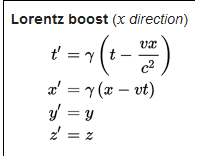
This is the Lorentz transformation in 1D, x axis:
2metgzd.jpg


I want to get the second term of the time t equation, I mean vx/c2, in two dimensions, I mean for a point in the XY plane.

I know this term arises because if we want to syncronize a point B with the origin what we do is sending a light signal from the middle point, for the frame at rest the origin is traveling to the light ray whereas point B is traveling away so the light will contact sooner the origin than the point B, that is why the clocks are not sincronized, according to the external observer.

If you have a point on the X axis you get the term v x/c2, for a point on the Y axis obviously because of the symmetry light will get in both frames of reference at point B and at the origin O at the same time, syncronization will be the same. But what happens with a point on the XY plane?

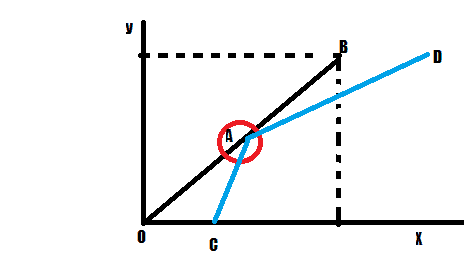
I made a picture:
2s964br.jpg


The middle point is A, the point we want to syncronize is B. For an external observer this systems travels to the right with speed v, and an observer will think light will get a lot sooner to point O at C, that is moving to the right, than with point B at D, because B is traveling away of the light ray. If I calculate these distances I have:

OC = v t1
BD= v t2
AC2 = AO2+ OC2 - 2 (OC) (BD) cos (oc-bd)
AD2= AB2+ BD2 - 2 (AB) (BD) cos (ab - bd)

THen I use simply: c= space/time, to get the time:

t1= AC/c ( in this case c is the speed of light and AC is a distance from A to C)

t2= AD/c

And when I calculate:

t2 - t1 using this expressions I don't get the result I see in the books. For the the distances have square roots so I cannot simplify these expressions.
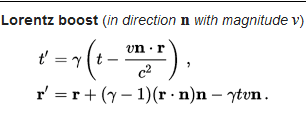
According to wikipedia these are the Lorentz transformations:
3005xjs.jpg


What I am doing wrong?

Thanks!
 
Physics news on Phys.org
What you have right at the beginning is the full 4d Lorentz transform for the case where the relative velocity between frames is in the x direction. It is valid for all x, y, z and t.

The equation you reproduced at the bottom is the same thing for a general velocity, in the direction given by the unit vector ##\vec n##. If you let that vector be parallel to the x-axis (i.e. ##\vec r=(x,y,z)^T##, ##\vec {r}'=(x',y',z')^T##, ##\vec n=(1,0,0)^T##) you will recover the first form.

I think what you are doing wrong is not realising that what you actually wanted is what you started with. Unless I misunderstand what you're trying to do.
 
Ibix said:
What you have right at the beginning is the full 4d Lorentz transform for the case where the relative velocity between frames is in the x direction. It is valid for all x, y, z and t.

The equation you reproduced at the bottom is the same thing for a general velocity, in the direction given by the unit vector ##\vec n##. If you let that vector be parallel to the x-axis (i.e. ##\vec r=(x,y,z)^T##, ##\vec {r}'=(x',y',z')^T##, ##\vec n=(1,0,0)^T##) you will recover the first form.

I think what you are doing wrong is not realising that what you actually wanted is what you started with. Unless I misunderstand what you're trying to do.
An image will help I think:
View attachment 118897Imagine that at t=t'=0 the origin of two coordinate systems F and F' are at the same point x=x'=0.
Points x, y and xy are points moving at the same speed as F'.

1.- IF we want to syncronize the clock at the origin of F' with the clock at point x' that is moving with F', as seen from F' there is no mystery at all since the light to syncronize them is emitted from the middle point of that reference system, so the light gets to the origin and to point x' at the same time.

But as seen from F, the origin of F' is traveling towards the light and point x' is traveling away from the light, so light will get to the origin of F' sooner than to point x'. To calculate this term, we simply need the distance traveled as seen from F:

distance from middle point to point x = L/2 + vt2

so:

t2= (L/2 + vt2 )/ c

distance from middle point to origin F' = L/2 - vt1t1 =(L/2 + vt1)/c

From here, using simply c=space/time we have:

t2-t1= (L v γ2 )/c2 , as seen from F, if you use time dilation and space contraction you get the lorentz term.

If you want to syncronize a clock on the y axis, I called it point y', you send a light signal from the middle point, obviously in this case because of the symmetry as seen from F the light rays travel the same distances to both the origin F' and the point y', no matter how fast F' is moving, so they are syncronized equally in both reference systems.

But, what happens if the point is neither on the x axis, nor on the y axis?

We have the point xy', and I tried to calculate the distance light travels from the middle point to the origin of F' and to point XY' but I get a time syncronization quite weird. Shouldn't I get the right result?

DO you understand my point now?
 
So, to synchronise two clocks you are adding a source at the midpoint of the two. It emits a pulse, and you are saying that the time that the clocks receive the pulse is what the clocks will call zero. The frame where the clocks are at rest is F', and where they are moving is F. Right?

The square root terms are the same when I try it, so drop out when I take the difference between the reception events and I get ##\Delta t=\gamma^2vX/c^2##. If you don't get that, post your working (LaTeX will help a lot in laying it out - see the link below the reply box for a guide if you don't know it) and we'll see where you've gone wrong.
 
  • Like
Likes   Reactions: jonjacson
Ibix said:
So, to synchronise two clocks you are adding a source at the midpoint of the two. It emits a pulse, and you are saying that the time that the clocks receive the pulse is what the clocks will call zero. The frame where the clocks are at rest is F', and where they are moving is F. Right?

The square root terms are the same when I try it, so drop out when I take the difference between the reception events and I get ##\Delta t=\gamma^2vX/c^2##. If you don't get that, post your working (LaTeX will help a lot in laying it out - see the link below the reply box for a guide if you don't know it) and we'll see where you've gone wrong.
Regarding the first part yes, that's it.
But it is F' who is moving to the right at speed v.
I add another picture to make that clear:

2zptp36.jpg


I will put the calculation I did again, with all the steps.

Again we are talking now about this image, point B is not on the X axis, is not on the Y axis, it is at a random point of the XY plane:

2s964br-jpg.118496.png


OC = v t1
BD= v t2
AC2 = AO2+ OC2 - 2 (OC) (BD) cos (oc-bd)
AD2= AB2+ BD2 - 2 (AB) (BD) cos (ab - bd)
Now c= space/time, so time = space / c :
(If we call L=OB, the distances AO and AB are L/2)
t2 = (1/c) * √(L/2)2 + (vt2)2 -2 (L/2) (vt2) cos ( AB - BD)

t1 = (1/c) * √(L/2)2 + (vt1)2 -2 (L/2) (vt1) cos ( AO - OC)

And now I have to rest t2 - t1:
t2 - t1 =[ (1/c) * √(L/2)2 + (vt2)2 -2 (L/2) (vt2) cos ( AB - BD) ] - [ (1/c) * √(L/2)2 + (vt1)2 -2 (L/2) (vt1) cos ( AO - OC) ]

And this is where I cannot see how to remove the square roots.
 
jonjacson said:
Regarding the first part yes, that's it.
But it is F' who is moving to the right at speed v.
Yes, but you've got some clocks at rest in F' which are what you are trying to sync. If they're at rest in F then the problem is trivial.
jonjacson said:
AD2= AB2+ BD2 - 2 (AB) (BD) cos (ab - bd)
##AD^2=AB^2+BD^2-2(AB)(BD)\cos (ABD)##
jonjacson said:
Now c= space/time, so time = space / c :
c is not space divided by time. It is the distance traveled by light in some time interval divided by that time interval. Why not say ##AD=ct_2## and ##AC=ct_1##, which is what you mean?
jonjacson said:
t2 = (1/c) * √(L/2)2 + (vt2)2 -2 (L/2) (vt2) cos ( AB - BD)
As written, this is wrong. You've written ##t_2=(1/c)\sqrt {L^2/4}+(vt_2)^2-2 (L/2)(vt_2)\cos (ABD)##, which is wrong. You mean ##t_2=(1/c)\sqrt {L^2/4+(vt_2)^2-2 (L/2)(vt_2)\cos (ABD)}## (Edit: or##t_2=(1/c)(L^2/4+(vt_2)^2-2 (L/2)(vt_2)\cos (ABD))^{1/2}## if you're on a tiny phone screen). That's why I strongly suggest you learn and use LaTeX. It's not difficult - quote my post to see how I did it.

Anyway. This is just a quadratic expression for ##t_2##. Substitute the appropriate value for the cosine and solve it. Likewise the equivalent expression for ##t_1##, and then take the difference. Simply taking the differences of the expressions you have doesn't help you because you've got a t on both sides and you don't know what the cosine terms are.
 
Last edited:

Similar threads

  • · Replies 54 ·
2
Replies
54
Views
4K
  • · Replies 101 ·
4
Replies
101
Views
7K
Replies
8
Views
2K
  • · Replies 12 ·
Replies
12
Views
3K
  • · Replies 53 ·
2
Replies
53
Views
4K
  • · Replies 9 ·
Replies
9
Views
1K
  • · Replies 30 ·
2
Replies
30
Views
3K
  • · Replies 54 ·
2
Replies
54
Views
3K
  • · Replies 10 ·
Replies
10
Views
2K
  • · Replies 16 ·
Replies
16
Views
2K