Undergrad Magnetic field at a point along the solenoid's axis but outside the solenoid

Click For Summary
SUMMARY

This discussion centers on calculating the electromotive force (EMF) induced by a solenoid when the secondary circuit for eddy currents is positioned outside the solenoid's length but still along its axis. The magnetic field vector inductance at this point is challenging to determine, as the net magnetic field vector is near zero outside the radius of the solenoid. The formula for the magnetic field in Gaussian units is provided, and users are advised to integrate the turns per unit length over the solenoid's length for accurate calculations.

PREREQUISITES
  • Understanding of electromagnetic theory, specifically solenoids
  • Familiarity with Gaussian units in electromagnetism
  • Knowledge of vector calculus for integrating magnetic fields
  • Ability to manipulate and interpret mathematical expressions in LaTeX
NEXT STEPS
  • Research "Magnetic field in axis of a current loop" for foundational concepts
  • Study "Integration techniques for magnetic field calculations" to enhance problem-solving skills
  • Explore "Gaussian units in electromagnetism" for better understanding of unit systems
  • Learn about "Eddy currents and their applications" to understand practical implications
USEFUL FOR

Physics students, electrical engineers, and researchers working on electromagnetic applications or solenoid design will benefit from this discussion.

turo_loler
Messages
3
Reaction score
1
TL;DR
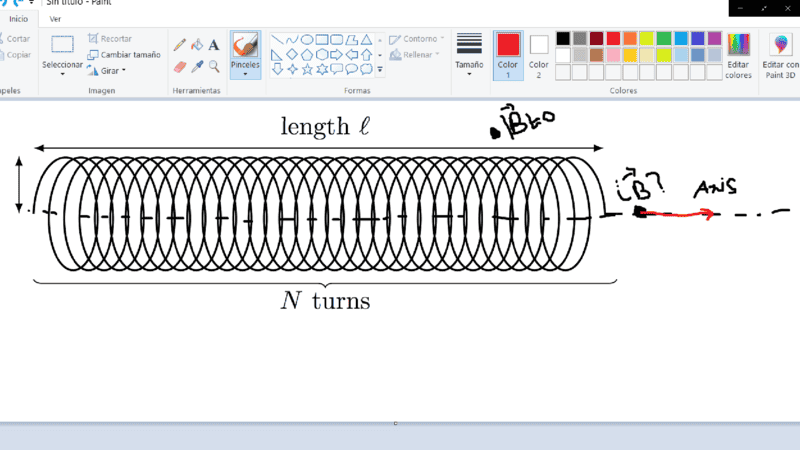
For a personal project, I need to calculate the EMF induced by a solenoid, the problem is, that the secondary circuiit where the eddy currents are formed are outside the solenoid's length but on it's axis.
For a personal project, I need to calculate the EMF induced by a solenoid, the problem is, that the secondary circuit where the eddy currents are formed are outside the solenoid's length but still on it's axis.
The problem comes when i need to calculate the vector magnetic field inductance at a point outside the solenoid, i've been searching for quite a while but I have not managed to find an awnser, I just find keep finding that the net magnetic field vector due to ampere's law is near zero, but outsithe the radious of the solenoid, not ousithe the length of the solenoid
A graphical representation of my problem:
1686347589344.png
 
Physics news on Phys.org
In Gaussian units, B is
$$B=\frac{2\pi nI}{c}\left[\frac{L/2-z}{\sqrt{(z-L/2)^2+a^2},
+\frac{(z+L/2)}{\sqrt{(z+L/2)^2+a^2}}\right]$$,
where ##n## is the number of turns per cm, ##I## is the current, ##a## is the radius, and ##z## is the distance along the axis from the center.
Why isn't latex working?
 
turo_loler said:
TL;DR Summary: For a personal project, I need to calculate the EMF induced by a solenoid, the problem is, that the secondary circuiit where the eddy currents are formed are outside the solenoid's length but on it's axis.

The problem comes when i need to calculate the vector magnetic field inductance at a point outside the solenoid
Google the magnetic field in axis of a current loop a distance ##z## from the loop (the off-axis field is moderately nasty but the on axis field is a simple expression). Then work out how many turns per unit length you have and integrate over the length of the solenoid.
Meir Achuz said:
Why isn't latex working?
You have unbalanced {} in the denominator of the first fraction inside the square brackets.
 
  • Like
Likes Meir Achuz and turo_loler
Meir Achuz said:
In Gaussian units, B is
$$B=\frac{2\pi nI}{c}\left[\frac{L/2-z}{\sqrt{(z-L/2)^2+a^2}}
+\frac{(z+L/2)}{\sqrt{(z+L/2)^2+a^2}}\right]$$,
where ##n## is the number of turns per cm, ##I## is the current, ##a## is the radius, and ##z## is the distance along the axis from the center.
Why isn't latex working?
It was a missing bracket in the first frac.
 
  • Like
Likes Meir Achuz and turo_loler
Ibix said:
Google the magnetic field in axis of a current loop a distance ##z## from the loop (the off-axis field is moderately nasty but the on axis field is a simple expression). Then work out how many turns per unit length you have and integrate over the length of the solenoid.

You have unbalanced {} in the denominator of the first fraction inside the square brackets.
Perfect, just what i needed, thnks!
 
Thread 'Colors in a plasma globe'
I have a common plasma globe with blue streamers and orange pads at both ends. The orange light is emitted by neon and the blue light is presumably emitted by argon and xenon. Why are the streamers blue while the pads at both ends are orange? A plasma globe's electric field is strong near the central electrode, decreasing with distance, so I would not expect the orange color at both ends.

Similar threads

  • · Replies 2 ·
Replies
2
Views
2K
  • · Replies 5 ·
Replies
5
Views
1K
  • · Replies 3 ·
Replies
3
Views
2K
  • · Replies 3 ·
Replies
3
Views
6K
  • · Replies 1 ·
Replies
1
Views
4K
  • · Replies 1 ·
Replies
1
Views
2K
  • · Replies 15 ·
Replies
15
Views
1K
  • · Replies 2 ·
Replies
2
Views
2K
  • · Replies 2 ·
Replies
2
Views
5K
  • · Replies 2 ·
Replies
2
Views
2K