Mastering Tricky Trigonometric Integrals: Tips and Techniques for Success

Click For Summary

Homework Help Overview

The discussion revolves around calculating a tricky indefinite integral involving trigonometric functions. Participants explore various substitution techniques and manipulations related to trigonometric identities.

Discussion Character

  • Exploratory, Mathematical reasoning, Problem interpretation

Approaches and Questions Raised

  • The original poster attempts to find a more elegant solution than universal substitution. Some participants suggest using trigonometric identities, such as replacing 1 with sin²(x) + cos²(x), to simplify the integral. Others seek clarification on the reasoning behind these substitutions.

Discussion Status

Participants are actively engaging with different approaches to the integral, with some expressing understanding and appreciation for the suggested methods. There is a mix of interpretations and attempts to clarify the steps involved in the reasoning.

Contextual Notes

There is an indication that the discussion is constrained by the need for a more straightforward method, as well as the complexity of the integral itself. Some participants are also seeking deeper explanations of the techniques proposed.

reaper616
Messages
3
Reaction score
0
Hi. I'm having troubles calculating this indefinite integral. I have tried a few things, but none seem to work.
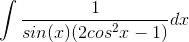
gif.latex?\int%20\frac{1}{sin%28x%29%282cos^2{x}-1%29}dx.gif


Actually, universal substitution does make it possible to integrate, but there has to be some shorter, more elegant way. Anyone?
 
Physics news on Phys.org
Replacing the 1 in the numerator by sin^2(x) + cos^2(x) does seem to work. You then do get the original integral back, but it is multiplied by 1/2 so you can move it back to the left hand side to solve for it.
 
Count Iblis said:
Replacing the 1 in the numerator by sin^2(x) + cos^2(x) does seem to work. You then do get the original integral back, but it is multiplied by 1/2 so you can move it back to the left hand side to solve for it.


I'm sorry, but I'm not sure that I understand what are you trying to say. Could you go a little bit more in-depth?
 
Abbreviation: Sin(x) = S, Cos(x) = C

[S^2 + C^2]/[S (2 C^2 - 1)] =

S/[2 C^2 - 1] (easy to integrate as the derivative of C is -S and S is in the numerator)

+

C^2/[S(2C^2 - 1)]

We can rewrite the numerator of the last term as:

C^2 = 1/2 2 C^2 = 1/2 (2 C^2 - 1 + 1)

This means that you can write the last term as:

1/(2S) + 1/2 * Original term you wanted to integrate.

Then you're done if you can integrate 1/S and that you can do using more or less the same trick:

1/Sin(x) = 1/(2Sin(1/2 x) Cos(1/2 x)) and then replace the numerator by Cos^2(1/2 x) + Sin^2(1/2 x) and you're done.
 
It works. Very nice. Thank you very much.
 
Last edited:

Similar threads

Replies
5
Views
1K
Replies
10
Views
2K
Replies
18
Views
2K
  • · Replies 10 ·
Replies
10
Views
4K
  • · Replies 3 ·
Replies
3
Views
1K
  • · Replies 2 ·
Replies
2
Views
3K
  • · Replies 9 ·
Replies
9
Views
2K
  • · Replies 4 ·
Replies
4
Views
2K
Replies
1
Views
1K
Replies
2
Views
2K