Math Challenge - August 2020

Click For Summary
SUMMARY

The forum discussion centers on advanced mathematical problems, particularly in functional analysis, operator theory, and topology. Key problems include constructing bounded operators with specific spectra, demonstrating the existence of integer differences in continuous functions, and proving the non-existence of continuous logarithms in complex analysis. Notably, the Tychonoff theorem's implications on the axiom of choice and the properties of meromorphic functions are also explored, with multiple users contributing solutions and insights.

PREREQUISITES
  • Functional analysis concepts, particularly bounded operators and spectra.
  • Understanding of topology, specifically compactness and the Tychonoff theorem.
  • Complex analysis, including properties of meromorphic functions and logarithms.
  • Measure theory fundamentals, especially related to probability spaces.
NEXT STEPS
  • Study the implications of the Tychonoff theorem in topology and its relation to the axiom of choice.
  • Learn about the properties of bounded operators in Hilbert spaces and their spectra.
  • Explore the concept of Borel-measurable sets in metric spaces and their applications.
  • Investigate the characteristics of meromorphic functions and their behavior in complex analysis.
USEFUL FOR

Mathematicians, graduate students in mathematics, and anyone interested in advanced topics in functional analysis, topology, and complex analysis.

fresh_42
Staff Emeritus
Science Advisor
Homework Helper
Insights Author
2025 Award
Messages
20,815
Reaction score
28,446
1. (solved by @nuuskur ) Let ##K## be a non-empty compact subset of ##\Bbb{C}##. Construct a bounded operator ##u: H \to H## on some Hilbert space ##H## that has spectrum ##\sigma(u) =K##. (MQ)

2. Let ##f,g:[0,2]\to\mathbb{R}## be continuous functions such that ##f(0)=g(0)=0## and ##f(2)=g(2)=2##. Show that there exist ##a,b\in [0,2)\,,a\neq b\,.## such that ##f(a)-f(b)## and ##g(a)-g(b)## are both integers. (IR)

3. (solved by @nuuskur ) Let ##V## be a normed vector space and ##W## be a closed linear subspace. If ##V/W## is a Banach space for the quotient norm, show that ##V## is a Banach space as well. (MQ)

4. (solved by @nuuskur ) Let ##(\Omega, \mathcal{F}, \Bbb{P})## be a probability space and ##X: \Omega \to \Bbb{R}## be a random variable. If ##\Bbb{P}(X \in A) \in \{0,1\}## for all Borel sets ##A##, show that there is a constant ##c \in \Bbb{R}## such that ##\Bbb{P}(X= c) = 1## (i.e. ##X## is constant almost surely). (MQ)

5. Let ##X,Y## be Banach spaces over the field ##\mathbb{R}## or ##\mathbb{C}##. By ##B_X(\hat x,R)## we denote the open ball of this space:
$$B_X(\hat x,R)=\{x\in X\mid \|x-\hat x\|_X<R\},$$ and ## \overline B_X(\hat x,R)=\{x\in X\mid \|x-\hat x\|_X\le R\}.##
Consider a continuous bilinear function ##A:X\times X\to Y## such that
$$\|A(x_1,x_2)\|_Y\le a\|x_1\|_X\|x_2\|_X,\quad A(x_1,x_2)=A(x_2,x_1).$$
Let ##B:X\to Y## stand for a bounded linear operator onto:
$$\overline B_Y(0,b)\subseteq B(\overline B_X(0,1))$$ with some positive constant ##b##. Let ##C## stand for a fixed element of ##Y,\quad \|C\|_Y=c##.
Show that
If ##D=b^2-4ac\ge 0## then the equation
$$A(x,x)+Bx+C=0$$ has a solution. (WR)

6. (solved by @nuuskur ) Show that in ZF the Tychonoff theorem (product of compact spaces is compact) implies the axiom of choice. (MQ)

7. (solved by @nuuskur ) Let ##f: (X,d_X) \to (Y,d_Y)## be a map between metric spaces (not necessarily continuous!). Show that ##D(f):= \{x \in X\mid f \mathrm{\ is \ not \ continuous \ at \ x}\}## is a Borel-measurable set of ##X##. (MQ)

8. (solved by @benorin , @Fred Wright , and @nuuskur ) Let ##F## be a meromorphic function (holomorphic up to isolated poles) in ##\mathbb{C}## with the following properties:
(1) ##F## is holomorphic (complex differentiable) in the half plane ##H(0)=\{z\in \mathbb{C}\, : \,\Re(z)>0\}.##
(2) ##zF(z)=F(z+1).##
(3) ##F## is bounded in the strip ##\{z\in \mathbb{C}\, : \,1\leq\Re(z)\leq 2\}.##
Show that ##F(z)=F(1)\Gamma(z).## (FR)

9. (solved by @PeroK ) Show that there exists no continuous function ##g: \Bbb{C}\setminus \{0\}\to \Bbb{C}## such that ##e^{g(z)} = z## for all ##z\in \Bbb{C}\setminus \{0\}## (i.e. there is no continuous logarithm on ##\Bbb{C}\setminus \{0\})##. (MQ)
(Corrected version, credits go to @PeroK for pointing out and solving the original problem.)

10. (solved by @PeroK ) Show that if ##f## is any continuous real function and ##n## any positive number (FR),
$$
I:=\int_{n^{-1}}^{n} f\left(x+\dfrac{1}{x}\right)\,\dfrac{\log x}{x}\,dx =0.
$$

1596234944639.png


High Schoolers only11. (solved by @Not anonymous ) Let ##a<b<c<d## be real numbers. Sort ##x=ab+cd\, , \,y=bc+ad\, , \,z=ac+bd## and prove it.

12. (solved by @Not anonymous ) Prove ##\overline{CP}^2=\overline{AP}\cdot \overline{BP}\,.##
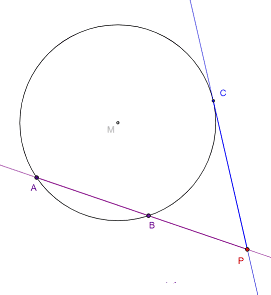
Sekanten-Tangentensatz.png


13. How big is the probability for two pocket aces in Texas Hold'em? Assume we have seen a show down in a heads-up. How many possible combinations are there, how many combinations of possible starting hands can the opponents have? How many possible community cards?

14. (solved by @etotheipi ) Everybody knows that Schrödinger's cat is trapped in the box since ##1935.## Not well known is the fact, that the radioactive material was ten ##{}^{14}C## isotopes. Calculate the probability that the cat is still alive.

15. (solved by @ItsukaKitto ) Show that there is no rational solution for ##p^2+q^2+r^2=7.##
 
Last edited:
  • Like
  • Haha
  • Informative
Likes   Reactions: Isaac0427, ItsukaKitto, DifferentialGalois and 8 others
Physics news on Phys.org
fresh_42 said:
14. Everybody knows that Schrödinger's cat is trapped in the box since ##1935.## Not well known is the fact, that the radioactive material was ten ##{}^{14}C## isotopes. Calculate the probability that the cat is still alive.

The time of an individual decay (which is independent of any other decays) follows an exponential distribution ##T \sim \text{Exp}(\lambda)## with ##P(T > t) = e^{-\lambda t}##. The number of atoms out of 10 that have decayed, ##X##, follows a binomial distribution ##X \sim \text{B}(10, 1-e^{-\lambda t})##, so $$P(X=0) =e^{-10\lambda t}$$The half life of ##^{14}\text{C}## is ##t_{1/2} = 5700 \text{ years}##, so ##\lambda t = \frac{\ln{2}}{5700 \text{ years}} \times 85 \text{ years} = \frac{17 \ln{2}}{1140}## which gives, assuming the Geiger counter detects all radiation, ##P(X=0) \approx0.90##

But given the maximum lifespan of a cat is only about 16 years...
 
Last edited by a moderator:
  • Like
  • Haha
Likes   Reactions: DifferentialGalois, benorin, Wrichik Basu and 1 other person
fresh_42 said:
10. Show that if ##f## is any continuous real function and ##n## any positive number (FR),
$$
I:=\int_{n^{-1}}^{n} f\left(x+\dfrac{1}{x}\right)\,\dfrac{\log x}{x}\,dx =0.
$$

Let ##u = x + \frac{1}{x}##, then ##x = \frac{u \pm \sqrt{u^2-4}}{2} := \alpha(u)## and$$I = \int_{n + n^{-1}}^{n + n^{-1}} f(u) \frac{\log(\alpha(u))}{\alpha(u)(1-\frac{1}{\alpha^2(u)})} du = 0$$because the limits are equal...
fresh_42 said:
2. Let ##f,g:[0,2]\to\mathbb{R}## be continuous functions such that ##f(0)=g(0)=0## and ##f(2)=g(2)=2##. Show that there exist ##a,b\in [0,2)## such that ##f(a)-f(b)## and ##g(a)-g(b)## are both integers. (IR)

Doesn't ##a = b## work?
 
Last edited by a moderator:
@etotheipi Fair enough, but the intent was to show that it can be done with ##a\neq b##.
 
  • Like
Likes   Reactions: etotheipi
Let ##x = \frac{1}{u}##.
$$I = \int_{n}^{1/n} f(u + \frac 1 u) (-\log(u))u(-\frac{1}{u^2})du = \int_{n}^{1/n} f(u + \frac 1 u) \frac{\log(u)}{u}du = -I$$
Hence ##I = 0##
 
etotheipi said:
Let ##u = x + \frac{1}{x}##, then ##x = \frac{u \pm \sqrt{u^2-4}}{2} := \alpha(u)## and$$I = \int_{n + n^{-1}}^{n + n^{-1}} f(u) \frac{\log(\alpha(u))}{\alpha(u)(1-\frac{1}{\alpha^2(u)})} du = 0$$because the limits are equal...
The new variable ##u## is not on a single interval for ##x \in [1/n, n]##.
 
  • Like
Likes   Reactions: etotheipi
fresh_42 said:
14. Everybody knows that Schrödinger's cat is trapped in the box since ##1935.## Not well known is the fact, that the radioactive material was ten ##{}^{14}C## isotopes. Calculate the probability that the cat is still alive.

A cat's been trapped in a box for 85 years and you think it might still be alive?
 
  • Haha
  • Like
Likes   Reactions: DifferentialGalois, member 587159, nuuskur and 1 other person
fresh_42 said:
9. Show that there exists no continuous function ##g: \Bbb{C}\setminus \{0\}\to \Bbb{C}## such that ##g(e^{z}) = z## for all ##z\in \Bbb{C}\setminus \{0\}## (i.e. there is no continuous logarithm on ##\Bbb{C}\setminus \{0\})##. (MQ)

This could be ridiculously along the wrong lines, but... let ##z = a + bi##, so $$g(e^z) = z$$ $$g(ie^a \sin{b} + e^a \cos{b}) = a + bi$$Since ##e^z = ie^a \sin{b} + e^a \cos{b}##, then ##\text{Re}(e^z) = e^a \cos{b}## and ##\text{Im}(e^z) = e^a \sin{b}##. This means that ##\text{Re}(e^z)^2 + \text{Im}(e^z)^2 = (e^a)^2 (\sin^2 b + \cos^2 b) = (e^a)^2##. We end up with$$a = \ln{\sqrt{\text{Re}(e^z)^2 + \text{Im}(e^z)^2}}$$and$$b = \arctan{\left(\frac{\text{Im}(e^z)}{\text{Re}(e^z)} \right)} + n\pi$$So$$g(e^z) = \ln{\sqrt{\text{Re}(e^z)^2 + \text{Im}(e^z)^2}} + i \left(\arctan{\left(\frac{\text{Im}(e^z)}{\text{Re}(e^z)} \right)} + n\pi \right)$$but this isn't a function, because it's not possible to recover the specific ##n## that corresponds to ##b##?
 
Last edited by a moderator:
fresh_42 said:
13. How big is the probability for two pocket aces in Texas Hold'em? Assume we have seen a show down in a heads-up. How many possible combinations are there, how many combinations of possible starting hands can the opponents have? How many possible community cards?

Is there an explanation of this for non-poker-playing high-schoolers?
 
  • Haha
Likes   Reactions: DifferentialGalois
  • #10
etotheipi said:
This could be ridiculously along the wrong lines, but... let ##z = a + bi##, so $$g(e^z) = z$$ $$g(ie^a \sin{b} + e^a \cos{b}) = a + bi$$Since ##e^z = ie^a \sin{b} + e^a \cos{b}##, then$$a = \ln{\sqrt{\text{Re}(e^z)^2 + \text{Im}(e^z)^2}}$$and$$b = \arctan{\left(\frac{\text{Im}(e^z)}{\text{Re}(e^z)} \right)} + n\pi$$so we could say...$$g(z) = \ln{\sqrt{\text{Re}(e^z)^2 + \text{Im}(e^z)^2}} + i \left(\arctan{\left(\frac{\text{Im}(e^z)}{\text{Re}(e^z)} \right)} + n\pi \right)$$but this isn't a function, because it's not possible to recover the specific ##n## that corresponds to ##b##?

How do you get that expression for the value of ##a##?
 
  • #11
The complex exponential function is not one-to-one, so cannot have an inverse, continuous or otherwise.

We have: $$e^z = e^x(\cos y + i\sin y)$$
Consider ##z_1 = i\frac\pi 2## and ##z_2 = i\frac{5\pi}{2}##, then
$$e^{z_1} = e^{z_2} = i$$
 
  • Like
Likes   Reactions: DifferentialGalois, member 587159 and etotheipi
  • #12
Math_QED said:
How do you get that expression for the value of ##a##?

I just used that ##\text{Re}(e^z) = e^a \cos{b}## and ##\text{Im}(e^z) = e^a \sin{b}## so ##\text{Re}(e^z)^2 + \text{Im}(e^z)^2 = (e^a)^2 (\sin^2 b + \cos^2 b) = (e^a)^2##
 
  • #13
PeroK said:
The complex exponential function is not one-to-one, so cannot have an inverse, continuous or otherwise.

We have: $$e^z = e^x(\cos y + i\sin y)$$
Consider ##z_1 = i\frac\pi 2## and ##z_2 = i\frac{5\pi}{2}##, then
$$e^{z_1} = e^{z_2} = i$$

Your attempt made me realize that I meant to ask for the non-existence of a continuous function ##g:\Bbb{C}\setminus \{0\}\to \Bbb{C}## with ##\exp(g(z))=z## for all ##z\in \Bbb{C}\setminus \{0\}##.

Since ##\exp: \Bbb{C}\to \Bbb{C}\setminus\{0\}## is surjective, a set-theoretical right inverse exists but your task is to prove it is not continuous.

Sorry for the inconvenience.
But we are honest and you'll get credit for the attempt but the question remains open.
 
  • Like
Likes   Reactions: DifferentialGalois
  • #14
etotheipi said:
I just used that ##\text{Re}(e^z) = e^a \cos{b}## and ##\text{Im}(e^z) = e^a \sin{b}## so ##\text{Re}(e^z)^2 + \text{Im}(e^z)^2 = (e^a)^2 (\sin^2 b + \cos^2 b) = (e^a)^2##

Add all these details in your attempt so it is easier for me to identify the mistake :) While the question was flawed due to my mistake, I do want to clear out where you were going wrong so we can learn something about it :)
 
  • Like
Likes   Reactions: etotheipi
  • #15
Compactness is equivalent to finite intersection property (FIP). Cf Proposition 3.1
Let X_\alpha,\ \alpha\in I, be a non-empty family of non-empty sets. We show \prod_{\alpha\in I} X_\alpha \neq\emptyset (AC). Suppose z\notin \bigcup _{\alpha\in I} X_\alpha (the union is a set by ZF). Equip X_\alpha \cup \{z\} with cofinite topology, \alpha\in I. These are compact. By Tikhonov's theorem S:=\prod_{\alpha\in I} X_\alpha\cup\{z\} is compact (under product topology). Fix \alpha\in I. The canonical projection \pi_\alpha :S\to X_\alpha\cup\{z\} is continuous. Since X_\alpha \subset X_\alpha\cup\{z\} is closed (\{z\} is open), the preimage \pi_\alpha^{-1}(X_\alpha) \subseteq S is closed. We show this family of preimages has FIP. Take n\in\mathbb N and let x_{\alpha_j} \in X_{\alpha _j},\ 1\leq j\leq n. We then have
<br /> s(\alpha) := \begin{cases} x_{\alpha _j}, &amp;\text{if }\alpha = \alpha _j \\ z, &amp;\text{otherwise} \end{cases} \Rightarrow s\in \bigcap _{k=1}^n \pi_{\alpha_k}^{-1}(X_{\alpha _k}).<br />
Due to compactness of S there exists y\in S such that y\in \bigcap _{\alpha\in I} \pi _{\alpha}^{-1}(X_\alpha) (because the family of preimages has FIP). By definition \pi _\alpha (y)\in X_\alpha for every \alpha\in I, thus y\in\prod _{\alpha\in I}X_\alpha.
Fun fact. Tikhonov's theorem is equivalent to the axiom of choice.
 
Last edited:
  • Like
Likes   Reactions: member 587159
  • #16
Math_QED said:
Your attempt made me realize that I meant to ask for the non-existence of a continuous function ##g:\Bbb{C}\setminus \{0\}\to \Bbb{C}## with ##\exp(g(z))=z## for all ##z\in \Bbb{C}\setminus \{0\}##.

Since ##\exp: \Bbb{C}\to \Bbb{C}\setminus\{0\}## is surjective, a set-theoretical right inverse exists but your task is to prove it is not continuous.

Sorry for the inconvenience.
But we are honest and you'll get credit for the attempt but the question remains open.
That's perhaps getting beyond my knowldege. It's not hard to show that the inverse must take the form:
$$g(z) = \ln r + i\theta$$
Which has a discontinuity (branch cut) along the positive x-axis. Is the problem to show that there must be a branch cut somewhere?
 
  • #17
Math_QED said:
Add all these details in your attempt so it is easier for me to identify the mistake :) While the question was flawed due to my mistake, I do want to clear out where you were going wrong so we can learn something about it :)

Whoops, the last line is supposed to read ##g(e^z)##, not ##g(z)##. Then I end up with what we'd expect for a logarithm, that ##g(z) = \ln{\sqrt{x^2+y^2}} + i\arctan{\frac{y}{x}}##, except I just took a very convoluted route :doh:
 
  • #18
nuuskur said:
Suppose we had g:\mathbb C^* \to \mathbb C with g(e^z) = z continuous. It would be a continuous inverse to z\mapsto e^z,\ z\in\mathbb C. Thus \mathbb C\cong \mathbb C^*, but that's impossible. The rough explanation is: homemorphism means same number of holes. \mathbb C^* has a hole in it, so it can't be homemorphic to \mathbb C.

Complex exponential isn't injective, any way, so a contradiction is arrived at earlier, even.

As stated in an earlier post, my question was flawed: see post #13. Sorry for the inconvenience, I'm waiting for post 1 to be edited.
 
  • #19
nuuskur said:
I'm confused. In #13 you asked for a proof that no continuous logarithm exists. Didn't I achieve that?

The question should be ##\exp(g(z))=z## not ##g(\exp(z))=z## as in your attempt.
 
  • #20
nuuskur said:
Compactness is equivalent to finite intersection property (FIP). Cf Proposition 3.1
Let X_\alpha,\ \alpha\in I, be a non-empty family of non-empty sets. We show \prod_{\alpha\in I} X_\alpha \neq\emptyset (AC). Suppose z\notin \bigcup _{\alpha\in I} X_\alpha (the union is a set by ZF). Equip X_\alpha \cup \{z\} with cofinite topology, \alpha\in I. These are compact. By Tikhonov's theorem S:=\prod_{\alpha\in I} X_\alpha\cup\{z\} is compact (under product topology). Fix \alpha\in I. The canonical projection \pi_\alpha :S\to X_\alpha\cup\{z\} is continuous. Since X_\alpha \subset X_\alpha\cup\{z\} is closed (\{z\} is open), the preimage \pi_\alpha^{-1}(X_\alpha) \subseteq S is closed. We show this family of preimages has FIP. Take n\in\mathbb N and let x_{\alpha_j} \in X_{\alpha _j},\ 1\leq j\leq n. We then have
<br /> s(\alpha) := \begin{cases} x_{\alpha _j}, &amp;\text{if }\alpha = \alpha _j \\ z, &amp;\text{otherwise} \end{cases} \Rightarrow s\in \bigcap _{k=1}^n \pi_{\alpha_k}^{-1}(X_{\alpha _k}).<br />
Due to compactness of S there exists y\in S such that y\in \bigcap _{\alpha\in I} \pi _{\alpha}^{-1}(X_\alpha) (because the family of preimages has FIP). By definition \pi _\alpha (y)\in X_\alpha for every \alpha\in I, thus y\in\prod _{\alpha\in I}X_\alpha.
Fun fact. Tikhonov's theorem is equivalent to the axiom of choice.

Looks correct! Well done!
 
  • #21
PeroK said:
That's perhaps getting beyond my knowldege. It's not hard to show that the inverse must take the form:
$$g(z) = \ln r + i\theta$$
Which has a discontinuity (branch cut) along the positive x-axis. Is the problem to show that there must be a branch cut somewhere?

There are multiple approaches. First, you need to say what convention you use: I guess you write ##z=r e^ {i \theta}##. What domain do you allow for ##\theta##?

Then, why does ##g## take that form and why does it have a discontinuity?
 
  • #22
nuuskur said:
You're right, I can't read. I'm going to need some black magic for this i.e complex analysis. To be a bit nitpicky, when you say there is no continuous logarithm on \mathbb C^* you actually mean there is no holomorphic map acting as a logarithm, because any logarithm is holomorphic.
Let g: \mathbb C^* \to \mathbb C satisfy the identity e^{g(z)} = z. Then g is holomorphic (Theorem 1.1). Also, @PeroK 's assertion is an immediate corollary (Cor 1.1). On the other hand, g is a logarithm if and only if g is a primitive for \frac{1}{z} such that e^{g(w)} = w for some w\in\mathbb C^*. By Cauchy's integral theorem there cannot exist such a primitive for \frac{1}{z} on \mathbb C^*. Indeed, otherwise we would have
<br /> 0=\oint_{|z|=1} g&#039;(z) dz = \oint_{|z|=1} \frac{1}{z} dz = 2i\pi.<br />

But the plane ##\Bbb{C}## with the origin removed is not simply connected (consider fundamental group), so the theorem does not apply. Also, if the plane was simply connected your theorem would contradict the exercise.
 
  • #23
Math_QED said:
But the plane ##\Bbb{C}## with the origin removed is not simply connected (consider fundamental group), so the theorem does not apply. Also, if the plane was simply connected your theorem would contradict the exercise.
Correct. My bad.
 
  • #24
etotheipi said:
The time of an individual decay (which is independent of any other decays) follows an exponential distribution ##T \sim \text{Exp}(\lambda)## with ##P(T > t) = e^{-\lambda t}##. The number of atoms out of 10 that have decayed, ##X##, follows a binomial distribution ##X \sim \text{B}(10, 1-e^{-\lambda t})##, so $$P(X=0) =e^{-10\lambda t}$$The half life of ##^{14}\text{C}## is ##t_{1/2} = 5700 \text{ years}##, so ##\lambda t = \frac{\ln{2}}{5700 \text{ years}} \times 85 \text{ years} = \frac{17 \ln{2}}{1140}## which gives, assuming the Geiger counter detects all radiation, ##P(X=0) \approx0.90##

But given the maximum lifespan of a cat is only about 16 years...
##5730## years, but this doesn't affect the answer very much..
 
  • Haha
  • Like
Likes   Reactions: etotheipi and nuuskur
  • #25
etotheipi said:
This could be ridiculously along the wrong lines, but... let ##z = a + bi##, so $$g(e^z) = z$$ $$g(ie^a \sin{b} + e^a \cos{b}) = a + bi$$Since ##e^z = ie^a \sin{b} + e^a \cos{b}##, then ##\text{Re}(e^z) = e^a \cos{b}## and ##\text{Im}(e^z) = e^a \sin{b}##. This means that ##\text{Re}(e^z)^2 + \text{Im}(e^z)^2 = (e^a)^2 (\sin^2 b + \cos^2 b) = (e^a)^2##. We end up with$$a = \ln{\sqrt{\text{Re}(e^z)^2 + \text{Im}(e^z)^2}}$$and$$b = \arctan{\left(\frac{\text{Im}(e^z)}{\text{Re}(e^z)} \right)} + n\pi$$So$$g(e^z) = \ln{\sqrt{\text{Re}(e^z)^2 + \text{Im}(e^z)^2}} + i \left(\arctan{\left(\frac{\text{Im}(e^z)}{\text{Re}(e^z)} \right)} + n\pi \right)$$but this isn't a function, because it's not possible to recover the specific ##n## that corresponds to ##b##?

Yes, the problem I see with this is that for different choices of ##z## you can have different values of ##n##. So you should write ##n= n(z)##.
 
  • Like
Likes   Reactions: etotheipi
  • #26
Math_QED said:
Assuming that this is correct, is this ##g## continuous?

Well ##\text{arctan}## will throw out a value between ##-\frac{\pi}{2}## and ##\frac{\pi}{2}##, so you will have a problem crossing over the negative ##x## axis. If you change ##g## so that the argument is taken between ##0## and ##2\pi##, now you have a problem crossing the positive ##x## axis. In any case, I guess not?
 
  • #27
etotheipi said:
Well ##\text{arctan}## will throw out a value between ##-\pi## and ##\pi##, so you will have a problem crossing over the negative ##x## axis. If you change ##g## so that the argument is taken between ##0## and ##2\pi##, now you have a problem crossing the positive ##x## axis. In any case, I guess not?

Yes, the idea is indeed that on the x-axis trouble arise, but I don't think what you wrote is rigorous enough.
 
  • Like
Likes   Reactions: etotheipi
  • #28
etotheipi said:
Let ##u = x + \frac{1}{x}##, then ##x = \frac{u \pm \sqrt{u^2-4}}{2} := \alpha(u)## and$$I = \int_{n + n^{-1}}^{n + n^{-1}} f(u) \frac{\log(\alpha(u))}{\alpha(u)(1-\frac{1}{\alpha^2(u)})} du = 0$$because the limits are equal...
Doesn't ##a = b## work?
I have a bit the impression that you tend to ignore the little details, e.g. here when you define two different substitutions and "forget" to manage them. This attitude is o.k. as you concentrate on the core of a problem, and it is wide spread among especially talented students. However, there will be occasions when this becomes a boomerang: exams and publications. This here isn't either, but a playground to practice. Maybe you try to practice being especially correct here. Please don't change your nature, just practice to be pedantic occasionally when it is necessary.
 
  • Like
Likes   Reactions: etotheipi
  • #29
PeroK said:
A cat's been trapped in a box for 85 years and you think it might still be alive?
Well, we cannot know for sure. The cat wasn't specified any further ...
PeroK said:
Is there an explanation of this for non-poker-playing high-schoolers?
https://howtoplaypokerinfo.com/poker-101/texas-holdem-rules/

A tiny bit of research can be expected, me thinks. Today more than ever we have to be prepared to consult the internet to look up details.
 
  • #30
Math_QED said:
There are multiple approaches. First, you need to say what convention you use: I guess you write ##z=r e^ {i \theta}##. What domain do you allow for ##\theta##?

Then, why does ##g## take that form and why does it have a discontinuity?

Okay, it makes sense to look for ##e^{g(z)} =z##.

Consider the points on the unit circle, which can be written ##z = e^{i\theta} = \cos \theta + i\sin \theta##.

Let ##g(z) = \alpha(\theta) + i\beta(\theta)## with ##e^{g(z)} = e^{\alpha}(\cos \beta + i\sin \beta) = z = e^{i\theta}##

We have ##\alpha(\theta) = 0##, ##\cos \theta = \cos \beta## and ##\sin \theta = \sin \beta##.

If we try to make ##\beta## continuous, then without loss of generality we can take ##\beta(0) = 0##, hence ##\beta = \theta## and we get a discontinuity at ##\theta = 0##. More generally, for any ##\phi## we could could take ##\beta(\phi) = \phi + 2n\pi## and get the discontinuous branch cut at ##\theta = \phi##.
 

Similar threads

  • · Replies 33 ·
2
Replies
33
Views
9K
  • · Replies 137 ·
5
Replies
137
Views
20K
  • · Replies 42 ·
2
Replies
42
Views
11K
  • · Replies 80 ·
3
Replies
80
Views
10K
  • · Replies 61 ·
3
Replies
61
Views
13K
  • · Replies 61 ·
3
Replies
61
Views
12K
  • · Replies 121 ·
5
Replies
121
Views
24K
  • · Replies 46 ·
2
Replies
46
Views
8K
  • · Replies 156 ·
6
Replies
156
Views
21K
  • · Replies 93 ·
4
Replies
93
Views
12K