Math Help Forum: Find the limit if it exists

  • Thread starter Thread starter calculus123
  • Start date Start date
  • Tags Tags
    Forum Limit
Click For Summary

Homework Help Overview

The discussion revolves around understanding limits in the context of graph analysis. Participants are exploring how to determine if a limit exists based on graphical representations and are seeking clarification on specific limit values as x approaches various points.

Discussion Character

  • Exploratory, Conceptual clarification, Assumption checking

Approaches and Questions Raised

  • Participants express difficulty in interpreting limits from graphs and question how to accurately identify if limits exist. There are discussions about specific limits as x approaches -2 and 2, with some participants attempting to clarify the notation used in the limits.

Discussion Status

The conversation is ongoing, with participants sharing their interpretations of the limits and seeking further assistance. Some have provided specific limit values based on their observations, while others are still grappling with the concepts and asking for explanations of the reasoning behind the answers.

Contextual Notes

There are mentions of potential confusion due to the resolution of the limit symbols and the specific points of approach in the limits being discussed. Participants are encouraged to explain their reasoning to facilitate understanding.

calculus123
Messages
4
Reaction score
0
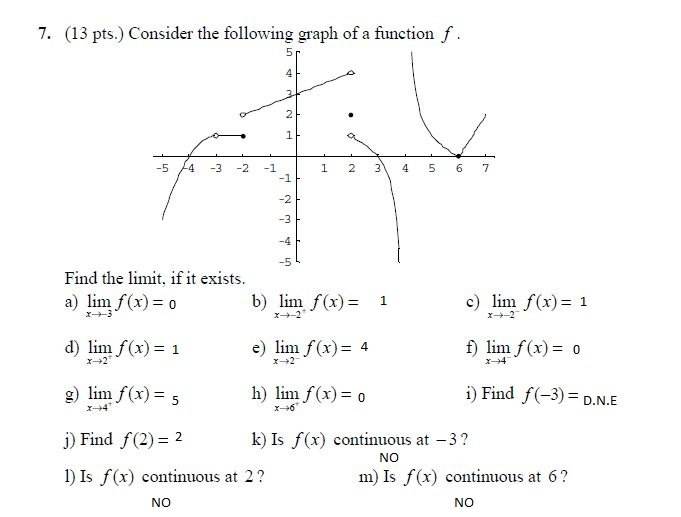
I'm having a really difficult time understanding limits from the graph. I don't completely understand how to find if the limit exists or not. I tried to do these for my homework but I don't know if they are right. Could someone please help me understand limits?
152hn36.jpg
 
Physics news on Phys.org
I'm having trouble reading the little + and - symbols in your limits. Is there any way you can display this at a higher resolution?

[edit] just noticed that in b and c, the limits are as x approaches -2, whereas in d and e, x approaches 2.

The first one that looks wrong is b. Is that the limit as x approaches -2 from the positive side? If so, the answer is not 1. To answer this question, ignore everything to the left of x = -2, and ignore what happens at x = -2 itself. Focus only on what the graph is doing as x approaches -2 from the right side. What number is the graph approaching?
 
B and C are -2, whereas D and E are +2. Going blind looking at it.
 
The limits appear to be:
\begin{align*}
\lim_{x \to -3} f(x) \\
\lim_{x \to -2^+} f(x) \\
\lim_{x \to -2^-} f(x) \\
\lim_{x \to 2^+} f(x) \\
\lim_{x \to 2^-} f(x) \\
\lim_{x \to 4^-} f(x) \\
\lim_{x \to 4^+} f(x) \\
\lim_{x \to 6^+} f(x)
\end{align*}
 
calculus123 said:
I'm having a really difficult time understanding limits from the graph. I don't completely understand how to find if the limit exists or not. I tried to do these for my homework but I don't know if they are right. Could someone please help me understand limits?
Explain how you arrived at your answers, so we can see where you're going wrong.
 

Similar threads

  • · Replies 10 ·
Replies
10
Views
2K
  • · Replies 7 ·
Replies
7
Views
1K
  • · Replies 16 ·
Replies
16
Views
3K
  • · Replies 8 ·
Replies
8
Views
2K
  • · Replies 7 ·
Replies
7
Views
2K
  • · Replies 9 ·
Replies
9
Views
3K
  • · Replies 5 ·
Replies
5
Views
2K
Replies
5
Views
2K
Replies
11
Views
2K
  • · Replies 4 ·
Replies
4
Views
1K