Maxwell Stress components of the energy-stress-momentum tensor

Click For Summary
SUMMARY

The discussion centers on the calculation of Maxwell stress components within the energy-stress-momentum tensor, specifically the expression for \( T^{\mu \nu} \). Participants highlight the importance of correctly applying the sign convention for the metric \( \eta^{\mu \nu} \) and emphasize the need to derive individual tensor components \( T^{\mu \nu} \) rather than summing them. Key corrections include ensuring the correct terms are used in calculations, such as replacing \( E_x^2 \) with \( E_z^2 \) and clarifying the expressions for \( T^{0i} \) and \( T^{ij} \). The discussion concludes with a method for demonstrating the conservation law \( \partial_\mu T^{\mu \nu} = 0 \) using Maxwell's equations.

PREREQUISITES
  • Understanding of the energy-stress-momentum tensor in electromagnetism
  • Familiarity with Maxwell's equations and their implications
  • Knowledge of tensor notation and index manipulation
  • Proficiency in using the metric tensor \( \eta^{\mu \nu} \)
NEXT STEPS
  • Study the derivation of the energy-stress-momentum tensor \( T^{\mu \nu} \) in detail
  • Learn about the implications of the conservation law \( \partial_\mu T^{\mu \nu} = 0 \)
  • Explore the role of the electromagnetic field tensor \( F^{\mu \nu} \) in deriving physical laws
  • Investigate the significance of the sign convention in tensor calculations
USEFUL FOR

Physicists, particularly those specializing in electromagnetism and field theory, as well as students and researchers working on the mathematical formulation of physical laws involving tensors.

milkism
Messages
118
Reaction score
15
Homework Statement
Find the Maxwell Stress components
Relevant Equations
See solution.
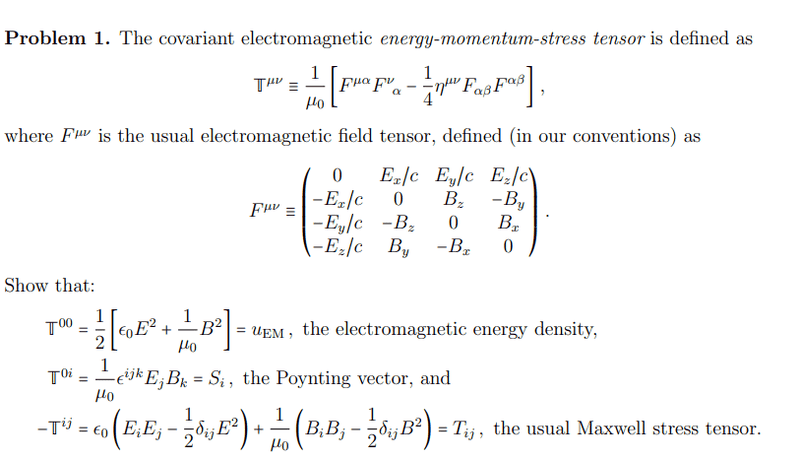
Question:
203f8bc0c7501d3b40241fdb78348b49.png

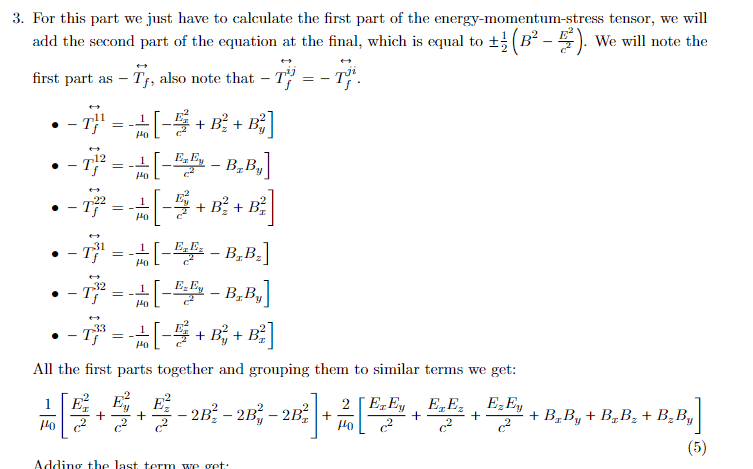
Solution:
I need help with the last part.
73175e5d1b5fba641f18dabe372c7ebd.png

I think my numerical factors are incorrect, even if I add the last term it will get worse. What have I done wrong, or is there a better way to deal with this?
 
Physics news on Phys.org
It's always a good idea to state the sign convention that you are using for the metric ##\eta^{\mu \nu}##. I think you are using ##\eta^{00} = -1## and ##\eta^{kk} = +1##.

We have ##T^{\mu \nu} = \frac 1 {\mu_0} \left[ F^{\mu \alpha}F^{\nu}_{\,\,\, \alpha} - \frac 1 4 \eta^{\mu \nu} [ F_{\alpha \beta}F^{\alpha \beta}\right]##

Your calculation of the spatial components of the first part ##T_f^{i j} = \frac 1 {\mu_0} F^{i \alpha}F^{j}_{\,\,\, \alpha}## looks right except where you have

1684073317532.png

The ##E_x^2## in the first term in the brackets should be ##E_z^2##. It's probably just a typo.

Then you write
1684074394743.png

I don't understand why you are adding together all of the ##T^{i j}##. Instead, you should just be finding expressions for the individual ##T^{i j}##, and also for ##T^{0 0}## and ##T^{0 i}##.
 
TSny said:
Then you write
View attachment 326543
I don't understand why you are adding together all of the ##T^{i j}##. Instead, you should just be finding expressions for the individual ##T^{i j}##, and also for ##T^{0 0}## and ##T^{0 i}##.
Do we need ##T^{00}## and ##T^{0i}##? Because the latin indices go from 1 to 3. Or did I misunderstood the question.
 
Yes, latin indices go from 1 to 3.

The problem asks you to find expressions for ##T^{0 0}, T^{0 i}, ## and ##-T^{i j}##.
So, you are essentially asked to find all the individual tensor components ##T^{\mu \nu}## for all values of the greek indices: ##\mu, \nu = 0, 1, 2, 3##.
 
TSny said:
Yes, latin indices go from 1 to 3.

The problem asks you to find expressions for ##T^{0 0}, T^{0 i}, ## and ##-T^{i j}##.
So, you are essentially asked to find all the individual tensor components ##T^{\mu \nu}## for all values of the greek indices: ##\mu, \nu = 0, 1, 2, 3##.
I have already have done first and second, I just want to do third one.
 
milkism said:
I have already have done first and second, I just want to do third one.
Ok. So, you are now just interested in finding the ##T^{i j}## for ##i, j = 1, 2, 3##. I see now where you stated that in the OP.

But I still don't understand why you are adding the various ##T^{i j}## together. That wouldn't have any physical meaning and the problem doesn't ask you to do that.
 
How else can I show that ##-T^{ij}## is equal to ##\epsilon_0 \left( E_i E_j - \frac{1}{2} \delta_{ij} E^2 \right) + \frac{1}{\mu_0} \left( B_i B_j - \frac{1}{2} \delta_{ij} B^2 \right)##. Without finding out all terms, adding them all together, and simplifying it to the given formula.
 
There is no summation implied in the notation ##T^{i j}##.

##T^{i j}## represents any one of nine components ##T^{11}, T^{12}, T^{13}, T^{21}, T^{22}, T^{23}, T^{31}, T^{32}, T^{33}##.

So, for example, you want to show that your result for ##T^{12}## agrees with the expression for ##T^{i j}## given below when ##i = 1## and ##j = 2##.

1684077258483.png
 
  • Care
Likes   Reactions: milkism
Wow! I just wasted lots of time for nothing, well it's nothing compared to first exercise where I went by every single ##\alpha##'s and ##\beta##'s (16 terms), where you could have usen the known expression ##F^{\alpha \beta} F_{\alpha \beta}## for second part of the tensor.
 
  • #10
milkism said:
Wow! I just wasted lots of time for nothing, well it's nothing compared to first exercise where I went by every single ##\alpha##'s and ##\beta##'s (16 terms), where you could have usen the known expression ##F^{\alpha \beta} F_{\alpha \beta}## for second part of the tensor.
I don't think you wasted your time in calculating the various ##T^{i j}##.

I think there is a typographical error in the statement of the problem :
1684078137175.png

[EDIT] I believe it should read $$T^{0i} = \frac 1 {\mu_0 c} \epsilon^{ijk}E_jB_k = \frac{1}{c} S^i$$ if ##\vec S## is defined as usual: ##\, \vec S = \frac 1 {\mu_0} \vec E \times \vec B \,\,\, ## (for free space).
 
Last edited:
  • Like
Likes   Reactions: vanhees71
  • #11
TSny said:
I don't think you wasted your time in calculating the various ##T^{i j}##.

I think there is a typographical error in the statement of the problem :
View attachment 326548
[EDIT] I believe it should read $$T^{0i} = \frac 1 c \epsilon^{ijk}E_jB_k = \frac{\mu_0}{c} S^i$$ if ##\vec S## is defined as usual: ##\, \vec S = \frac 1 {\mu_0} \vec E \times \vec B \,\,\, ## (for free space).
Yes, that's true.
 
  • #12
How can I show that ##\partial _ \mu T^{\mu \nu} = 0##?
Or ##\frac{\partial T^{0 \nu}}{c \partial t} + \frac{\partial T^{1 \nu}}{ \partial x^1} + \frac{\partial T^{2 \nu}}{ \partial x^2} + \frac{\partial T^{3 \nu}}{ \partial x^3} = 0##.
 
  • #13
milkism said:
How can I show that ##\partial _ \mu T^{\mu \nu} = 0##?
Or ##\frac{\partial T^{0 \nu}}{c \partial t} + \frac{\partial T^{1 \nu}}{ \partial x^1} + \frac{\partial T^{2 \nu}}{ \partial x^2} + \frac{\partial T^{3 \nu}}{ \partial x^3} = 0##.
I guess you need to show this for free space where there is no charge density or current density (otherwise, the equation is not true).

Do you know how to express Maxwell's equations in terms of derivatives of ##F^{\mu \nu}##?

If so, then you can show ##\partial _ \mu T^{\mu \nu} = 0## by first expressing ##T^{\mu \nu}## in terms of ##F^{\alpha \beta}## (as given at the beginning of Problem 1). Then try carrying out ##\partial _ \mu T^{\mu \nu}## and simplifying by using Maxwell's equations and the antisymmetry of ##F^{\alpha \beta}##. There will be some index gymnastics involved.
 
  • Like
Likes   Reactions: vanhees71 and milkism
  • #14
TSny said:
I guess you need to show this for free space where there is no charge density or current density (otherwise, the equation is not true).

Do you know how to express Maxwell's equations in terms of derivatives of ##F^{\mu \nu}##?

If so, then you can show ##\partial _ \mu T^{\mu \nu} = 0## by first expressing ##T^{\mu \nu}## in terms of ##F^{\alpha \beta}## (as given at the beginning of Problem 1). Then try carrying out ##\partial _ \mu T^{\mu \nu}## and simplifying by using Maxwell's equations and the antisymmetry of ##F^{\alpha \beta}##. There will be some index gymnastics involved.
Wow, thought it would be easier.
 

Similar threads

  • · Replies 0 ·
Replies
0
Views
1K
  • · Replies 6 ·
Replies
6
Views
2K
  • · Replies 3 ·
Replies
3
Views
2K
  • · Replies 5 ·
Replies
5
Views
3K
  • · Replies 3 ·
Replies
3
Views
4K
  • · Replies 3 ·
Replies
3
Views
3K
Replies
8
Views
2K
  • · Replies 10 ·
Replies
10
Views
682
  • · Replies 1 ·
Replies
1
Views
5K
  • · Replies 10 ·
Replies
10
Views
3K