Mechanics of Materials — Torsional Stress on a Spinning Shaft

Click For Summary
SUMMARY

The discussion centers on understanding torsional stress in a freely spinning shaft as described in the "Torsion" chapter of a mechanics of materials textbook. Participants clarify that while the shaft is not fixed, it still experiences torsional shear due to the dynamic interaction between the motor's driving moment and the resisting moment from the attached load. The relationship between power, torque, and angular velocity is emphasized, highlighting that power remains constant unless torque or angular velocity reaches zero. The tension drop across the pulley is identified as a critical factor in calculating the torque applied to the shaft.

PREREQUISITES
  • Understanding of torsional stress and shear stress in mechanics of materials
  • Familiarity with power transmission concepts in rotating systems
  • Knowledge of torque, angular velocity, and their interrelationship
  • Basic principles of pulley systems and belt tension dynamics
NEXT STEPS
  • Study the derivation and application of the torsional stress formula in rotating shafts
  • Learn about the relationship between torque, power, and angular velocity in mechanical systems
  • Investigate the effects of belt tension and pulley radius on torque calculations
  • Explore fixed versus freely spinning shaft scenarios in mechanics of materials
USEFUL FOR

Mechanical engineers, students of mechanics of materials, and professionals involved in power transmission system design will benefit from this discussion.

mhrob24
Messages
53
Reaction score
9
Summary:: Torsional stress on freely spinning shaft?

Hey guys,

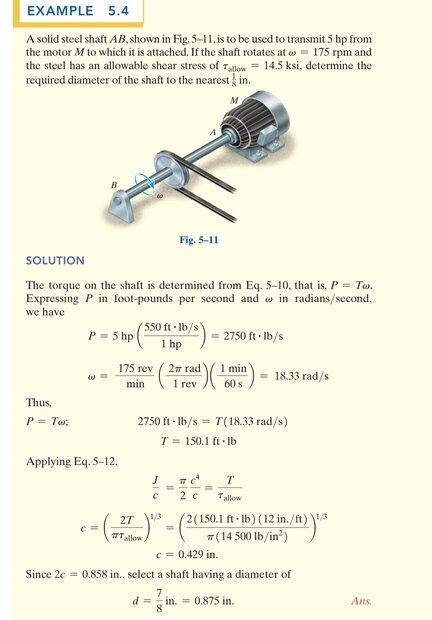
I’m having some confusion with a certain section of the “Torsion” chapter in my mechanics of materials book: “power transmission”.

Please see the problem below. This is very easy to SOLVE (basically plug and chug with the equations), but conceptually, I am not understanding something:

I do not see how we are allowed to use the torsional formula to solve for the minimum shaft DIA when from what I see, there is no TORSIONAL stress. The problems that were explained earlier in the chapter made sense because they were FIXED at one end. So the support fights the rotation, and because of this, the polar moment of inertia due to the shaft geometry is fighting torsional deformation. Without the support, the way I see it currently, the polar moment of inertia isn’t really “fighting” anything…right?

Like, when I look at this: all I see stress-wise is a shear stress due to reaction forces from the “supports” (the motor attachment point and the bearing support) that prevent translation of the shaft, and the shear stress from the tension force of that belt (but it’s not given, so it’s assumed zero). I know it doesn’t say to solve for torsional stress, but we’re using the torsional stress formula to solve it.

Idk where I’m going wrong here, but I’m spending too much time thinking about this now….
5C118DA7-5888-4086-B772-1DC62B959628.jpeg
 
Physics news on Phys.org
Thanks for the response.

I’m not really seeing how that’s possible. The 5 HP is the power from the motor. The belt isn’t spinning the shaft.

And even so, like I said, I do see that there is a shear stress developed in the shaft due to the belt tension, but how is that torsional shear? The shaft is allowed to spin. There isn’t a resistance to the twisting
 
The nature of this problem is the same as of the problems that were explained earlier in the chapter that were fixed at one end (zero angular velocity ω): two moments are fighting each other; one is a dynamic situation (ω > 0) and the other one is a static one (ω = 0).

The motor induces a driving moment and the rotating thing at the other end of the belt loop induces a resisting moment while it rotates.

The size of the belt is selected based on the calculation of its tension while normally rotating; therefore, there is certain amount of tangential force, which induces certain amount of moment or torque on the shaft when combined with the radius of the belt middle line.

Same principle would apply if the transmision of power were done via roller chain or gears.
 
Last edited:
Hey, nice to hear from you again.

This does make a lot of sense. I guess because it’s moving I felt like it wasn’t fighting anything, but like you said: there is still a resistance from whatever is attached to that belt; regardless of if it’s moving or not. Not sure why I didn’t see that…..

So just be sure I’m correctly thinking about how these equations work: power (mechanical) is work per second…..or in other words, torque times angular velocity. So solving for torque, you get power divided by angular velocity. So as the weight of whatever is being pulled goes up, the angular velocity would drop (there would be less cycles per second) which would mean torque is proportionally increased. So basically, the power supplied from the motor is constant unless angular velocity or torque is zero. This seems odd to me for some reason.
 
The belt tension coming into the pulley is different from that coming out of the pulley. So there is a tension drop across the pulley. This tension drop times the pulley radius is equal to the torque the load applies to the pulley and the pulley, in turn, applies to the shaft.
 
  • Like
Likes   Reactions: Lnewqban

Similar threads

  • · Replies 1 ·
Replies
1
Views
2K
  • · Replies 2 ·
Replies
2
Views
3K
Replies
1
Views
5K
  • · Replies 2 ·
Replies
2
Views
3K
  • · Replies 6 ·
Replies
6
Views
2K
  • · Replies 1 ·
Replies
1
Views
2K
  • · Replies 6 ·
Replies
6
Views
4K
  • · Replies 1 ·
Replies
1
Views
2K
  • · Replies 5 ·
Replies
5
Views
3K
  • · Replies 2 ·
Replies
2
Views
2K