- 8,519
- 17
I was recently reading about the Meissner effect, in which certain superconductors are able to "exclude" any external magnetic field lines from their interior, as seen in the right half of this diagram:
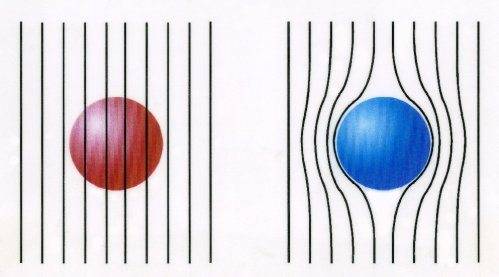
I understand that some superconductors exhibit a sort of imperfect Meissner effect in which some field lines do pass through localized "flux tubes" in the material of the superconductor, an effect known as flux pinning, but in the case of a superconductor that exhibits a perfect Meissner effect, does this imply that there is never a net magnetic force on the superconductor, so no external magnetic field will cause it to accelerate in any direction?
If the answer to that last question is "yes", then I'm wondering how conservation of momentum is ensured in examples of magnetic levitation involving such a superconductor. As described on this page:
This would seem to imply that if you place a permanent magnet next to this type of superconductor in zero gravity, the permanent magnet will accelerate away from it, gaining momentum in that direction. But if there's no net magnetic force on the superconductor, this can't be balanced out by it being accelerated in the opposite direction, can it? If not, I imagine the change in momentum of the permanent magnet must be balanced by a change in linear momentum carried by the electromagnetic field (either in EM waves or in some other form)--is this conclusion correct or is there some error in my understanding?
I understand that some superconductors exhibit a sort of imperfect Meissner effect in which some field lines do pass through localized "flux tubes" in the material of the superconductor, an effect known as flux pinning, but in the case of a superconductor that exhibits a perfect Meissner effect, does this imply that there is never a net magnetic force on the superconductor, so no external magnetic field will cause it to accelerate in any direction?
If the answer to that last question is "yes", then I'm wondering how conservation of momentum is ensured in examples of magnetic levitation involving such a superconductor. As described on this page:
Magnetic fields are actively excluded from superconductors (Meissner effect). If a small magnet is brought near a superconductor, it will be repelled becaused induced supercurrents will produce mirror images of each pole. If a small permanent magnet is placed above a superconductor, it can be levitated by this repulsive force.
This would seem to imply that if you place a permanent magnet next to this type of superconductor in zero gravity, the permanent magnet will accelerate away from it, gaining momentum in that direction. But if there's no net magnetic force on the superconductor, this can't be balanced out by it being accelerated in the opposite direction, can it? If not, I imagine the change in momentum of the permanent magnet must be balanced by a change in linear momentum carried by the electromagnetic field (either in EM waves or in some other form)--is this conclusion correct or is there some error in my understanding?