What happens to the temperature of a superconductor?

Click For Summary

Discussion Overview

The discussion revolves around the temperature behavior of superconductors, particularly in relation to their switching states during a thermodynamic cycle. Participants explore the implications of temperature changes when a superconductor transitions between its superconducting and normal states, referencing both theoretical and experimental aspects.

Discussion Character

  • Exploratory
  • Technical explanation
  • Debate/contested
  • Mathematical reasoning

Main Points Raised

  • One participant describes a setup involving a stationary magnet and a moving magnet in relation to a Type I superconductor, questioning the temperature changes after switching the superconducting state.
  • Another participant challenges the symmetry of the force vs. distance curve, suggesting it should be asymmetric when the superconductor is in a superconducting state.
  • There is a discussion about the net area under the curves being zero in both scenarios, but the total area being greater for the blue curve (T < Tc) than for the red curve (T > Tc).
  • Participants agree that the point where the force switches sign will differ between the superconducting and normal states.
  • There is a query about the thermodynamic cycle of the superconductor, specifically under the assumption of an adiabatic process.
  • A participant notes that results from a specific software (flux software) should be considered, while dismissing results from Type II superconductors as incorrect.

Areas of Agreement / Disagreement

Participants generally agree on the differences in the force switching points between the superconducting and normal states, but there is no consensus on the implications for the temperature changes during the thermodynamic cycle. The discussion remains unresolved regarding the complete thermodynamic cycle of the superconductor.

Contextual Notes

Participants reference early papers by Keesom regarding temperature drops, but there is no confirmation or detailed discussion on the thermodynamic cycle's assumptions or implications. The discussion also highlights potential limitations in the models used for Type II superconductors.

nithinyes
Messages
15
Reaction score
0
TL;DR
In the following setup, what would happen to the temperature of the superconductor after on cycle?
Consider the following setup:

11.png

Stationary magnet and Superconductor are fixed and Moving magnet is allowed to move freely in the horizontal direction.
Assume the superconductor as Type I superconductor.

Following figure shows the Horizontal Force acting on Moving Magnet vs Distance curve:
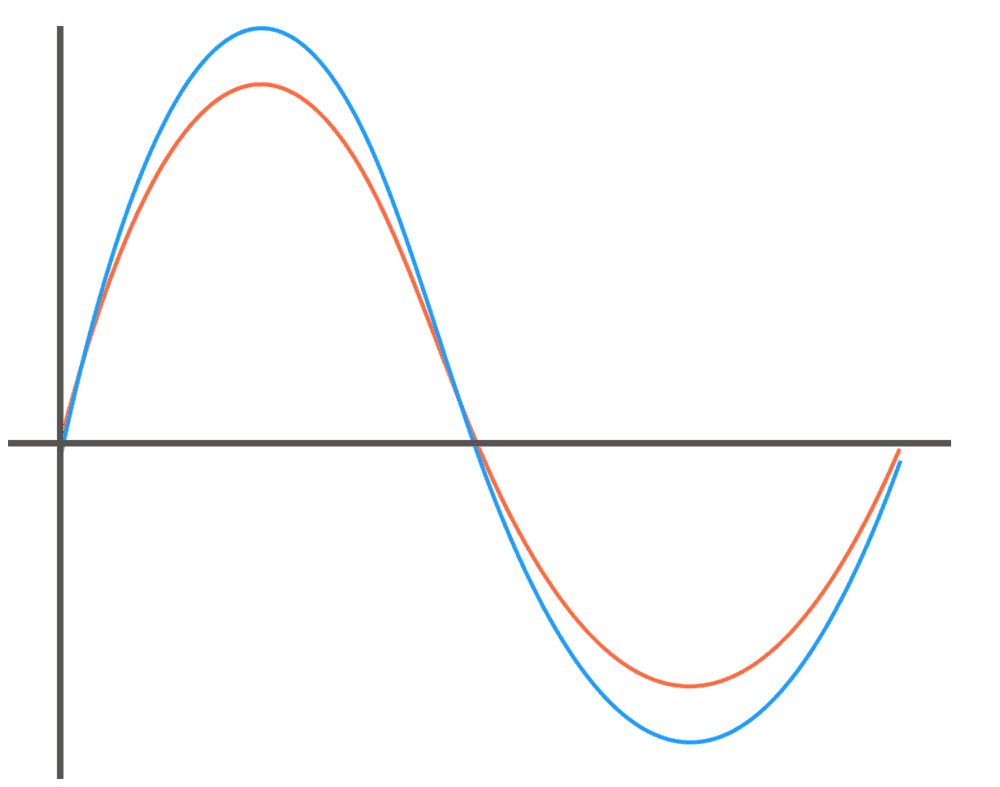
Screenshot 2020-10-25 at 6.34.01 PM.png

Red is when Superconductor is at temperature greater than critical temperature of superconductor (T > Tc).
Blue is when Superconductor is cooled down to a temperature less than critical temperature of superconductor (T < Tc).

Switching of superconducting state using Temperature in Meissner motor is discussed by A Takeoka et.al (1989).
Switching of superconducting state using Current Density in Superconductor actuator is discussed by Y Kim et.al (1989).

However, any device using switching of superconducting state using magnetic field is not discussed in the literature to my knowledge.

If we switch superconducting state of the superconductor from on to off, is it possible to switch from blue curve to red curve after the half cycle?

Following is an illustration of magnetic field distribution with shaded region having H > Hc:
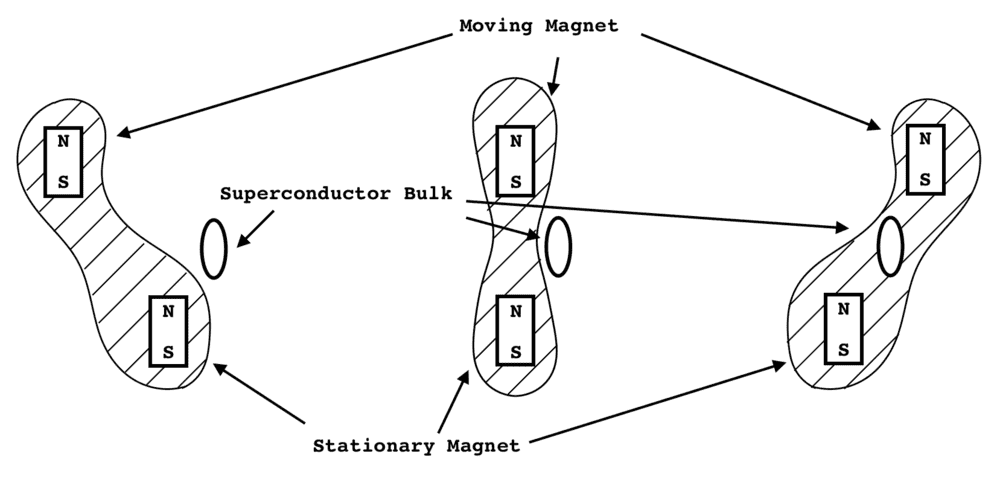
18.png

What would happen to the temperature of superconductor after one complete cycle?
Early papers from Keesom shows the drop in temperature. Any confirmation or discussion would help.
Need understanding of complete thermodynamic cycle of the superconductor.
 
Physics news on Phys.org
nithinyes said:
Following figure shows the Horizontal Force acting on Moving Magnet vs Distance curve:
That doesn't look right, in particular it should be asymmetric based on the sketch.
 
mfb said:
That doesn't look right, in particular it should be asymmetric based on the sketch.
The figure is just for illustration. Yes, it should be asymmetric when the superconductor is in superconducting state and symmetric when it is not. Also the ends would flatten.

One can obtain these results from any commercial software, I used flux software.

The point is that the net area in both cases is zero. But the total area is greater with blue curve than red curve. Agree?
 
nithinyes said:
The point is that the net area in both cases is zero. But the total area is greater with blue curve than red curve.
Looks plausible. The point where the force switches its sign will differ between the two scenarios.
 
mfb said:
Looks plausible. The point where the force switches its sign will differ between the two scenarios.
Absolutely, the switching point differs.
Now, what about the thermodynamic cycle, assuming adiabatic process.
 
nithinyes said:
Absolutely, the switching point differs.
Now, what about the thermodynamic cycle, assuming adiabatic process.
Anyone?
 
mfb said:
Looks plausible. The point where the force switches its sign will differ between the two scenarios.
s5.png

Above are the actual results from flux software. Kindly ignore results from Type II(the model implemented is not correct)
 

Similar threads

  • · Replies 3 ·
Replies
3
Views
2K
  • · Replies 13 ·
Replies
13
Views
3K
  • · Replies 2 ·
Replies
2
Views
18K
  • · Replies 1 ·
Replies
1
Views
2K
  • · Replies 54 ·
2
Replies
54
Views
6K
  • · Replies 7 ·
Replies
7
Views
3K
  • · Replies 8 ·
Replies
8
Views
6K
Replies
2
Views
2K
  • · Replies 2 ·
Replies
2
Views
2K
  • · Replies 3 ·
Replies
3
Views
12K