Mercury Precession and the Hypothetical Oblate Sun Model

  • Context: Undergrad 
  • Thread starter Thread starter universityteacher
  • Start date Start date
  • Tags Tags
    Mercury Precession
Click For Summary

Discussion Overview

The discussion revolves around the precession of Mercury's orbit and the potential role of the Sun's oblateness in explaining this phenomenon. Participants explore whether the Sun's mass distribution could account for Mercury's precession without invoking General Relativity, examining both theoretical and hypothetical models.

Discussion Character

  • Debate/contested
  • Technical explanation
  • Conceptual clarification

Main Points Raised

  • One participant suggests modeling the Sun's oblateness by splitting its mass and calculating the resulting acceleration on a point mass, proposing that if the Sun is sufficiently oblate, it might explain Mercury's precession without relativity.
  • Another participant argues that the Sun, being a gas (plasma), has a mass distribution that is likely spherical, with rotation being the primary factor affecting its shape.
  • Concerns are raised about the uncertainty in the Sun's mass distribution, with one participant noting that the tidal gravitational influence of planets is negligible compared to the Sun's oblateness from rotation.
  • Some participants reference the solar quadrupole moment and provide links to external resources, suggesting that while the Sun is known to be oblate, its contribution to Mercury's perihelion shift is minimal compared to General Relativity.
  • There is a discussion about the implications of gas dynamics on mass distribution, with some participants asserting that a gas or plasma can adjust its mass distribution under gravitational effects, while others question the certainty of the Sun's internal structure.
  • One participant emphasizes that multiple independent measurements support the current understanding of the Sun's quadrupole moment, while another insists that there could still be more mass concentrated at the equator.

Areas of Agreement / Disagreement

Participants express differing views on the significance of the Sun's oblateness and its ability to account for Mercury's precession without relativity. There is no consensus on the nature of the Sun's mass distribution or the extent to which it affects Mercury's orbit.

Contextual Notes

Participants acknowledge limitations in understanding the Sun's internal structure and mass distribution, noting that while some measurements exist, uncertainties remain regarding the exact nature of the Sun's oblateness.

universityteacher
Messages
5
Reaction score
0
I have a student who thinks he is smarter than me.
When we calculate the precession the classical way we also account for the supposed oblate sun. If we model sun's oblateness by splitting the mass of the Sun into 2 masses and separate them by distance s, then the acceleration we get on point mass particle on x-axis is: a = - M/2 / [ (r + s)^2 ] - M/2 / [ (r - s)^2 ] and the equation that describe the motion takes on this form:
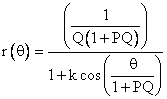
image024.gif

the ellipse will precess by 2(pi)PQ radians per revolution.

Now when we are modelling oblate sun (shape wise) we are actually modelling oblate sun mass wise. And so hypothetically if the sun is oblate enough (mass wise), then could we explain Mercury without Relativity.
I was telling him yes he could make this ridiculous claim and commit this blasphemy but he wouldn't get hired anywhere with that kind of attitude.
I was thinking of ways to prove that density of sun is not oblate (mass wise) and that we can use the shell theorem at will. Is there a way to prove our density of sun model or is his claim purely hypothetical at best?
 
Physics news on Phys.org
Because it is a gas (plasma), mass would be spherically distributed, except for the effect of rotation. I presume this is not enough to account for the Mercury problem.
 
I forgot to mention (sorry) that he was talking about mass moved to the equator by the pull of the planets (not Sun by itself). The problem here is that it looks like we cannot say for sure how the mass is distributed in the Sun.
 
universityteacher said:
I was thinking of ways to prove that density of sun is not oblate (mass wise)

How is this different from proving that it isn't oblate shape wise?
 
universityteacher said:
I forgot to mention (sorry) that he was talking about mass moved to the equator by the pull of the planets (not Sun by itself). The problem here is that it looks like we cannot say for sure how the mass is distributed in the Sun.
The tidal gravitational influence of the planets on the sun is well-known, and completely negligible compared to the oblateness from rotation. The oblateness from rotation is also well-known, and its contribution to the perihelion shift is negligible (less than 0.1% of the contribution from GR). Sure, you can discuss a tiny correction to a tiny effect, but it is utterly negligible.
 
Dale said:
This is known as the solar quadrupole moment. Here is a good reference

http://cds.cern.ch/record/516377/files/0109032.pdf

mathman said:
except for the effect of rotation.
Is this what you mean by "known as the solar quadrupole moment?" Isn't that simulation done on a model of the Sun? The problem is we cannot know if mass is distributed spherically or oblately in the Sun. We have built a model of the Sun and are just running simulations on it.
 
Last edited:
universityteacher said:
The problem is we cannot know if mass is spherical or oblate in the Sun.
We know the mass is oblate, we know pretty well just how oblate it is, and we know how much that affects the orbit of Mercury.
 
PeterDonis said:
How is this different from proving that it isn't oblate shape wise?
We might claim if the shape is round the mass distribution must also be round, but we're talking about gas(plasma). The mass distribution in gas as a whole can still be more in the equator. The problem here is we cannot know how it is on the inside.
 
  • #10
mfb said:
The tidal gravitational influence of the planets on the sun is well-known, and completely negligible compared to the oblateness from rotation. The oblateness from rotation is also well-known, and its contribution to the perihelion shift is negligible (less than 0.1% of the contribution from GR). Sure, you can discuss a tiny correction to a tiny effect, but it is utterly negligible.
mfb said:
The tidal gravitational influence of the planets on the sun is well-known
What do you mean by that? There could still be more mass in the equator. There could be or absolutely not? If there is than we can explain Mercury without Relativity.
 
  • #11
universityteacher said:
What do you mean by that? There could still be more mass in the equator. There could be or absolutely not? If there is than we can explain Mercury without Relativity.
Please read the material provided. The sun is oblate. We have both theoretical values and measured values for its quadrupole moment. Neither the theoretical nor the measured oblateness is sufficient to explain the precession of Mercury's orbit without relativity.

Please stop posting incorrect claims that have already been addressed.
 
  • #12
universityteacher said:
We might claim if the shape is round the mass distribution must also be round, but we're talking about gas(plasma).

The mass distribution will be more like the shape for a gas or plasma than it will for a liquid or especially a solid. In a gas or plasma there is effectively no internal force that prevents the mass distribution from adjusting itself to the effects of gravity, which is what determines the shape.
 
  • Like
Likes   Reactions: stoomart, vanhees71 and Dale
  • #13
universityteacher said:
We might claim if the shape is round the mass distribution must also be round, but we're talking about gas(plasma). The mass distribution in gas as a whole can still be more in the equator. The problem here is we cannot know how it is on the inside.
We can know it, and we do know it.
A plasma is in hydrostatic equilibrium to an extremely good approximation (and we can measure the deviations). We also have helioseismography to probe the interior structure and we can use the differential rotation of poles and equators as cross-check. Multiple independent measurements all lead to consistent, small values for the quadrupole moment.
universityteacher said:
There could still be more mass in the equator.
Only within the uncertainties. The oblateness might be 20% smaller or larger than the current best estimate. But it is not a factor 1000 larger.
 
  • Like
Likes   Reactions: Dale

Similar threads

  • · Replies 5 ·
Replies
5
Views
5K
  • · Replies 6 ·
Replies
6
Views
2K
  • · Replies 9 ·
Replies
9
Views
3K
  • · Replies 11 ·
Replies
11
Views
2K
  • · Replies 6 ·
Replies
6
Views
2K
  • · Replies 6 ·
Replies
6
Views
2K
Replies
6
Views
2K
  • · Replies 2 ·
Replies
2
Views
3K
  • · Replies 2 ·
Replies
2
Views
3K
  • · Replies 1 ·
Replies
1
Views
2K