Method to create a high current and low voltage

Click For Summary

Discussion Overview

The discussion centers around the feasibility of creating a circuit that can produce a very high current (200 million amps) at a very low voltage, with participants exploring various technical aspects, potential applications, and implications of such a setup.

Discussion Character

  • Exploratory
  • Technical explanation
  • Debate/contested

Main Points Raised

  • Some participants inquire whether the desired output is AC or DC, and what specific application is intended for such high current.
  • One participant mentions the need to sustain the high current for 0.18 seconds and questions the proximity of the nearest power substation.
  • There are discussions about the implications of using a large capacitor bank to achieve the desired current and the necessary capacitance for energy storage.
  • Concerns are raised about the feasibility of producing 200 million amps, with references to historical applications of high current in aluminum production and skepticism regarding the claim of such high currents being achievable.
  • Participants discuss the potential use of Bitter coils and the energy implications of high currents, suggesting that the energy involved could be equivalent to significant amounts of TNT.
  • Some participants express doubts about the seriousness of the original question and suggest that it may be a form of trolling.
  • There are mentions of practical experiences with high current applications and the challenges associated with managing such currents in real-world scenarios.

Areas of Agreement / Disagreement

Participants express a range of views, with some skepticism about the feasibility of the proposed current levels and others sharing personal experiences related to high current applications. No consensus is reached regarding the practicality of achieving 200 million amps at low voltage.

Contextual Notes

Participants highlight various assumptions regarding circuit impedance, energy storage requirements, and the physical limitations of materials when dealing with such high currents. There are unresolved questions about the specific application and the technical details necessary for implementation.

Who May Find This Useful

This discussion may be of interest to those exploring high current applications in electrical engineering, researchers in experimental physics, and individuals involved in industrial applications of high currents.

Siddhartha Peri
Messages
4
Reaction score
0
How would I be able to produce a circuit that produces a very high current at a very low voltage? Would it be considered a reverse Tesla coil?
 
Engineering news on Phys.org
Siddhartha Peri said:
How would I be able to produce a circuit that produces a very high current at a very low voltage? Would it be considered a reverse Tesla coil?
Welcome to the PF. :smile:

Are you wanting AC or DC high current capability? What level of current are you asking for? Can you say what the application is?
 
berkeman said:
Welcome to the PF. :smile:

Are you wanting AC or DC high current capability? What level of current are you asking for? Can you say what the application is?

DC high current capability, 200 million amps, research study
 
Siddhartha Peri said:
DC high current capability, 200 million amps, research study
Woo doggies! That's a lot of amps. How long do you need to sustain this level of DC current? How close is the nearest power substation?
 
  • Like
Likes   Reactions: Klystron
berkeman said:
Woo doggies! That's a lot of amps. How long do you need to sustain this level of DC current? How close is the nearest power substation?

I believe for 0.18 seconds and the nearest substation is 30 miles away.
 
Siddhartha Peri said:
I believe for 0.18 seconds and the nearest substation is 30 miles away.
Your Profile page says you are in Undergrad right now. Do you have an advisor for this research work? What is your budget for creating this facility?
 
berkeman said:
Your Profile page says you are in Undergrad right now. Do you have an advisor for this research work? What is your budget for creating this facility?

Yes I do have an advisor and we have a budget of 250k.
 
What degree are you pursuing? Have you looked into charging a (very) large capacitor bank? What capacitance would be needed to store that kind of energy?
 
Siddhartha Peri said:
How would I be able to produce a circuit that produces a very high current at a very low voltage?
What is a very low voltage? Is it 20uV, 1V or 50V ?

Where will the 200 million amp current flow? That will identify the load voltage, and so the energy storage requirement.
How might you switch such a current?

Are you making a magnetic field using a Bitter electromagnet? If so, have you considered the implications of inductance in the circuit?
There are also Marx impulse generators that produce a circular current rather than a high voltage.

You must explain the application so we do not have to guess which answers might be most appropriate. We probably know many of the possible answers to your open-ended question.
 
  • #11
?
upload_2018-8-1_8-51-5.png
?
 

Attachments

  • upload_2018-8-1_8-51-5.png
    upload_2018-8-1_8-51-5.png
    97.4 KB · Views: 953
  • Like
Likes   Reactions: berkeman
  • #12
Siddhartha Peri said:
Yes I do have an advisor and we have a budget of 250k.
Is that budget in joules, Rupee, Yen or US$?

We cannot help you if you are unable to communicate.
 
  • Like
Likes   Reactions: Klystron, NTL2009, berkeman and 1 other person
  • #13
haha - I'll just leave THIS here...
 
  • Like
Likes   Reactions: NTL2009, anorlunda and berkeman
  • #14
In the 1970s I worked at a plant installing radio controls on the cranes over aluminum potlines. Aluminum is made by passing a high current through a mixture of bauxite and an electrolyte. In one plant there were 8 potlines, each running about 200,000 amps. The pots are in series with about 5 volts across each one and 750 volts across the whole line. The conductors produced about 200 gauss which was enough to saturate the powdered metal cores in the radio receivers and detune them. And yes, this plant was very close to a power station.

As such I am very skeptical of the claim that 100,000 amps is by far the highest current ever produced in the world. By the way isn't RT the name of the magazine that used to be called Russia Today?
 
  • #15
skeptic2 said:
As such I am very skeptical of the claim that 100,000 amps is by far the highest current ever produced in the world.
I think the 100,000 amp record was only for a superconductor.
 
  • #16
A railgun uses a principle where they charge up a fairly capacitor bank and then discharge it at high current when they want to fire it.
 
  • #17
Current density is the limiting factor.

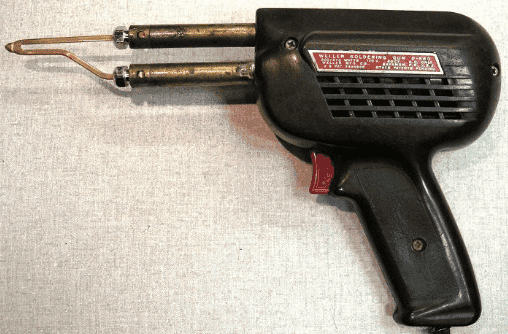
For more reasonable currents in a household experimental environment ,
buy a secondhand soldering gun to take apart and play with.

upload_2018-8-3_12-56-58.png


low voltage high current out of those two stubs.

Junk shops are full of them, around here they go for five bucks..
 

Attachments

  • upload_2018-8-3_12-56-58.png
    upload_2018-8-3_12-56-58.png
    80.8 KB · Views: 1,110
  • #18
jim hardy said:
upload_2018-8-3_12-56-58-png.png


low voltage high current out of those two stubs.
Heck. I still use mine.

jim hardy said:
Junk shops are full of them, around here they go for five bucks.
I really need to visit that junk shop with a pocket full of money. :approve:
 

Attachments

  • upload_2018-8-3_12-56-58-png.png
    upload_2018-8-3_12-56-58-png.png
    80.8 KB · Views: 892
  • Like
Likes   Reactions: jim hardy
  • #19
skeptic2 said:
The conductors produced about 200 gauss ..
I thought you were going to say the conductors were jumping around causing damage. :olduhh:
 
  • #20
High currents are invariably used for high magnetic fields. The strongest magnetic fields I believe are created using optimised Bitter coils with an explosive compression. The energy involved in 200Mega-amp with a 1 volt drop for 0.2 seconds is equivalent to 40kg of TNT.

It seems the OP has simply reversed the voltage and current specifications of a Tesla coil or lightning strike without considering the circuit impedance R+jX, energy, or the square law. I do not believe the OP is really serious about the question.
 
  • Like
Likes   Reactions: anorlunda and jim hardy
  • #21
In the early 1980s I was working in an industrial research institute. Several projects had to do with new and non-standard ways of doing things related to the offshore oil business. One project in particular was about detecting internal cracks in subsea pipes using magnetic field measurements. As far as I remember, the voltage used to drive the current had to be below 1V, otherwise the sea water would start to conduct. Since such a pipe is large, there would be very little resistance between the two voltage supply points. Therefore: Low voltage, high current.

I may not recall correctly, but my mind suddenly pictured 0.85V and 100A.

No, I do not know what happened to that project.
 
  • #22
dlgoff said:
Heck. I still use mine.
Me too. Great for car wiring - trailer lights, repairs,
and if you replace the tip with a coil of #12 solid you have a demagnetizer for hand tools tape heads and the like. . Worked great when an unshielded subwoofer underneath my Sony Triniton turned that corner of the screen purple. (today's flatscreens seem unaffected )

Will pick one up for you.

old jim
 
  • Like
Likes   Reactions: dlgoff and Asymptotic
  • #23
CERN's record is only 20 Kamps but that is for a fairly long superconductor. https://home.cern/about/updates/2014/04/world-record-current-superconductor
Isn't it true that the magnetic field that the superconductor creates will quench the superconductor at some critical field.strength limiting the maximum current?

What is the object of OP experiment?

For 200 Mamps an ordinary conductor would have to be short with a large crossectional area. If you do the calcs a 1m long by 10 x10 cm copper buss it would probably explode with that current flowing for a time significantly less than 0.18 sec.

The energy released using E = I2Rt is about 12 GJ for the aforementioned buss would be equivalent to about 1.5 tonnes of TNT

Baluncore said:
The energy involved in 200Mega-amp with a 1 volt drop for 0.2 seconds is equivalent to 40kg of TNT.

To drive 200 Mamps with 1 V you would need something like a 1 meter cubed block of copper.

Think about it can you deliver that amount of energy in that time frame from any reasonable physical setup. you would blow up the transmission line.

Siddhartha Peri said:
Yes I do have an advisor and we have a budget of 250k.

Not sure about the adviser.
 
  • Like
Likes   Reactions: Asymptotic
  • #24
gleem said:
What is the object of OP experiment?
Right now it looks like he was just trolling. Still, it generated an interesting discussion about high-current applications in the real world (not his world)...
 
  • Like
Likes   Reactions: Klystron and Asymptotic
  • #25
Svein said:
I may not recall correctly, but my mind suddenly pictured 0.85V and 100A.
When a welding level regulated current passes through a poor weld, there is a change in the flow path of the current that can be detected by magnetic powder, or mapped with hall effect sensors. That technique of crack detection has been used for many years.
 
  • Like
Likes   Reactions: Asymptotic and jim hardy
  • #26
FWIW

Our main generator armature current was around 20 kiloamps. The armature conductors were made of square strands stacked together and insulated from one another so magnetic effects wouldn't push all the current out to the periphery by 'skin effect'. They left lengthwise internal passages through which hydrogen gas flows for cooling.

Haven't found a picture yet.

old jim
 
  • #27
jim hardy said:
Haven't found a picture yet.
A bit of an advertising (sorry), but the main point can be seen here.
 
  • Like
Likes   Reactions: jim hardy
  • #28

Attachments

  • upload_2018-8-6_14-25-24.png
    upload_2018-8-6_14-25-24.png
    30.5 KB · Views: 641
  • Like
Likes   Reactions: Asymptotic
  • #29
jim hardy said:
Me too. Great for car wiring - trailer lights, repairs,
and if you replace the tip with a coil of #12 solid you have a demagnetizer for hand tools tape heads and the like. . Worked great when an unshielded subwoofer underneath my Sony Triniton turned that corner of the screen purple. (today's flatscreens seem unaffected )

Will pick one up for you.

old jim
Another useful repurposing is to supply the soldering gun with a variac, add an ammeter, and use it as an adjustable high current source to check whether motor starter thermal overload relays trip at their rated values. It can also be used to check the calibration of, and set up AC current to 4-20 ma/0-10V signal conditioners.
 
  • Like
Likes   Reactions: dlgoff, Tom.G, jim hardy and 1 other person
  • #30
jim hardy said:
Current density is the limiting factor.

For more reasonable currents in a household experimental environment ,
buy a secondhand soldering gun to take apart and play with.

View attachment 228778

low voltage high current out of those two stubs.

Junk shops are full of them, around here they go for five bucks..
Waitaminnit ... how did my soldering gun end up into that junk shop?
 

Similar threads

  • · Replies 3 ·
Replies
3
Views
2K
Replies
17
Views
2K
  • · Replies 49 ·
2
Replies
49
Views
5K
  • · Replies 31 ·
2
Replies
31
Views
3K
  • · Replies 38 ·
2
Replies
38
Views
5K
  • · Replies 3 ·
Replies
3
Views
2K
  • · Replies 18 ·
Replies
18
Views
3K
  • · Replies 10 ·
Replies
10
Views
3K
  • · Replies 20 ·
Replies
20
Views
5K
  • · Replies 3 ·
Replies
3
Views
2K