Moment of intertia of a cuboid

  • Context: Undergrad 
  • Thread starter Thread starter Stickybees
  • Start date Start date
  • Tags Tags
    Intertia Moment
Click For Summary
SUMMARY

The total moment of inertia (MOI) of a cuboid is calculated using the formula I = (1/12)m(C² + D²), where m is the mass of the cuboid, given by m = ρABh, with ρ representing the homogeneous mass density. The derivation involves integrating over the dimensions of the cuboid, specifically using the dimensions A, B, C, and D. The MOI is influenced by the axis of rotation, as demonstrated by the varying MOI of a slender rod depending on its rotational axis.

PREREQUISITES
  • Understanding of moment of inertia concepts
  • Familiarity with integration techniques in calculus
  • Knowledge of mass density and its implications
  • Basic geometry of cuboids and their dimensions
NEXT STEPS
  • Study the derivation of moment of inertia for different geometric shapes
  • Explore the impact of axis of rotation on moment of inertia
  • Learn about the applications of moment of inertia in engineering and physics
  • Investigate the relationship between mass density and structural integrity
USEFUL FOR

Students and professionals in physics, mechanical engineering, and structural analysis who are looking to deepen their understanding of moment of inertia calculations and their applications in real-world scenarios.

Stickybees
Messages
36
Reaction score
0
Simple question but I've never been through the proofs to know what I'm plugging into.
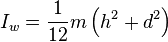
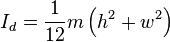
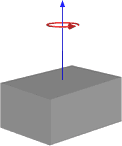
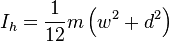
Are these components of the cuboid and can they just be added together for the total moment of inertia?
697f71993a53e52705d538d750276d06.png

3caec6a10252dea4cf7f31a060e9a065.png

81f6d018fceaad3d5a0de6939a9c1f0a.png

Moment_of_inertia_solid_rectangular_prism.png


Thanks!
 
Physics news on Phys.org
It is very important that you check every step that I take, try to understand what I do.

Think of a cuboid like this one:

Image33.gif


The shape with sides A and B is a quarter of the whole shape with sides C and D. The column with sides a and b is very narrow, where a and b tend to go to zero.

The total moment of intertia is given by: I = \sum\limits_{i=1}^n m_ir_i^2

Calculating the mass of the narrow column: m=ρabh
(assuming the mass-desnsity is homogenous, we call it ρ)

The distance from the axis of rotation:
r=\sqrt{a^2+b^2}

So

I=ρh\int_a^A\int_b^B(a^2+b^2)da db<br /> =hρ\int_a^A\frac{1}{3}B^3+Ba^2da<br /> =hρ[\frac{1}{3}B^3A+\frac{1}{3}BA^3]<br /> =\frac{1}{3}hρBA(B^2+A^2)<br />But we do not have one of those blocks, but four of them, so multiply by four gives:

I=\frac{4}{3}hρBA(B^2+A^2)

From the image on the beginning, we can conclude that A=C/2, and that B=D/2,
putting this into the last equation gives:

I=\frac{1}{12}hρCD(C^2+D^2)

The mass of such a cuboid is given by

m=ρABh

so

I=\frac{1}{12}m(C^2+D^2)

If you were to replace the C and D with w, d or h, you will get your answer.
 
Last edited:
It's not clear what the OP is talking about when he mentions the 'total moment of inertia' of the cuboid.

The moment of inertia of anybody depends on the axis of rotation. For example, the MOI of a long, slender rod is a minimum when the rod is rotated about an axis which runs along the length of the rod and through the center of the cross section. If the rod is rotated about an axis which is perpendicular to the rod, then the MOI can be greater.
 

Similar threads

Replies
25
Views
2K
  • · Replies 4 ·
Replies
4
Views
3K
  • · Replies 2 ·
Replies
2
Views
1K
  • · Replies 138 ·
5
Replies
138
Views
8K
  • · Replies 10 ·
Replies
10
Views
2K
  • · Replies 49 ·
2
Replies
49
Views
5K
  • · Replies 12 ·
Replies
12
Views
2K
  • · Replies 3 ·
Replies
3
Views
2K
  • · Replies 10 ·
Replies
10
Views
2K
Replies
4
Views
2K