Motion analysis of an accelerating wedge and a block

Click For Summary

Discussion Overview

The discussion revolves around the motion analysis of a block on an accelerating wedge, exploring both inertial and non-inertial reference frames. Participants engage in applying Newton's laws to understand the forces acting on the block and the wedge, including the normal force and the components of acceleration.

Discussion Character

  • Technical explanation
  • Mathematical reasoning
  • Debate/contested

Main Points Raised

  • Some participants question whether the acceleration of the wedge (##a_0##) is given, suggesting that if it is, the mass of the wedge may not be necessary for the analysis.
  • There are conflicting interpretations of how to apply Newton's Second Law to the block, with some participants proposing to use a fixed coordinate system while others suggest a coordinate system that moves with the wedge.
  • One participant asserts that the normal force does not remain constant, challenging the assumption that the block moves down with an acceleration of ##mg \cos \theta##.
  • Participants discuss the implications of the wedge's acceleration on the block's motion, particularly in the y-direction, leading to confusion about the relationship between the wedge's and block's accelerations.
  • There is a suggestion to clarify the nature of the wedge's acceleration, whether it is a fixed constant or something to be computed, which remains unresolved.

Areas of Agreement / Disagreement

Participants express differing views on the application of Newton's laws and the behavior of forces acting on the block and wedge. There is no consensus on the correct approach to analyzing the motion, and multiple competing interpretations persist throughout the discussion.

Contextual Notes

Participants have not fully clarified the assumptions regarding the wedge's acceleration, leading to uncertainty in the analysis. The choice of coordinate systems and their implications on the forces involved are also points of contention.

NoahCygnus
Messages
96
Reaction score
2
I don't understand the motion of an accelerating wedge and a block. I'd really appreciate if you make me understand the motion in both an inertial and a non inertial reference frame.

Here's a figure I have made, a0 is the acceleration on the wedge with respect to an inertial frame, towards right.
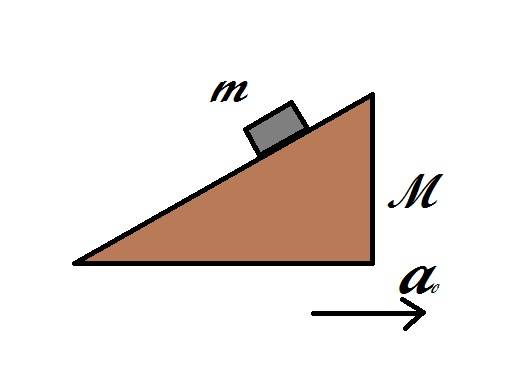
sfoMZDk.jpg
 
Last edited:
Physics news on Phys.org
Is ##a_0## given? If so then the mass M of the wedge is not needed
 
zwierz said:
Is ##a_0## given? If so then the mass M of the wedge is not needed
Yes , a0 is towards right. I apologise, I made a mistake earlier by saying a0 is towards left.
 
Let's start from inertial viewpoint. Write down the Newton Second Law for the briсk
 
zwierz said:
Let's start from inertial viewpoint. Write down the Newton Second Law for the briсk
EnuXycR.jpg

Let's take the angle of incline as θ. Applying Newton's Second Law to the block;
∑Fx = mgsinθ = ma (Where a is acceleration with respect to ground, which we take to be inertial.)
∑Fy = N - mgcosθ = 0 ⇔ N = mgcosθ

Am I correct?
 
Stop! do not be so quickly. First we must write the Newton second Law in vector form: ##m\boldsymbol a=m\boldsymbol g+\boldsymbol T##; here ##\boldsymbol a## is an acceleration of the brick relative to an inertial frame. This was the first step of the solution. Now you can expand this vector equality by any coordinate frame you want. Let's introduce a frame ##Oxy## such that ##O## is the highest angle of the wedge and the axis ##OX## goes down along the slope; Oy is directed upwards perpendicular to the slope.
Then ##\boldsymbol T=T\boldsymbol e_y;##
##\boldsymbol g=..##
##\boldsymbol a=##
go on
 
NoahCygnus said:
Let's take the angle of incline as θ. Applying Newton's Second Law to the block;
∑Fx = mgsinθ = ma (Where a is acceleration with respect to ground, which we take to be inertial.)
∑Fy = N - mgcosθ = 0 ⇔ N = mgcosθ

Am I correct?
no
 
zwierz said:
Stop! do not be so quickly. First we must write the Newton second Law in vector form: ##m\boldsymbol a=m\boldsymbol g+\boldsymbol T##; here ##\boldsymbol a## is an acceleration of the brick relative to an inertial frame. This was the first step of the solution. Now you can expand this vector equality by any coordinate frame you want. Let's introduce a frame ##Oxy## such that ##O## is the highest angle of the wedge and the axis ##OX## goes down along the slope; Oy is directed upwards perpendicular to the slope.
Then ##\boldsymbol T=T\boldsymbol e_y;##
##\boldsymbol g=..##
##\boldsymbol a=##
go on
zwierz said:
no
Why not? Those are the only forces I see.
 
NoahCygnus said:
Why not? Those are the only forces I see.
NoahCygnus said:
View attachment 205294
Let's take the angle of incline as θ. Applying Newton's Second Law to the block;
∑Fx = mgsinθ = ma (Where a is acceleration with respect to ground, which we take to be inertial.)
∑Fy = N - mgcosθ = 0 ⇔ N = mgcosθ

Am I correct?
Partly. You seem to be adopting a coordinate system where "x" is along an axis rotated θ up from the horizontal and where "y" is along the axis at right angles to that. [This coordinate system is notionally fixed in space. It does not move with the wedge]. Against that coordinate system, only g has any component along the x axis. We may immediately determine the x component of the acceleration of the block. You have done that and correctly computed ##ma_x## for the block.

You have not computed ##m\vec{a}## for the block.

You have not justified the claim that N = mg cos θ. Why should that be so?
 
  • #10
jbriggs444 said:
Partly. You seem to be adopting a frame of reference where "x" is along an axis rotated θ up from the horizontal and where "y" is along the axis at right angles to that. [This coordinate system is notionally fixed in space. It does not move with the wedge]. Against that coordinate system, only g has any component along the x axis. We may immediately determine the x component of the acceleration of the block. You have done that and correctly computed ##ma_x## for the block.

You have not computed ##m\vec{a}## for the block.

You have not justified the claim that N = mg cos θ. Why should that be so?
Doesn't the block stay in contact with wedge through out the motion? Let's see, the wedge moves to right with acceleration a0, and at the same time, the block moves down with an acceleration of mgcosθ. I thought the normal force stayed same. I must admit, this motion is confusing me.
 
  • #11
NoahCygnus said:
Doesn't the block stay in contact with wedge through out the motion? Let's see, the wedge moves to right with acceleration a0, and at the same time, the block moves down with an acceleration of mgcosθ. I thought the normal force stayed same. I must admit, this motion is confusing me.
The normal force does not stay the same. The block does not move down with an acceleration mg cosθ (as it would if the normal force were zero).

Is ##a_0## given? Or is is something that you wish to compute?
 
  • #12
Ah, yes, that makes sense. I am new to Newtonian mechanics, so I am likely to make mistakes. Can you tell me why normal force does not remain the same?
 
  • #13
NoahCygnus said:
Ah, yes, that makes sense. I am new to Newtonian mechanics, so I am likely to make mistakes. Can you tell me why normal force does not remain the same?
The wedge is accelerating (or is allowed to accelerate -- you still have not said which). If ##\vec{A}## is the acceleration of the wedge, what is Ay? If Ay is the acceleration of the wedge in the y direction, what is ay -- the acceleration of the block in the y direction?

Write down a force balance for the block in the y direction. ∑Fy = may
 
  • #14
jbriggs444 said:
The wedge is accelerating (or is allowed to accelerate -- you still have not said which). If ##\vec{A}## is the acceleration of the wedge, what is Ay? If Ay is the acceleration of the wedge in the y direction, what is ay -- the acceleration of the block in the y direction?

Write down a force balance for the block in the y direction. ∑Fy = may
The wedge is accelerating towards right. Ay should be 0, as the wedge is not acceleration upward or downward. What do you mean by "Ay is the acceleration of the block"? Didn't you just say A is the acceleration on the wedge?
 
  • #15
NoahCygnus said:
The wedge is accelerating towards right. Ay should be 0
You rotated your coordinate axes. "right" has a component in the direction of negative y.
What do you mean by "Ay is the acceleration of the block"? Didn't you just say A is the acceleration on the wedge?
I editted that post a few times. It should read better now.
 
  • #16
jbriggs444 said:
You rotated your coordinate axes. "right" has a component in the direction of negative y.

I editted that post a few times. It should read better now.
Do I have to choose the same coordinate system for the wedge that I chose for block? If I do so, the component of acceleration in the Y direction will be Asinθ.
 
  • #17
NoahCygnus said:
Do I have to choose the same coordinate system for the wedge that I chose for block? If I do so, the component of acceleration in the Y direction will be Asinθ.
You were trying to figure out the normal force. For normal force, what matters is the acceleration of the block in the direction perpendicular to the surface.

You persist in not clarifying whether the acceleration of the wedge is a given fixed constant or whether it is something to be computed. I will assume that it is a given fixed constant, A0. In that case, the acceleration of the block and of the wedge in the y direction is -A0sin θ.

Edit: fixed the sign. This is a "downward" acceleration.

With that information in hand, can you now expand ∑Fy = may with all relevant forces?
 
  • #18
jbriggs444 said:
You were trying to figure out the normal force. For normal force, what matters is the acceleration of the block in the direction perpendicular to the surface.

You persist in not clarifying whether the acceleration of the wedge is a given fixed constant or whether it is something to be computed. I will assume that it is a given fixed constant, A0. In that case, the acceleration of the block and of the wedge in the y direction is -A0sin θ.

Edit: fixed the sign. This is a "downward" acceleration.

With that information in hand, can you now expand ∑Fy = may with all relevant forces?
The acceleration on the wedge which you denoted by A, is a constant, and it is towards right.
jbriggs444 said:
You were trying to figure out the normal force. For normal force, what matters is the acceleration of the block in the direction perpendicular to the surface.

You persist in not clarifying whether the acceleration of the wedge is a given fixed constant or whether it is something to be computed. I will assume that it is a given fixed constant, A0. In that case, the acceleration of the block and of the wedge in the y direction is -A0sin θ.

Edit: fixed the sign. This is a "downward" acceleration.

With that information in hand, can you now expand ∑Fy = may with all relevant forces?

With that information in hand, can you now expand ∑Fy = may with all relevant forces?[/QUOTE]
The acceleration on the wedge which you denoted by A, is a constant, and it is towards right.
Applying Newton's second law to the wedge:
∑Fy = N = MAsinθ
 
  • #19
NoahCygnus said:
Applying Newton's second law to the wedge:
∑Fy = N = MAsinθ
You forgot the sign. That term should be -mA0 sinθ.
You also missed the force of gravity.

Edit: It is good practice to be consistent with your variable names...

Having used lower case "m" for the mass of the block, you should continue to use "m" and not switch to upper case "M". That way we can reserve "M" for the mass of the wedge.

Having used "A0" for the rightward acceleration of the wedge, you should not shift to an un-subscripted "A".

At one point in this thread, I had used ##\vec{A}## to refer to the acceleration of the wedge as a vector. More properly, I should have used ##\vec{A_0}##.
 
  • #20
jbriggs444 said:
You forgot the sign. That term should be -mA0 sinθ.
You also missed the force of gravity.
jbriggs444 said:
You forgot the sign. That term should be -mA0 sinθ.
You also missed the force of gravity.

Edit: It is good practice to be consistent with your variable names...

Having used lower case "m" for the mass of the block, you should continue to use "m" and not switch to upper case "M". That way we can reserve "M" for the mass of the wedge.

Having used "A0" for the rightward acceleration of the wedge, you should not shift to an un-subscripted "A".

At one point in this thread, I had used ##\vec{A}## to refer to the acceleration of the wedge as a vector. More properly, I should have used ##\vec{A_0}##.
jPWOIFm.jpg

Then there is also normal force from the ground on the wedge, let it be N'. I hope you can see the figure, and thank you for trying to help me. I really appreciate it.
All right, let's use A0 for the acceleration of the wedge. Let's apply Newton's second law to wedge;
∑Fy = N'cosθ - Mgcosθ - N = -MA0sinθ
 
  • #21
NoahCygnus said:
Applying Newton's second law to the wedge
Whoah. I missed this. You are applying Newton's 2nd to the wedge?! Try applying it to the block.
 
  • #22
jbriggs444 said:
Whoah. I missed this. You are applying Newton's 2nd to the wedge?! Try applying it to the block.
Yes, I am applying it to the wedge .
I applied it to the block, and you said that normal force does not remain the same. I asked you why does it change , you said apply Newton's law to the wedge. and choose the same coordinate system that you for the block. I don't know where this is going. Okay let me apply Newton's second law to the block again:
∑Fy = N - mgcosθ = 0 (You said this equation is wrong, normal force is not constant)
∑Fx = mgsinθ = ma (You said this equation is correct)
 
  • #23
NoahCygnus said:
Yes, I am applying it to the wedge .
I applied it to the block, and you said that normal force does not remain the same. I asked you why does it change , you said apply Newton's law to the wedge.
You applied it to the block incorrectly.
I told you to:
jbriggs444 said:
Write down a force balance for the block in the y direction. ∑Fy = may

NoahCygnus said:
Okay let me apply Newton's second law to the block again:
∑Fy = N - mgcosθ = 0 (You said this equation is wrong, normal force is not constant)
You said that normal force "stayed the same". You did not say what it would be the same as.
I said that no, it did not "stay the same", assuming you had meant that it would stay the same as mg cos θ. So let me clarify. No, it is not given by mg cos θ. Yes, it will be constant.

∑Fx = mgsinθ = ma (You said this equation is correct)
Now then, you wrote down the equation for y:

∑Fy = N - mgcosθ = 0

Where did the ma go? It is not zero.
 
  • #24
jbriggs444 said:
You applied it to the block incorrectly.
I told you to:
You said that normal force "stayed the same". You did not say what it would be the same as.
I said that no, it did not "stay the same", assuming you had meant that it would stay the same as mg cos θ. So let me clarify. No, it is not given by mg cos θ. Yes, it will be constant.Now then, you wrote down the equation for y:

∑Fy = N - mgcosθ = 0

Where did the ma go? It is not zero.
So, there is also an acceleration in the y direction for the block? I did not know that, I thought the block was only accelerating in x direction. Why is the block accelerating in the y direction?
 
  • #25
NoahCygnus said:
So, there is also an acceleration in the y direction for the block? I did not know that, I thought the block was only accelerating in x direction. Why is the block accelerating in the y direction?
Because it is in contact with the wedge and the wedge is accelerating in the y direction.

If you are going to pick a coordinate system, pick a coordinate system. Do not change willy nilly in mid-problem.
 
  • #26
jbriggs444 said:
Because it is in contact with the wedge and the wedge is accelerating in the y direction.

If you are going to pick a coordinate system, pick a coordinate system. Do not change willy nilly in mid-problem.
I guess that is the problem. I've been choosing different coordinate system for both the wedge and the block. I thought I had choice to choose different coordinate systems for two different objects.
 
  • #27
NoahCygnus said:
I guess that is the problem. I've been choosing different coordinate system for both the wedge and the block. I thought I had choice to choose different coordinate systems for two different objects.
If you are going to compute ax and ay for the block, you should make sure that the x and y directions you use are at right angles. Having chosen a direction for the "x" acceleration of the block, you have no choice for its "y" direction.

If you like, you can use a different coordinate system for the wedge. But then you have to be very careful that you do not blindly assert that Ay for the wedge is zero, therefore ay for the block must also be zero. Those two y's would be different.
 
  • #28
jbriggs444 said:
If you are going to compute ax and ay for the block, you should make sure that the x and y directions you use are at right angles. Having chosen a direction for the "x" acceleration of the block, you have no choice for its "y" direction.
Of course, I know that. I chose a coordinate system for the block, that had x-axis along the incline, and y-axis perpendicular to it. I chose a coordinate system for the wedge, which I determined forces on the wedge differently, that coordinate system had its x-axis along with ground and y-axis perpendicular to it,
 
  • #29
NoahCygnus said:
Of course, I know that. I chose a coordinate system for the block, that had x-axis along the incline, and y-axis perpendicular to it. I chose a coordinate system for the wedge, which I determined forces on the wedge differently, that coordinate system had its x-axis along with ground and y-axis perpendicular to it,
Fair enough. So can you now compute ay for the block using the block's coordinate system?
 
  • #30
jbriggs444 said:
Fair enough. So can you now compute ay for the block using the block's coordinate system?
I will try, but before that, can you tell me if the block and the wedge momentarily lose contact, as the wedge moves toward right, and then the mgcosθ makes the block accelerate in -y direction? Is that what happens? I can't visualise what happens.
 
Last edited:

Similar threads

  • · Replies 3 ·
Replies
3
Views
2K
  • · Replies 114 ·
4
Replies
114
Views
7K
  • · Replies 10 ·
Replies
10
Views
3K
  • · Replies 5 ·
Replies
5
Views
3K
  • · Replies 117 ·
4
Replies
117
Views
10K
  • · Replies 5 ·
Replies
5
Views
1K
Replies
30
Views
2K
  • · Replies 19 ·
Replies
19
Views
10K
Replies
3
Views
2K
  • · Replies 64 ·
3
Replies
64
Views
6K