Motion Equations by Newton's Formalism for a Double Pendulum

Join the discussion
Registration is free. Start your own thread to ask a follow-up.
3 replies · 3K views · last reply
Daniel Boy
Messages
4
Reaction score
0
By Lagrange's formalism, the motion equations for double pendulum are:

Two coupled equations of motion for a double pendulum, with angular accelerations, cosine and sine terms in the angle difference, and gravity terms; the second involves masses m1 and m2 and lengths L1 and L2.


Using Newton's formalism I can't obtain the second equation. Anyone can help?
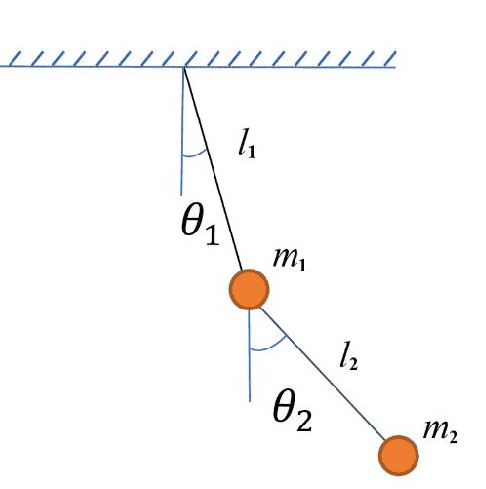
Diagram of a double pendulum hanging from a ceiling: first rod length l1 with angle θ1 from vertical to mass m1, second rod length l2 with angle θ2 from vertical to mass m2.
 
Physics news on Phys.org
Hello @Daniel Boy , ##\qquad## :welcome: ##\qquad## !

Usually, at this point we ask 'what have you got so far ? ' (for the 2nd eqn, I mean)
You do have a Lagrangian already ? Or do you try a Newton approach from scratch ?

Perhaps a comparable thread (with ##l_2 = l_3##) is :

PaBlo14101066 said:
 
  • Like
Likes   Reactions: Daniel Boy and etotheipi
If you want to use the Newton formalism, there are some different approaches you can take. Maybe the easiest would be to write one ##\boldsymbol{\tau} = \dot{\boldsymbol{L}}## equation for the whole system in coordinate system with origin at the topmost hinge, and then another ##\boldsymbol{\tau}' = \dot{\boldsymbol{L}}'## equation for the lower rod only in a coordinate system with origin at the position of an ##m_1## [N.B. this latter coordinate system will be accelerating, so you need to include a further 'fictitious' force ##-m_2 \boldsymbol{a}_1## acting on ##m_2## in your analysis].

I think the algebra will be a little nasty, whichever way you go about it. Good luck!
 
  • Like
Likes   Reactions: Daniel Boy
BvU said:
Hello @Daniel Boy , ##\qquad## :welcome: ##\qquad## !

Usually, at this point we ask 'what have you got so far ? ' (for the 2nd eqn, I mean)
You do have a Lagrangian already ? Or do you try a Newton approach from scratch ?

Perhaps a comparable thread (with ##l_2 = l_3##) is :

I already have the Lagragian. I want to obtain the same equations using Newton's formalism, so I did the free body diagrams:
Two free-body diagrams with x and y axes: left shows m1 with forces F1 at angle θ1 and F2 at angle θ2 plus weight P1 downward; right shows m2 with force F2 at angle θ2 plus weight P2 downward.


For m2, I found F2 (analysis in x) and I found the following equation (analysis in y):
Equation in a box: L2 θ2'' + L1 θ1'' cos(θ1 − θ2) − L1 θ1'² sin(θ1 − θ2) + g sin θ2 = 0, a double pendulum equation of motion.

So, using F2 in the free body diagram for m1, the resultant equation does not coincide with:
Equation: (m1 + m2)L1 θ1'' + m2 L2 θ2'' cos(θ1 - θ2) + m2 L2 θ2'^2 sin(θ1 - θ2) + (m1 + m2) g sin θ1 = 0