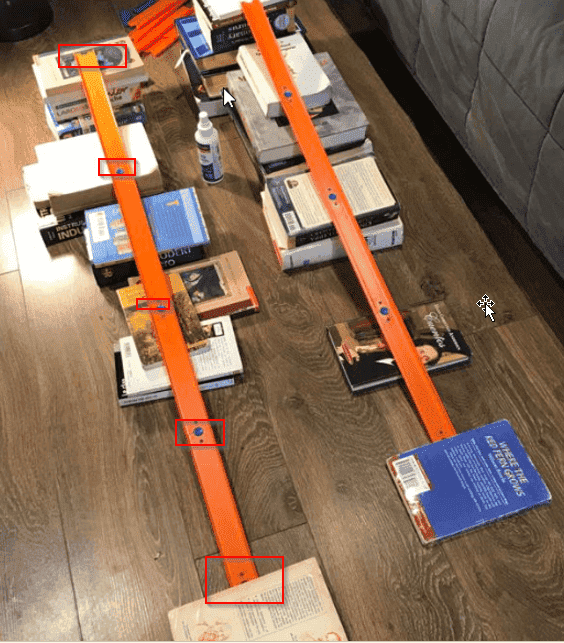
Motion in one dimension -- Experiments with a Hot Wheels car rolling down a ramp

Click For Summary

Homework Help Overview

The discussion revolves around an experiment involving a Hot Wheels car rolling down a ramp inclined at 10 degrees. The original poster shares their observations and calculations regarding the car's motion, specifically focusing on the relationship between distance, time, and velocity, while questioning the interpretation of graphical representations of these variables.

Discussion Character

  • Exploratory, Conceptual clarification, Mathematical reasoning, Assumption checking

Approaches and Questions Raised

  • Participants explore the calculations of velocity and distance using the formula d = v*t, questioning the validity of their assumptions regarding average and final velocities. They discuss the area under velocity-time graphs and its relation to displacement, particularly the confusion between triangular and rectangular areas.

Discussion Status

The discussion is active, with participants providing insights and questioning the original poster's assumptions. Some participants suggest reconsidering definitions of velocity and acceleration, while others highlight the importance of understanding the implications of constant acceleration in the context of the experiment. There is no explicit consensus, but various interpretations and clarifications are being explored.

Contextual Notes

Participants note that the original poster's measurements and assumptions may not align with standard physics principles, particularly regarding the use of average versus final velocity in calculations. The discussion also touches on the implications of changing ramp lengths while keeping height differences constant, raising questions about the relationship between acceleration and distance.

chucho11028
Messages
9
Reaction score
0
Homework Statement
calculate velocity using the graph
Relevant Equations
d=v*t
vf=vo+1/2*a*t
Hello

This is not a homework, this is my own experiment to understand how the motion works. Please, follow my question here below:

I have a hot wheels race with a slope with 10 degrees where I use a small car which departs from the top to the bottom. I have taken 5 times the time to get an average which is 1.242 seconds and the distance is 92 cent which 0.92 m.

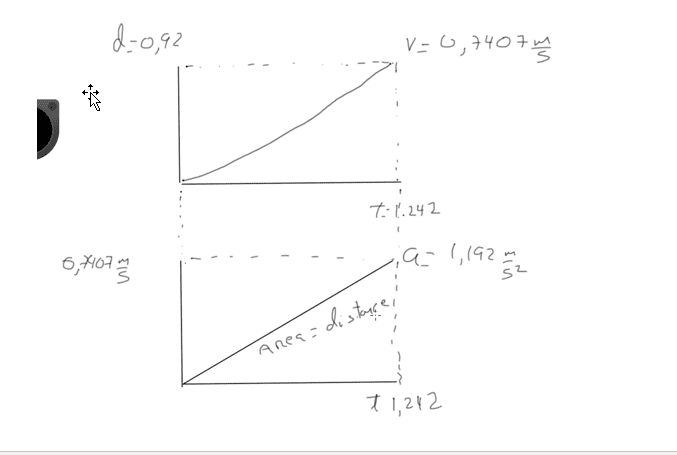
Using the formula for distance d=v*t, I know my final velocity is 0.7407 m/s then, I have two graphs:

First graph, velocity and time, where I assume the velocity is increasing constantly and it will reflect a parabolic curve. I have attached the graph

Second graph, velocity and time, where I have a line with a slope which it should be the acceleration.So, my question is:

I know the area between velocity and time should be the distance, but this area is a triangle, so if I multiply time by velocity and divide by 2 it won’t give me .92 cm. I t will give a half. The only way to get the distance is using the rectangle but it would be wrong. Where is my mistake?

Regards,
pendiente.png

race.png
 

Attachments

  • pendiente.png
    pendiente.png
    7.1 KB · Views: 170
  • race.png
    race.png
    157.8 KB · Views: 223
Last edited by a moderator:
Physics news on Phys.org
chucho11028 said:
Homework Statement:: calculate velocity using the graph
Graph of what, precisely ? Is your picture an invented observation, or an actual measurement ?
Relevant Equations:: d=v*t
What are these ? Distance, speed, time ? If yes, the this is only valid if v is constant.
vf=vo+1/2*a*t
What are these ? Final velocity, initial velocity, acceleration, time ? For constant acceleration ?
If yes, then: No, not correct.

Google SUVAT equations
chucho11028 said:
I use a small car which departs from the top to the bottom. I have taken 5 times the time to get an average which is 1.242 seconds and the distance is 92 cent which 0.92 m.
So, not 1.244 or 1.240 seconds ? That is really very accurate... :rolleyes:

It's also very fast. Or is v0 non-zero ?
 
The graph is not a measure but could you please explain me why the distance in the second graph is only obtained by multiply the area of the rectangle and not the triangle?
v=d/t = 0.92m/ 1.242 sec = 0.7407 m/s and it is totally correct at least there is a new rule in the physics
The acceleration is gives by gravity which is constant
why the graphs just provide the response with 0.92 m if I use the rectangle area instead triangle ?
where is my error or misunderstanding ?
 
chucho11028 said:
v=d/t ... is totally correct
Any equation can be correct if you define the variables in the right way. How are you defining these? In particular, if d is displacement and t is the time over which the displacement occurs, what, precisely, does v represent?
You seem to be defining it as final velocity, given a zero initial velocity. If so, the equation is wrong.
Maybe you are thinking of ##v_{average}=\frac {\Delta s}{\Delta t}##.
 
  • Like
Likes   Reactions: chucho11028
the v equal to 0.7407 should final velocity, d is displacement and t is the time over which the displacement occurs. The initial velocity should be 0 .
So, the question is, when can I say the area under the graphs (v x t) represents the displacement?
I assume the acceleration is constant because it is the gravity.
Could you please orient me in my misunderstanding?
I would really appreciate
 
chucho11028 said:
the v equal to 0.7407 should final velocity, d is displacement and t is the time over which the displacement occurs. The initial velocity should be 0

Your error is using " d=v*t " which is valid only for a constant velocity.

Since you indicate yourself that the initial speed is zero, you clearly do not have a constant speed.

BvU said:
Google SUVAT equations
Or look in the Homework Help: Introductory Physics Formulary
 
  • Like
Likes   Reactions: chucho11028
chucho11028 said:
my own experiment
I suspect your experimental results consist of a set of five time measurements only. Am I correct ?

In that case you can not draw any graphs and also can not
calculate velocity using the graph

unless you make particular assumptions that you do not mention ...
 
Last edited:
BvU said:
It's also very fast. Or is v0 non-zero ?
I must withdraw this sceptical and premature remark. Sorry, ignore it.
 
chucho11028 said:
I know the area between velocity and time should be the distance, but this area is a triangle, so if I multiply time by velocity and divide by 2 it won’t give me .92 cm. I t will give a half. The only way to get the distance is using the rectangle but it would be wrong. Where is my mistake?
Your mistake is assuming that d/t is the final velocity. It is not. It is the average velocity over the time interval t. When the acceleration is constant and the object starts from rest, the final velocity is twice the average velocity. The relevant SUVAT equation is $$d=\frac{1}{2}(v_0+v_f)t=v_{\text{avg.}}t$$ in which ##v_0=0.##

Thus, in your ##v## vs. ##t## drawing the vertical height of the triangle should be ##2\times 0.7407~\text{m/s}=1.481~\text{m/s}.## Then the area under the curve would be ##\text{Area}=\frac{1}{2}\times 1.481~\text{m/s}\times 1.242~\text{s}=0.92~\text{m}## to two significant figures.
 
  • Like
Likes   Reactions: chucho11028
  • #10
I understood where was my mistake. I assume average velocity as final velocity which is wrong (Big mistake)

I did a resume (attaching here)with my new procedure and possible graph just to leave a possible guide for anyone with similar question

I have a new question based in what I found
I add more segments in my test (I double 1.84) and I curious the average velocity is almost the same 0.77 m/s

in the first test, my acceleration is 1.19.28 m/s^2
the VF=1.4814 m/s

the second test with 1.84 m longitude
acceleration is 0,654061. It is less than before
even is the distance is double, the time is bigger and the acceleration has been reduced (interesting)
but vf= 1.551433 is a little bit high than the vf with 0.92 m
I am not sure the results is because the time that I have taken is not exact or the final velocity is increasing which make sense for me

But my main question is why the acceleration is decreasing here? yeah, it is true the formula says we have double distance divide by time power 2 , but what is the reason the acceleration is decreasing?
I was expecting the acceleration be increasing in order to increase the Vf.
Could you guide me here?

regards,
 

Attachments

  • #11
chucho11028 said:
I add more segments in my test (I double 1.84) and I curious the average velocity is almost the same 0.77 m/s
I don't understand what "I add more segments in my test" means. Your parenthetical explanation "I double 1.84" is equally cryptic. What does 1.84 represent? I understand that English is not your primary language, but you need to explain yourself better so that we can understand you. If you recorded data, such as times and distances, please post them and we will help with the analysis. The document that you attached is not much help.
 
  • #12
kuruman said:
What does 1.84 represent?
Seems to be the length of the ramp:
chucho11028 said:
the second test with 1.84 m longitude
But it looks like the end-to-end height difference is unchanged:
chucho11028 said:
acceleration is 0,654061. It is less than before
chucho11028 said:
the average velocity is almost the same 0.77 m/s
 
  • #13
haruspex said:
Seems to be the length of the ramp:

But it looks like the end-to-end height difference is unchanged:
Yes, I didn't notice that. This could be a wonderful discovery-type experiment for @chucho11028.

To @chucho11028: Consider this. If the height difference between the ends ##\Delta h## is kept the same, as @haruspex observed, and only the length of the ramp is changed, then the product of the acceleration ##a## and ramp length ##d## is constant, ##a_1d_1 = a_2 d_2.## Your numbers are pretty close to verifying that. Here is an explanation.

A simplified theoretical treatment shows that the acceleration is given by ##a=\dfrac{g\Delta h}{d}##. It is assumed that the object travels distance ##d## and at the same time drops by ##\Delta h.## Also, ##g## = 9.8 m/s2 is the constant acceleration of gravity. You see then that ##ad=g\Delta h## which means that, if you don't change the height difference, the product of acceleration times ramp length is constant; if you increase one of them, the other must decrease to keep the product constant.

This comes from a more detailed treatment which models the small car as a block sliding down the ramp without friction. Dynamical analysis shows that the car's acceleration along the ramp is given by ##a=g\sin\theta## where ##\theta## is the angle of the incline. From trigonometry, ##\sin\theta=\dfrac{\Delta h}{d}## hence the expression for the acceleration that I quoted above.

You might want to test the constancy of the product by varying the length but not the height. Just make sure that the start and end points of the length ##d## traveled by the car on the ramp match the points that you use to measure the height difference ##\Delta h##.
 

Similar threads

  • · Replies 7 ·
Replies
7
Views
2K
  • · Replies 8 ·
Replies
8
Views
2K
  • · Replies 16 ·
Replies
16
Views
2K
  • · Replies 32 ·
2
Replies
32
Views
3K
  • · Replies 9 ·
Replies
9
Views
896
Replies
18
Views
3K
Replies
4
Views
3K
  • · Replies 4 ·
Replies
4
Views
2K
Replies
24
Views
3K
Replies
39
Views
4K