Multivariable epsilon-delta proof

Join the discussion
Ask a follow-up here, or get your own question answered by working scientists, mathematicians and engineers — people, not an autocomplete.
Real named experts · corrections over time · the nuance an AI answer skips
4 replies · 3K views
nafisanazlee
Messages
20
Reaction score
2
Homework Statement
$$\lim\limits_{(x,y) \to (1,2)} (5x^3 - x^2y^2)$$
Relevant Equations
For every $$\epsilon > 0$$, we must find $$\delta > 0$$ such that whenever
$$
\sqrt{(x - 1)^2 + (y - 2)^2} < \delta
$$
it follows that
$$
| (5x^3 - x^2y^2) - 1 | < \epsilon.
$$
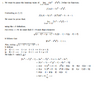
I have provided my solution here. I just want to be sure if it's correct or not.
 

Attachments
  • Screenshot 2025-02-22 003454.png
    Screenshot 2025-02-22 003454.png
    23.4 KB · Views: 86
Physics news on Phys.org
nafisanazlee said:
I used the triangular inequality.
I think we are not talking about the same line. Are you sure about the logic giving the line with the strict inequality? It's such a combination of signs and substitutions that I can not follow it. Maybe if you applied the triangle inequality before that line to break up the terms into separate absolute values it would be easier to follow.
ADDED: I'm not saying it's wrong. I just can't follow it and would like something simpler.
 
Last edited: